Who is afraid of a binding treaty? Stumbling Blocks on the Accountability of Transnational Corporations by Sara Martinetto

Editor's note: Sara Martinetto is an intern at T.M.C. Asser Institute. She has recently completed her LLM in Public International Law at the University of Amsterdam. She holds interests in Migration Law, Criminal Law, Human Rights and European Law, with a special focus on their transnational dimension.


Since the adoption by the UN Human Rights Council of Resolution 26/9 in 2014, an Open-ended Intergovernmental Working Group (WG) is working on a binding Treaty capable of holding transnational corporations accountable for human rights abuses. Elaborating on the proposal presented by Ecuador and South Africa, the WG has been holding periodical sessions. In much trepidation for what is supposed to be the start of substantive negotiations – scheduled for October 23-27, 2017 – it is worth summarising and highlighting the struggles this new instrument is likely to encounter, and investigating whether (and how) such an agreement could foster transnational corporations’ (TNCs) human rights compliance.

Shortcomings of instruments already in place.

In past decades, corporations have come to acknowledge the need to go beyond their mere economic dimension, in view of their increasing impact on society as a whole. From the 1970s, they started to create a “private self-regulatory system”, today known as Corporate Social Responsibility (CSR).[1] The expression indicates a body of voluntary measures, aiming at tailoring enterprises’ operations on perceived societal needs.

Undeniably, the adoption of such codes and standards has played a role in advancing compliance of TNCs with human rights. However, there is a stark difference between CSR and  “business and human rights” (BHR) instruments: the latter endeavour to provide a broader coverage – both ratione materiae and ratione personae – with regard to the self-regulation of human rights violations by TNCs, thereby referring to relevant international standards. As examples of this, it is worth recalling, among others, the UN Global Compact, the ILO Declaration of 1998, the OECD Guidelines, and, ultimately, the UN Guiding Principles on Business and Human Rights of 2011 (UNGP). The major downside of these sources is to be found in their soft-law nature: they create no true legal accountability, nor are they currently enforced by courts.

It is worth reminding that the 2014 Resolution does not constitute the first attempt to negotiate a binding instrument on the matter: the 2003 Norms on Transnational Corporations, drafted by the UN Sub-Commission on the Promotion and Protection of Human Rights, were ultimately not adopted. This failure was mainly attributable to the lack of consensus around several concepts, which are essentially still contested today. 

The decision to re-engage in such a project largely relies on a rekindled consensus, triggered by the adoption of the UNGP. In fact, the UNGP has formed unprecedented agreement on relevant issues: it shaped common standards to which relevant stakeholders can refer when corporate interests and human rights collide.

Do we need new commitments?

The decision to pursue a binding agreement has not yet resulted in the abandoning the UNGP. The Human Rights Council keeps fostering and monitoring the implementation of the Guiding Principles in national law. Albeit slowly, States are adopting national action plans and a variety of other instruments, which aim at operationalising the UNGP. The new Dutch Agreement on Sustainable Garment and Textile or the 2015 UK Modern Slavery Act are examples of this trend. Thus, the question would be… do we really need a new Treaty?

Certainly, the prospective instrument cannot constitute a mere repetition of its predecessors.[2] Thus, a successful drafting requires the identification of shortcomings of the previous legislation, to be developed and specified. Three main issues have been identified:[3] the question of monitoring mechanisms and remedies; the development of extraterritorial clauses establishing State responsibility for TNCs incorporated under their laws; the actual extent of the due diligence obligation designated by the UNGP (especially in Principles 15 and 17).

Moreover, delegates have to take into account the lack of consensus, which has immediately marred Resolution 26/9: notwithstanding the intense lobbying carried out by numerous NGOs, several States are opposing the formation of a new Treaty. In particular, the EU argues against its usefulness, deeming the implementation of the UNGP sufficient to tackle the problem, without undergoing further lengthy negotiations. This vision is endorsed by some scholars, who believe that the adoption of effective domestic measures, rather than an international Treaty, could better tackle the problem.[4]

Furthermore, there are still major disagreements on some basic concepts and theoretical foundations. Therefore, delegations will need to agree on a precise and coherent framework; to take a normative stance on some key issues; to identify the right level of abstraction, agreeing on the grade of depth, precision, and prescriptiveness these rules ought to have; and, probably, to limit the content and scope of the treaty, leaving aside aspects which would be better tackled on the national level.[5] Of course, this is easier said than done. From the reports of the first and second sessions of the WG, it appears clearly that, even when delegations agree on the desired result, discrepancies on the means still remain. 

Ultimately, if not solved, these disagreements could lead to two possible outcomes: either negotiations will bog down, or meaningful instances and the identification of precise obligations will be sacrificed on the altar of compromise. In the next sections, I will review what I consider the burning issues and choices ahead for the negotiators.

Would there be a catalogue of rights?

There are two contrasting views on this issue. On one side, the inclusive approach – i.e., the decision to protect all human rights, without further specification – has the undoubted perk of averting the possibility of undue prioritization of social and political rights over social and economic rights. On the other, it is a risky tactic, since quantity might prevail over quality: the category of rights covered will be inflated, thereby potentially resulting in an overall lower standard of protection.

Moreover, including a catalogue inside the Treaty could have two main advantages: with regard to TNCs, it could provide better guidance on the actual obligations they are supposed to implement;  more generally, it could be a way of developing the interpretation of certain rights, which still rely on quite vague concepts (e.g. standard of living, the concept of ‘living wages’, etc.).[6]

Which enterprises?

Drawing on the text of the Resolution, some have argued that the new Treaty will focus merely on TNCs, narrowing the scope of UNGP. Some delegations (in particular, the EU), have strongly criticised this stand, submitting that even local companies and State-owned companies can violate human rights. Thus, a restricted scope would ultimately result in discrimination not only between different companies, but between victims, who will have different access to remedies depending on the perpetrator.

Ultimately, this issue boils down to the need to adopt a definition of TNC susceptible to include all the actors of the supply chain.[7] Nonetheless, it is still unclear whether the proposed instrument will include such a definition. Instead, some delegations have proposed to include all enterprises within the scope of the Treaty, but to provide for more specific norms for TNCs.

Imposition of direct obligations upon TNCs

This question essentially depends on whether TNCs are to be considered as subjects of international law. The complex and lengthy literature on this matter falls outside the scope of this post.[8] However, this much debated issue cannot be easily dismissed, since its answer establishes the existence of international legal personality and, ultimately, of responsibility of TNCs.

The growing consensus on the legal personality of corporations under international law is mainly based on an application, by analogy, of the reasoning of the ICJ in Reparations of Injuries. The argument is further supported by the existence, in international law, of rights enjoyed by corporations, especially in the context of Investor-State Dispute Settlement (ISDS). Logically, an entity provided with legal rights should be also capable of being bound by legal obligations.

Furthermore, it is believed that UNGP already attached legal personality to TNCs. However, the Human Rights Council has clarified that the second pillar of the Principles, i.e., the responsibility of TNCs to respect human rights, does not per se entail a legal obligation, but more of a moral and social responsibility. 

The inclusion of direct obligations on TNCs to respect (or even protect) human rights has the purpose to avert the so-called “race to the bottom”, namely, a situation in which the State is too weak to uphold human rights in its territory and finds itself incapable of resisting to the pressure of TNCs, fearing a negative impact on their economy.[9]

Nonetheless, the idea remains quite controversial, especially because there is no general rule in international law providing for responsibility of TNCs. Therefore, a Treaty would need to set up an all-comprehensive construction which would deal both with primary and secondary rules.[10]

Thus, it might be considered more appropriate to maintain the regulatory focus on States. Indeed, there is an inherent value in keeping them at the centre of the system: since the States which are major supporters of the Treaty also have a poor human rights record, one wonders whether the focus on TNCs will lead to a blame game between different subjects.[11] However, this does not mean that a satisfactory result cannot be achieved by mean of indirect obligations on TNCs, which would result in a direct responsibility of States. This could be put into practice by providing for precise due diligence obligations to be implemented, probably, with the help of extraterritorial clauses.

Due diligence obligations

There are mainly two dimensions of due diligence which are relevant in this context. On the one hand, a due diligence obligation stemming from international law would provide ground for States’ responsibility for its breach, in case of a violation perpetrated by TNCs incorporated under their domestic law; on the other hand, due diligence might be required from TNCs for acts of other entities which are part of their supply chain.

At the outset, it is important to stress that State responsibility will be broader or narrower, depending on the degree of due diligence a State is asked to exercise. Since there is no general obligation of due diligence in international law,[12] the Treaty would have to provide for it: this will allow to cover the conduct of private entities, whose acts cannot be traced back to the State by means of a rule of attribution or by using the framework of complicity. Thus, most likely, these new obligations would serve the purpose of clarifying the level of control a State must exercise on the conduct of private actors in any given moment.

Without denying the need for new rules on the matter, it would be hard to conceive that a single instrument could carry out such a task with the sufficient degree of precision effectiveness requires. A decision will have to be taken on what a State could reasonably be expected to exercise control over, presumably drawing from the landmark case Velásquez Rodríguez (Inter-American Court of Human Rights), and on the obligation posed by art. 2(1) International Covenant on Civil and Political Rights (ICCPR). Of course, this does not take away States’ international obligation to provide remedies for violations perpetrated by private actors on their territory. This issue will be further discussed below.

As far as the second dimension is concerned, UNGP already provided for a due diligence obligation for TNCs. However, for it to become prescriptive and operational, the extent of this duty would need to be further clarified. Corporations have already a wide set of responsibilities under national laws as domestic legal systems provide for different legal obligations (from tax to labour, from environment to anti-discrimination). Responsibility for a breach of those obligations is reflected in different types of liability. However, defining the scope of responsibility of TNCs has become increasingly difficult also in domestic law. This is largely due to the maze of different subsidiaries, suppliers, and (sometimes even illegal) subcontractors a parent company might have.[13]

In order to appraise that, one should take a step back to consider the much-debated question of the corporate veil, i.e. the obstacles created for accountability by the doctrine of separate personality, and the distinction between different legal entities. This veil exists even between a company and its shareholders, as clearly affirmed by the ICJ in Barcelona Traction, and even more so between different companies. However, the ICJ in the very same judgement (§38-39) has held that the veil can be lifted in some circumstances, such as when the privilege given by the doctrine of separate personality has been abused. This reasoning has slowly been expanded in order to create direct liability of the parent company in case of breach of due diligence with regard to other legal persons belonging to its supply chain.[14] In this way, it will be possible to avoid the problem of undercapitalisation of subsidiaries or suppliers, which are often unable to pay compensation when a case is decided against them.

Up until now, the notion of due diligence has been accompanied by very vague concepts, as, for example, the one of sphere of influence.[15] This notion reflects the idea that the more the company is powerful and influential, the stronger responsibility it has vis-à-vis human rights, because it will be able to leverage the entity in its supply chain committing the abuse.[16] The envisaged Treaty will need to provide legal certainty on how this concept will be operationalized, and how far this due diligence obligation extends. While it is feasible to conceive of a due diligence obligation of the parent company toward its subsidiaries, it becomes harder and harder the more the network of contractors and subcontractors expands.

Extraterritoriality

Were the delegates to agree upon the actual scale of the due diligence obligation required, the putative ruling against the parent company for a breach of due diligence could have some extraterritorial effects against the subsidiaries. Extraterritorial clauses would entail the direct jurisdiction of foreign States on companies incorporated in another State, provided that there is a link between the two actors.[17] The possibility of including such extraterritorial clauses in the Treaty would be revolutionary, since it would challenge one of the core principles of human rights jurisdiction, i.e. territoriality. Moreover, such a provision could be subject to criticism, because of its possible impact on the sovereignty of the host State.

It is probably right that extraterritorial clauses will have a greater deterrent effect on TNCs. However, clarifying the link between the forum State and the State of incorporation, or between the two companies, will be essential in practice. Particularly, while in the case of subsidiaries thresholds and standards can be borrowed from other fields of law (e.g. competition law, consumer law), an effective control test might need to be developed in order to capture the required link between a company and another contractor.[18]  Although the Maastricht Principles on Extraterritorial Obligations might provide guidance, they seem overly vague for this purpose.

Thus, the Treaty will probably need to phrase the extraterritoriality question as a conflict of jurisdictions. An international binding instrument governing the relationship between different jurisdictions on the matter would ensure cooperation between States, while limiting the above-mentioned possible disruptive effect of extraterritorial clauses. This would obviously have a direct impact on the issue of access to remedies 

Remedies

During the negotiations, some have advanced the idea of a new international body to monitor compliance. Yet, the enforcement of the prospective instrument will most likely rely on domestic courts. The current hurdles to access to justice for victims of human rights violations are largely related to jurisdictional issues, lack of recognition of foreign judgements, and extensive use of the principle of forum non conveniens. Therefore, obligations dealing with procedural matters regarding remedies are of the upmost importance to a successful Treaty.

One might discuss whether to criminalise certain conducts: perpetration of certain human rights abuses is deemed to be criminal in nature, and, hence, linked to the remedies attached to criminal liability. However, the interplay between corporations and criminal law is still uncertain even in some domestic jurisdictions.

Conclusion

In conclusion, there are a number of key issues which will define the impact of the future Treaty and be at the heart of the upcoming negotiations.

First, who is primarily responsible for the human rights violations of a TNC broadly speaking (including subsidiaries and subcontractors)? The home State, the TNC, or both? The answer provided will most likely condition the practical bite of the Treaty and the ease or difficulty to enforce the obligations it will set out.

Second, the definition of core concepts, such as ‘due diligence’ and ‘sphere of influence’, is an important semantic battleground. They will define the scope of the responsibility of TNCs and States and the extent to which they are deemed responsible for activities occurring outside of their immediate (contractual or territorial) surroundings.

Finally, the capacity of victims to access remedies will be crucial to the practical effect of the new Treaty. This could entail the recognition of the extraterritorial nature of due diligence obligations and the potential responsibility of States vis-à-vis third country nationals.


[1] B. Sheehy, Understanding CSR: an empirical study of private regulation, in Monash University Law Review, 2012, 105

[2] K. Mohamadieh, Approaching States’ Obligations Under a Prospective Legally Binding Instrument on TNCs and Other Business Enterprises In Regard to Human Rights, in South Centre Policy Brief, October 2016, 1

[3] O. De Schutter, Towards a legally binding instrument on business and human rights, in CRIDHO Working Paper 2015/2 2015, 17

[4] S. Mc Brearty, The Proposed Business and Human Rights Treaty: Four Challenges and an Opportunity, in Harvard International Law Journal, 2016, 12

[5] K. Mohamadieh, Ibid., 3

[6] S. Mc Brearty, Ibid., 13

[7]  K. Mohamadieh, Ibid., 2

[8] See also N. Gal-Or et al., Responsibilities of the Non-State Actor in Armed Conflict and the Market Place, Brill Nijhoff, The Hague, 2015; M. Karavias, Corporate Obligations under international law, Oxford monographs in international law, Oxford, 2013.

[9] L. Mc Connell, Assessing The Feasibility Of A Business And Human Rights Treaty, in International and Comparative Law Quarterly, 2017, 162

[10] L. Mc Connell, Ibid., 151

[11] S. Mc Brearty, Ibid., 14

[12] R. P. Barnidge, The Due Diligence Principle Under International Law, in International Community Law Review, 2006, 92

[13] O. De Schutter, Ibid., 20

[14] O. De Schutter, Ibid., 19

[15] The concept was first used in the 2003 Draft Norms and it is still used in current negotiations

[16] O. De Schutter, Ibid., 21

[17]  K. Mohamadieh, Ibid., 4

[18]  K. Mohamadieh, Ibid.

Comments are closed
Doing Business Right Blog | The Rise of Human Rights Due Diligence (Part I): A Short Genealogy - By Shamistha Selvaratnam

The Rise of Human Rights Due Diligence (Part I): A Short Genealogy - By Shamistha Selvaratnam

Editor’s note: Shamistha Selvaratnam is a LLM Candidate of the Advanced Masters of European and International Human Rights Law at Leiden University in the Netherlands and a contributor to the Doing Business Right project of the Asser Institute. Prior to commencing the LLM, she worked as a business and human rights solicitor in Australia where she specialised in promoting business respect for human rights through engagement with policy, law and practice.


Human right due diligence (HRDD) is a key concept of Pillar 2 of the UN Guiding Principles on Business and Human Rights (UNGPs), the corporate responsibility to respect human rights. Principle 15 of the UNGPs, one of the foundational principles of Pillar 2, states that in order to meet the responsibility to respect human rights, businesses should have in place a HRDD process to ‘identify, prevent, mitigate and account for how they address their impacts on human rights’. However, how was the concept of HRDD developed? What does it mean? What are its key elements?

This first blog of a series of articles dedicated to HRDD answers these questions by providing an overview of the concept of HRDD and its main elements (as set out in the UNGPs) as well as how the concept was developed. It will be followed by a general article looking at HRDD through the lens of a variety of actors including international organisations, non-state actors and consultancy organisations. Case studies will then be undertaken to look at how HRDD has materialised in practice. To wrap up the series, a final piece will reflect on the effectiveness of the turn to HRDD to strengthen respect of human rights by businesses.


History of the Concept of HRDD

The concept of due diligence was around well before John Ruggie assumed the mandate of Special Representative on the issue of human rights and transnational corporations and other business enterprises back in 2005. Indeed the concept was initially a creature of American securities law under the auspices of ‘reasonable investigation’. The Securities Act 1933 imposes strict civil liability on certain people for untrue statements and omissions of material fact in a securities registration statement.[1] However, an exception is carved out where ‘reasonable investigations’ have been undertaken.[2] The relevant standard of reasonableness to be applied in this situation is that of a ‘prudent man in the management of his own property’.[3]

Following this, the concept of due diligence emerged in other corporate contexts, particularly with respect to financial transactions such as mergers and acquisitions.[4] While the due diligence carried out on such transactions in the 1980s was quite limited, the process has gradually become much more extensive. Over time, the concept has been transplanted into the international human rights law framework – a positive duty has been imposed on states to conduct due diligence to prevent human rights violations by non-state actors, including businesses.[5] Thus, in the international human rights law arena due diligence has been applied as a standard of conduct that states are required to meet in order to uphold human rights within their jurisdiction.

In the business and human rights sphere, the concept of due diligence was first introduced back in 2003 when the draft Norms on the Responsibilities of Transnational Corporations and Other Business Enterprises with Regard to Human Rights (draft Norms) were introduced. Article 1 of the draft Norms placed a primary responsibility on states to ensure that businesses respect human rights. It also placed a separate obligation on businesses ‘to promote, secure the fulfillment of, respect, ensure respect of and protect human rights recognized in international as well as national law’ within their sphere of influence. The commentary to article 1 notes that businesses have the responsibility to use ‘due diligence in ensuring that their activities do not contribute directly or indirectly to human rights abuses, and that they do not directly or indirectly benefit from abuses of which they were aware or ought to have been aware’. No further explanation was provided on the due diligence to be conducted and the draft Norms were not approved by the Human Rights Council in 2004.

The concept of due diligence was brought back into the business and human rights arena when Ruggie was appointed as Special Representative. Following the failure of the draft Norms, Ruggie introduced the concept of HRDD back into the international arena in 2008 and developed it over a period of about three years until the UNGPs were endorsed by the UN Human Rights Council. As he acknowledges, until then due diligence was considered a ‘business process’ used in ‘strictly transactional terms’.[6] However, Ruggie sought to broaden the concept into ‘a comprehensive, proactive attempt to uncover human rights risks, actual and potential, over the entire life cycle of a project or business activity, with the aim of avoiding and mitigating those risks.’[7] He did this by drawing on the key elements of due diligence and combining them with the distinctive elements of human rights. This is what is now referred to and articulated as the concept of HRDD in the UNGPs. Ruggie gave HRDD such a key role in Pillar 2 of the UNGPs because he recognised that companies cannot know or show that they are respecting human rights without conducting HRDD.[8] Indeed, he envisioned that HRDD would facilitate movement from ‘naming and shaming’ businesses by external stakeholders to ‘knowing and showing’ through internalising respect for human rights.[9]

Ruggie identified a number of benefits to business for undertaking HRDD, in particular he highlighted that it wouldn’t impose additional burdens on business.[10] He argued that HRDD assists business to ‘address their responsibilities to individuals and communities that they impact and their responsibilities to shareholders, thereby protecting both values and value’.[11] He further acknowledged that HRDD assists companies to lower their risks, particularly with respect to legal non-compliance.[12] He also noted that conducting HRDD has the ability to protect Boards against claims brought by shareholders regarding mismanagement.[13]

In setting out the scope of HRDD, Ruggie stated that it is to be ‘determined by the context in which a company is operating, its activities, and the relationships associated with those activities’[14] by reference to three factors, namely: (a) the country and local context in which the relevant business activities take place; (b) what human rights impacts the business’ own activities may have within that context; and (c) whether the business’ own activities might contribute to abuse through the relationships connected to their activities.[15] Importantly, he noted that the scope of HRDD is not fixed or based on influence, rather it ‘depends on the potential and actual human rights impacts resulting from a company’s business activities and the relationships connected to those activities’.[16]

With respect to the substantive content of HRDD, John Ruggie stated that the minimum requirements are set out in the International Bill of Human Rights and the ILO core conventions, as well as additional standards relevant to the context of a particular business such as international humanitarian law.[17]

As to the HRDD process itself, Ruggie set out four minimum requirements. Businesses should:[18]

  • Adopt a human rights policy.
  • Conduct human rights impact assessments to ‘understand how existing and proposed activities may affect human rights’.
  • Integrate human rights policies through the business, which requires a top down approach in order to ‘embed respect for human rights throughout a company’ as well as training and the ‘capacity to respond appropriately when unforeseen situations arise’.
  • Track their performance through monitoring and auditing processes with regular updates of human rights impact and performance.


Following these developments, the HRDD concept was finally articulated in the UNGPs, which were endorsed by the UN General Assembly in 2011.


Concept of HRDD as articulated in the UNGPs

Meaning of HRDD and its Scope

Despite being a key element of the UNGPs, HRDD is not defined in the UNGPs itself. Rather, as stated above, the UNGPs states that HRDD is a process – that is, a process that should ‘identify, prevent, mitigate and account for how [businesses] address their impacts on human rights’. However, in interpretative guidance provided by the Office of the High Commissioner of Human Rights, due diligence is defined as follows:[19]

 such a measure of prudence, activity, or assiduity, as is properly to be expected from, and ordinarily exercised by, a reasonable and prudent [person] under the particular circumstances; not measured by any absolute standard, but depending on the relative facts of the special case”. In the context of the Guiding Principles, human rights due diligence comprises an ongoing management process that a reasonable and prudent enterprise needs to undertake, in the light of its circumstances (including sector, operating context, size and similar factors) to meet its responsibility to respect human rights. (Emphasis added)

It is clear from the definition above that HRDD is separate to the due diligence processes generally carried out by a business (for example, corporate due diligence). It is also clear that HRDD should be undertaken by all businesses in order to respect human rights. However, the extent of the HRDD to be carried out is dependent on various factors. As stated in Principle 17, the scope of HRDD is dependent on the ‘size of the business enterprise, the risk of severe human rights impacts, and the nature and context of its operations’. Accordingly, the scope of HRDD processes should be tailored to a specific business’ needs and should evolve as a business’ operations and operating context develop – therefore, the process that is applied by one business cannot necessarily be applied by another business. For example, larger businesses are required to carry out more extensive HRDD than smaller businesses.


Elements of HRDD

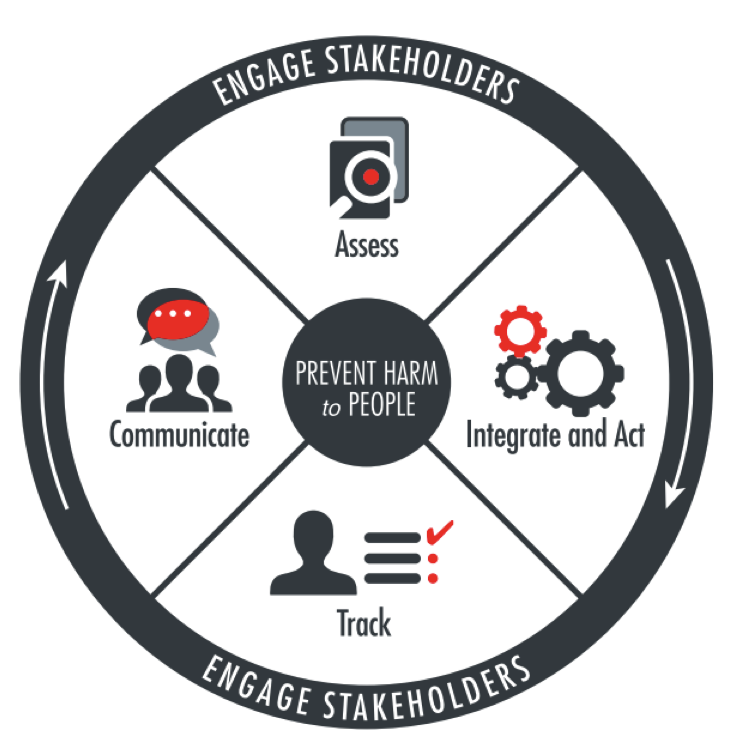
The four key interrelated elements of HRDD are set out in Principles 18 to 21 of the UNGPs, namely, assessing actual or potential adverse human rights impacts, integrating findings across the business and taking appropriate action, tracking the effectiveness of their response and communicating with stakeholders. This process will be explained in further detail below.

In order to conduct HRDD, businesses should start by conducting regular human rights impact assessment in order to by identify and assess ‘any actual or potential adverse human rights impacts which they may be involved’ in both their activities as well as their business relationships. Such an assessment is a critical aspect of HRDD as it is necessary for a business to evaluate its human rights risks before it can consider the steps to take to address those risks. The assessments should involve:[20]

assessing the human rights context prior to a proposed business activity, where possible; identifying who may be affected; cataloguing the relevant human rights standards and issues; and projecting how the proposed activity and associated business relationships could have adverse human rights impacts on those identified.

The findings of such assessments should then be integrated across a business’ relevant internal functions and processes to prevent and mitigate risks identified. Further, action should be taken where the business has had actual impacts so as to remediate those affected. Complexities may arise with respect to this element of HRDD, with situations existing where a business may not contribute to an adverse human rights impact, but nevertheless because of the business’ relationship with a third party the impact is directly linked to the business’ operations, products or services. Situations may also exist where a business has little or no leverage to address an impact. In such situations, businesses should seek independent expert advice.[21]

Businesses should then track the effectiveness of their response to adverse human rights impacts. Tracking allows a business to ensure that it is appropriately and adequately addressing the human rights impacts of its operations and to adapt its response if required. It should be ‘based on appropriate qualitative and quantitative indicators’ and ‘draw on feedback from both internal and external sources’.

The approach taken by businesses to address their human rights impacts should be communicated externally, including to those affected. Where severe human rights impacts exist within a business, how the business responds to impacts should be reported in a formal manner. In order to ensure that useful information is provided to external stakeholders, all communications should be accessible to its intended audience and provide sufficient information to ensure that business’ can evaluate the adequacy of their response to a particular human rights impact involved. Such communication ensures accountability and transparency on the part of the business.

The image below developed by Shift illustrates the cyclical nature of the HRDD process and shows that it is an ongoing process that must be undertaken in regular intervals in order to truly assist businesses to identify, prevent, mitigate and account for how they address their impacts on human rights.


Conclusion

As discussed above, HRDD lies at the heart of the corporate responsibility to respect human rights in the UNGPs. While the UNGPs were released in 2011, the concept of due diligence was around almost two decades before that – however, it was applied purely in the context of commercial transactions. The draft Norms imported the idea of due diligence into the business and human rights sphere. After the draft Norms failed, Ruggie revived the concept when he was appointed as Special Representative. He saw HRDD as key to businesses being able to know and show that they respect human rights to their stakeholders. Ruggie developed the concept from 2005 onwards, emphasising its benefits for businesses. Leading to the final articulation of HRDD as a central mechanism of the UNGPs in 2011.

From the discussion in this blog post, it is clear that the UNGPs as well as Ruggie’s reports and statements in the lead up to their inception do not (and probably could not) explicitly address how HRDD is to be applied and operationalised by businesses in practice. This will be explored in greater detail in the upcoming blog posts in this series.


[1] Securities Act 1933, section 11(a).

[2] Ibid, section 11(b).

[3] Ibid, section 11(c).

[4] See Michael Harvey and Robert Lusch, Expanding the Nature and Scope of Due Diligence, 10(1) Journal of Business Venturing 5 (1995); Michael Harvey and Robert Lusch, Beyond Traditional Due Diligence for Mergers and Acquisitions in the 21st Century, 19(3) Review of Business 17 (1998); Olga Martin-Ortega, Human Rights Due Diligence for Corporations: From Voluntary Standards to Hard Law at Last, 32 Neth. Q. Hum. Rts. 44 (2014), p 49.

[5] See for example Velasquez Rodriguez v. Honduras (1989) 28 ILM 294, [172] and the Council of Europe’s Convention on preventing and combating violence against women and domestic violence (2010), article 5(2).

[6] John Ruggie and John Sherman, The Concept of ‘Due Diligence’ in the UN Guiding Principles on Business and Human Rights: A Reply to Jonathan Bonnitcha and Robert McCorquodale, 28(3) The European Journal of International Law 921 (2017), p 924; Report of the Special Representative of the Secretary-General on the issue of human rights and transnational corporations and other business enterprises, John Ruggie: Business and human rights: towards operationalizing of the “protect, respect and remedy” framework (22 April 2009), UN Doc. A/HRC/11/13 (2009 Report), [25].

[7] 2009 Report, [25].

[8] John Ruggie and John Sherman, The Concept of ‘Due Diligence’ in the UN Guiding Principles on Business and Human Rights: A Reply to Jonathan Bonnitcha and Robert McCorquodale, 28(3) The European Journal of International Law 921 (2017), p 924.

[9] Keynote Address by SRSG John Ruggie “Engaging Business: Addressing Respect for Human Rights” (2010).

[10] Ibid.

[11] Report of the Special Representative of the Secretary-General on the issue of human rights and transnational corporations and other business enterprises, John Ruggie: Business and human rights: further steps toward the operationalization of the “protect, respect and remedy” framework (9 April 2010), UN Doc. A/HRC/14/27 (2010 Report), [79].

[12] Keynote Address by SRSG John Ruggie “Engaging Business: Addressing Respect for Human Rights” (2010).

[13] 2010 Report, [86].

[14] Ibid, [25].

[15] Ibid, [57]; 2009 Report, [50].

[16] Report of the Special Representative of the Secretary-General on the issue of human rights and transnational corporations and other business enterprises, John Ruggie: Protect, Respect and Remedy: a Framework for Business and Human Rights (7 April 2008), UN Doc. A/HRC/8/5, [72].

[17] Ibid, [58]; 2009 Report, [53]-[54].

[18] Ibid, [60]-[63].

[19] UN Human Rights Office of the High Commissioner, The Corporate Responsibility to Protect Human Rights: An Interpretative Guide, UN Doc. HR/PUB/12/02, p 6.

[20] UNGPs, p 19.

[21] UNGPs, pp 21-22.

Comments are closed