Global Modern Slavery Developments (Part II): A Review of the New Australian Modern Slavery Act – By Shamistha Selvaratnam

Editor’s note: Shamistha Selvaratnam is a LLM Candidate of the Advanced Masters of European and International Human Rights Law at Leiden University in the Netherlands and a contributor to the Doing Business Right project of the Asser Institute. Prior to commencing the LLM, she worked as a business and human rights solicitor in Australia where she specialised in promoting business respect for human rights through engagement with policy, law and practice.


Soon after the introduction of the UK Modern Slavery Act (UK Act) in 2015, discussions about establishing similar legislation in Australia commenced. In February 2017, the Attorney-General asked the Joint Standing Committee on Foreign Affairs, Defence and Trade (Committee) to commence an inquiry into establishing a Modern Slavery Act in Australia. The terms of reference of the inquiry included, inter alia, considering the ‘prevalence of modern slavery in the domestic and global supply chains of companies, businesses and organisations operating in Australia’ and whether a Modern Slavery Act comparable to the UK Act should be introduced in Australia. The Committee released an interim report in August 2017 and then a final report in December 2017 – both reports supported the idea of developing a Modern Slavery Act in Australia and set out the Committee’s recommendations with respect to the parameters of a corporate reporting requirement. In the meantime, the Australian Government also published a consultation paper and regulation impact statement outlining its proposed reporting requirement for an Australian Modern Slavery Act.

In June this year, the first draft of the Modern Slavery Bill 2018 (Cth) (the Federal Bill) was introduced into the Australian Parliament. It set out a reporting requirement for large Australian entities to submit a statement on risks of modern slavery in their operations and supply chains. The Explanatory Memorandum to the Federal Bill stated that it supports ‘large businesses to identify and address modern slavery risks and to develop and maintain responsible and transparent supply chains. It will drive a ‘race to the top’ as reporting entities compete for market funding and investor and consumer support.’ On 29 November 2018 the Federal Bill passed both houses of the Australian Parliament incorporating amendments made by the Upper House of Parliament. The amendments resulted in the inclusion of a provision giving the Minister power to request explanations from entities that fail to comply with the reporting requirement (discussed in further detail below) and gives the Minister the power to cause an annual report to be prepared providing an overview of compliance by entities and identifying best practice modern slavery reporting. 

This second blog of a series of articles dedicated to the global modern slavery developments provides an overview of the main elements of the Federal Bill and how it compares to the UK Act. It also discusses the Modern Slavery Act 2018 (NSW) (NSW Act), which was introduced by New South Wales (NSW), a State in Australia. The introduction of NSW Act was relatively unexpected given the movement at the Federal level to introduce national legislation addressing modern slavery in the corporate context. Therefore, this blog will discuss the NSW Act’s interplay with the Federal Bill. It will be followed by a final piece on the modern slavery developments in other jurisdictions in the corporate context.


Key Aspects of the Federal Bill

The Federal Bill requires reporting entities with at least $100 million global consolidated revenue to submit an annual modern slavery statement on the risks of modern slavery in their operations and supply chains.

What is ‘modern slavery’?

As stated in the first blog post in this series, while there is no globally agreed definition of ‘modern slavery’ under international law, it does appear that modern slavery is an umbrella term that covers a range of exploitative practices. As summarised by Anti-Slavery International, human exploitation characterised by only one of the following features is classed as ‘modern slavery’: (i) coercion to work through either mental or physical threat; (ii) being owned or controlled by an employer, usually through mental or physical abuse or the threat of abuse; (iii) being dehumanised or treated as a commodity; or (iv) being physically constrained or with limited freedom of movement.

The Federal Bill defines ‘modern slavery’ by reference to certain offences in the Australian Criminal Code, including slavery, servitude, forced labour, trafficking in persons, forced marriage, child trafficking, debt bondage and other slavery-like practices, and certain forms of child labour. Accordingly, the acts caught by the term ‘modern slavery’ under the Federal Bill are broader than the acts caught under the UK Act, which states that the offences of ‘modern slavery’ are slavery, servitude, forced or compulsory labour and human trafficking.

Who is required to report?

The term ‘reporting entity’ is defined as any of the following:

  • An Australian entity or an entity carrying on a business in Australia with a consolidated revenue of at least $100 million for the reporting period.
  • The Commonwealth.
  • A corporate Commonwealth entity or Commonwealth company which has a consolidated revenue of at least $100 million for the reporting period.
  • An entity that volunteers to comply with the Federal Bill.

Accordingly, similarly to the UK Act, the Federal Bill applies to an entity regardless of its geographic location, so long as it carries on at least a part of its business in Australia. A body corporate carries on a business in Australia if it, inter alia, has a place of business (i.e. a business address) in Australia.[1] Entities that do not meet the definition of a ‘reporting entity’ can voluntarily produce a Modern Slavery Statement. However, the monetary threshold in the Federal Bill is higher than that in the UK Act and, accordingly, a smaller group of entities will be captured under the Federal Bill. It is anticipated that approximately 3,000 entities will be captured.

What are reporting entities required to report on?

Unlike the UK Act which sets out optional criteria which Modern Slavery Statements may include information about, the Federal Bill sets out mandatory criteria which such Statements must cover, namely: 

a)     the identity of the reporting entity;

b)     a description of the structure, operations and supply chains of the reporting entity;

c)     a description of the risks of modern slavery practices in the operations and supply chains of the reporting entity, and any entities that the reporting entity owns or controls;

d)     a description of the actions taken by the reporting entity and any entity that the reporting entity owns or controls, to assess and address those risks, including due diligence and remediation processes;

e)     a description of how the reporting entity assesses the effectiveness of such actions;

f)      a description of the process of consultation with any entities that the reporting entity owns or controls; and

g)     any other information considered relevant.

Accordingly, the Federal Bill is prescriptive about the content of Modern Slavery Statements and goes beyond the optional criteria in the UK Act by requiring reporting entities to not only report on modern slavery risks in their operations and supply chains, but also on how they assess the effectiveness of the actions they take to address those risks.

Further, the Federal Bill allows for joint statements to be published by a reporting entity on behalf of the reporting entities that it owns or controls. The parent entity must consult with the boards of the relevant subsidiaries when preparing the statement on their behalf.

Who is responsible for reporting?

Similarly to the UK Act, the Board of directors will bear the ultimate responsibility for Modern Slavery Statements with the Federal Bill requiring the Board to approve the statement and a director to sign the statement.

How can published Modern Slavery Statements be accessed?

Unlike the UK Act, the Federal Bill provides for a Modern Slavery Statements Register to be established and maintained by the Minister, with Statements being available for public inspection online.

What happens if reporting entities do not report?

In the event that a reporting entity that is required to report under the Federal Bill does not report, similarly to the UK Act, no financial penalties will be imposed on that entity. However, the Minister does have the power to request an explanation from an entity about its failure to comply with a requirement in relation to Modern Slavery Statements, and may also request that the entity undertake remedial action in relation to that requirement. If the entity fails to comply with the request, the Minister may publish information (including the identity of the entity) about the failure to comply on the Modern Slavery Statements Register or elsewhere. The publication of such information is likely to result in public, shareholder and investor criticism, which can be costly to the reputation of reporting entities.


The critiques of the Federal Bill

While the Federal Bill is very young, it has received some critiques.

Human Rights Watch has argued that the Federal Bill ‘falls short of an effective response to the widespread and growing role of modern Slavery in Australia’s supply chains.’ Among other things, it stated that the monetary threshold is too high thereby limiting the scope of application of the Federal Bill. Further, it contends that because the Federal Bill does not require entities to carry out due diligence, they may simply engage in a ‘”checking the box” exercise’. It recommends that minimum guidelines for due diligence that are ‘proportional to the size of a company’s supply chain and modern slavery risk’ be introduced in the Federal Bill. It has also strongly recommended the inclusion of financial penalties for failure to report under the Federal Bill in order to provide an ‘additional incentive toward compliance’ by businesses.

Oxfam International notes that the Federal Bill is ‘not strong enough’ as it is ‘missing critical elements to ensure companies will be compelled to take the urgent action needed to protect’ victims of modern slavery in their operations and supply chains. It argues that the Federal Bill should include penalties for entities that fail to report and an independent oversight body should be established to monitor the implementation of the Bill. 

Similarly to Oxfam International, Justine Nolan and Fiona McGaughey have also stated that a shortcoming of the Federal Bill is the lack of penalties for non-compliance with the reporting requirement. They argue that enforcement is effectively left to NGOs, shareholders and investors to ‘put pressure on the companies to comply with their reporting obligations’. They also state that the lack of independent oversight raises questions regarding the ‘efficacy’ of the reporting requirement.


Modern Slavery Act in New South Wales

In June 2018, prior to the passing of the Federal Bill, the NSW Act was passed (for more on the NSW MSA, see here and here). The NSW Act requires ‘commercial organisations’ to prepare an annual Modern Slavery Statement. ‘Commercial organisations’ are organisations with more than one employee in NSW that supply goods and services for profit or gain with a total global turnover of not less than $50 million per financial year. The criteria that must be satisfied by the Statement will be set out in regulations that have not yet been introduced in the NSW Parliament. However, the criteria may include information about the following:

a)     the organisation’s structure, its business and its supply chains,

b)     its due diligence processes in relation to modern slavery in its business and supply chains,

c)     the parts of its business and supply chains where there is a risk of modern slavery taking place, and the steps it has taken to assess and manage that risk,

d)     the training about modern slavery available to its employees.

Unlike both the UK Act and the Federal Bill, the NSW Act has teeth as failure to report may result in financial penalties of up to $1.1 million being imposed on the relevant organisation. Further, failure to make a Modern Slavery Statement public or to provide false or misleading information in a Statement carry financial penalties of up to $110,000.

The position as to whether entities will be required to report under both the Federal Bill and the NSW Act is still unclear. However, the NSW Act does state that it will not apply to a commercial organisation where it is subject to obligations under a Commonwealth law that is ‘prescribed as a corresponding law’. The Federal Bill is yet to be prescribed as a ‘corresponding law’. If it is so prescribed, then entities that would otherwise be required to report under the Federal Bill and the NSW Act will only be required to report under the Federal Bill. Accordingly, the NSW Act will capture entities with a total global turnover of between $50 million and $100 million.


Conclusion

The Federal Bill and the NSW Act are part of the wider movement towards greater corporate regulation and transparency with respect to human rights. It marks another steps towards the implementation of the UN Guiding Principles on Business and Human Rights globally and aims at fostering corporate respect for human rights.

It is clear that the Federal Bill and NSW Act have been heavily influenced by the UK Act but have addressed some of the shortcomings of the UK MSA discussed in the first blog post. In particular, the Federal Bill has mandatory criteria that reporting entities are required to report on and it is likely that the NSW Act will also have similar mandatory criteria. The UK Act on the other hand has optional criteria meaning that business are only required to publish a Modern Slavery Statement that is signed by a director and approved by the Board – the content of the Statement is irrelevant. The use of mandatory criteria is more likely to inspire change within businesses in Australia with respect to their practices relating to addressing and preventing modern slavery.

Similarly to the UK Act, the Federal Bill does not impose financial penalties on businesses that fail to comply with the reporting requirement. It does however give the Minister power to request an explanation from an entity about its failure to comply with a requirement in relation to Modern Slavery Statements, and to publish information in the event of non-compliance with such a request. The effectiveness of this provision will depend on whether the Minister invokes it. The NSW Act goes beyond both the UK Act and Federal Bill by imposing financial penalties on businesses that fail to comply with its reporting requirement. This is a big step forward in the fight against modern slavery as it is likely to incentivise businesses to take active steps to combat modern slavery in their operations and supply chains.

The Federal Bill will come into force on 1 January 2019. It is likely that the NSW Act will come into force around the same time. Accordingly, the first Modern Slavery Statements will be due by 1 January 2021. The date on which the first Modern Slavery Statements will be due under the NSW Act will be known once the regulations have been introduced. It is likely that the reporting dates of the Federal Bill and the NSW Act will be aligned in order to decrease the administrative burden on entities.


[1] An body corporate will also carry on a business in Australia if it establishes or uses a share transfer office or share registration office in Australia, or in the State or Territory, as the case may be, or administers, manages, or otherwise deals with, property situated in Australia, or in the State or Territory, as the case may be, as an agent, legal personal representative or trustee, whether by employees or agents or otherwise.


Comments are closed
Doing Business Right Blog | Background paper - Rana Plaza: Legal and regulatory responses - By Raam Dutia & Abdurrahman Erol

Background paper - Rana Plaza: Legal and regulatory responses - By Raam Dutia & Abdurrahman Erol

Editor’s note: You will find attached to this blog the background paper to the event Five Years Later: Rana Plaza and the Pursuit of a Responsible Garment Supply Chain hosted by the Asser Institute in The Hague on 12 April. 


Background paper: executive summary

Raam Dutia & Abdurrahman Erol (Asser Institute)

The collapse of the Rana Plaza building on 24 April 2013 in Savar, Bangladesh, left at least 1,134 people dead and over 2,500 others wounded, while survivors and the families of the dead continue to suffer trauma in the aftermath of the disaster. The tragedy triggered a wave of compassion and widespread feelings of guilt throughout the world as consumers, policy makers and some of the most well-known companies in Europe and North America were confronted with the mistreatment and abject danger that distant workers face in service of a cheaper wardrobe.

Partly in order to assuage this guilt, a number of public and private regulatory initiatives and legal responses have been instituted at the national, international and transnational levels. These legal and regulatory responses have variously aimed to provide compensation and redress to victims as well as to improve the working conditions of garment workers in Bangladesh. Mapping and reviewing how these responses operate in practice is essential to assessing whether they have been successful in remedying (at least partially) the shortcomings that led to the deaths of so many and the injury and loss suffered by scores more.

This briefing paper outlines and provides some critical reflections on the steps taken to provide redress and remedy for the harm suffered by the victims of the catastrophe and on the regulatory mechanisms introduced to prevent its recurrence. It broadly traces the structure of the panels of the event. 

In line with Panel 1 (Seeking Justice, Locating Responsibility), the paper begins by focusing on litigation that has been conducted to secure justice and compensation for the victims, as well as to bring the relevant actors to account for their alleged culpability for the collapse. To this end, the paper examines the avenues that have been taken to hold corporations legally accountable in their home jurisdictions for their putative contributions to the collapse on the one hand, and individuals (particularly local actors) legally accountable before the courts in Bangladesh on the other; it then considers softer mechanisms aimed at compensating victims and their dependants. 

In keeping with Panel 2 (Never again! Multi-level regulation of the garment supply chain after Rana Plaza: Transnational Responses), the paper then considers the transnational (public and private) regulatory responses following the tragedy, enacted by stakeholders including NGOs, industry associations, trade unions and governments and largely connected to issues surrounding labour standards and health and safety.

Finally, in line with Panel 3 (Never again! Multi-level regulation of the garment supply chain after Rana Plaza: National Responses), the paper looks at numerous (soft and hard) regulatory developments at the national level in response to the Rana Plaza collapse. It charts the legislative response by the government of Bangladesh to attempt to shore up safety, working conditions and labour rights in garment factories. It also focuses on legislative and other arrangements instituted by certain national governments in the EU, and how these arrangements relate to the United Nations Guiding Principles on Business and Human Rights and the OECD Guidelines on Multinational Enterprises.
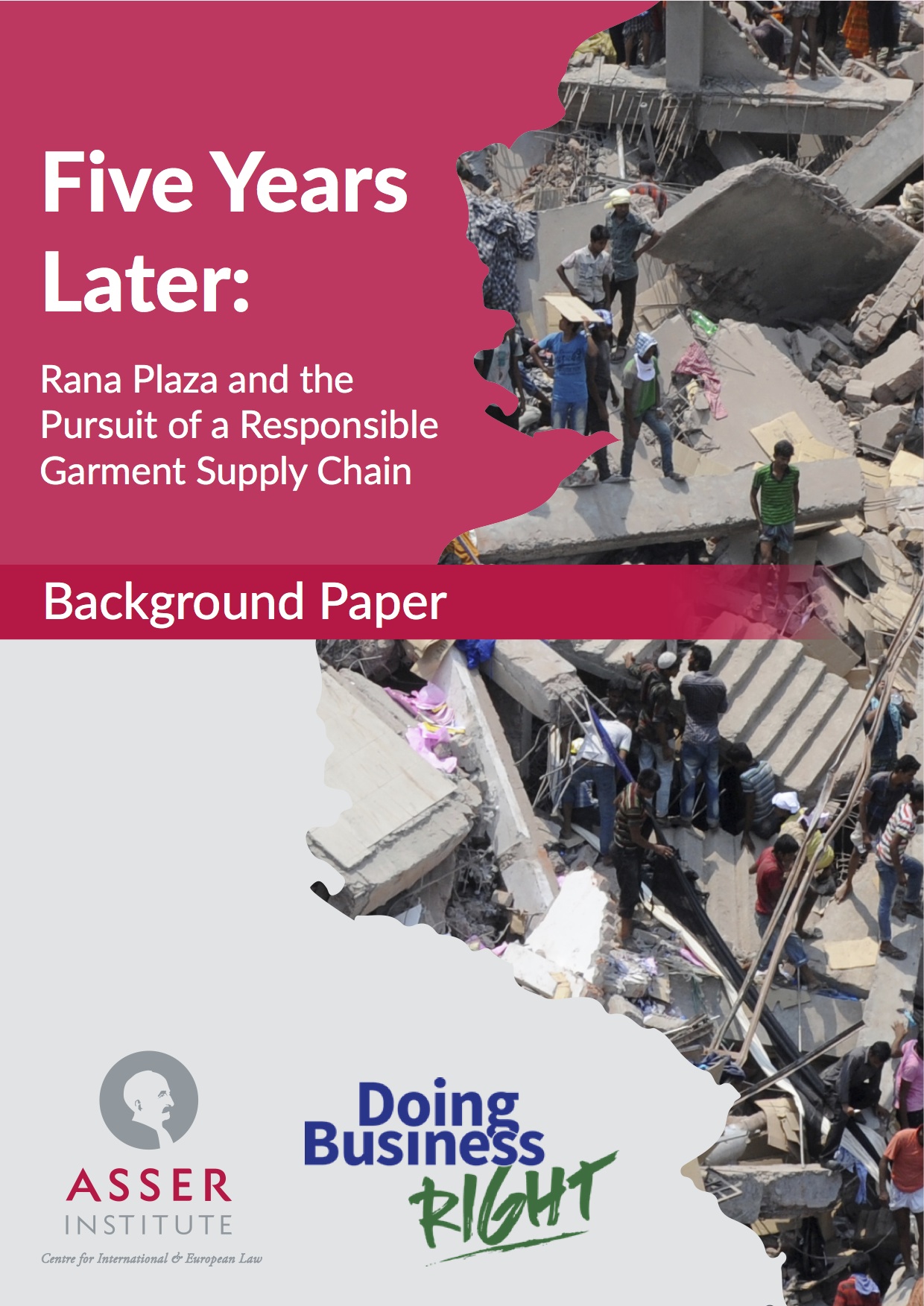

Download the full paper: RanaPlazaBackgroundPaper.pdf (3.5MB)
Comments are closed
Doing Business Right Blog | National Human Rights Institutions as Gateways to Remedy under the UNGPs: The Australian Human Rights Commission (Part.4) - By Alexandru Tofan

National Human Rights Institutions as Gateways to Remedy under the UNGPs: The Australian Human Rights Commission (Part.4) - By Alexandru Tofan

Editor's Note: Alexandru Rares Tofan recently graduated with an LLM in Transnational Law from King’s College London where he focused on international human rights law, transnational litigation and international law. He is currently an intern with the Doing Business Right project at the Asser Institute in The Hague. He previously worked as a research assistant at the Transnational Law Institute in London on several projects pertaining to human rights, labour law and transnational corporate conduct.


The Australian Human Rights Commission (AHRC) is charged with leading the promotion and protection of human rights in Australia and with ensuring that Australians have access to effective complaint and public inquiry processes on human rights matters (see the Australian Human Rights Commission Act No 125, hereinafter ‘the Act’). The AHRC was established in 1986 as the Human Rights and Equal Opportunity Commission but underwent a name change and several other amendments through the 2003 Australian Human Rights Commission Legislation Bill (see also the Explanatory Memorandum). The AHRC primarily exercises the functions conferred on it by four federal anti-discrimination acts, namely the Age Discrimination Act 2004, the Disability Discrimination Act 1992, the Racial Discrimination Act 1975, and the Sex Discrimination Act 1984 (see s.11). It is further empowered to act on the basis of several international human rights instruments such as the ICCPR (see here). Specifically, the AHRC advises the federal government on the compatibility of its legislation with human rights, promotes an understanding and acceptance of human rights in Australia, undertakes research and educational programmes, intervenes in court proceedings as an amicus, and it may handle complaints through its conciliatory process (see s.11 (1) (a)-(o)). Notably, the AHRC enjoys an open-ended mandate in that s.11 (1) (p) stipulates that it may undertake any action that is incidental or conducive to the performance of the functions contained in subparagraphs (a) to and including (o). The Commission is made up of one president and seven specialised commissioners (see s.8 (1)). Its headquarters are located in Sydney.

This article analyses two types of actions in order to assess the extent to which the AHRC has assumed its role in promoting access to remedy in business and human rights cases. According to the 2010 Edinburgh Declaration of the International Co-ordinating Committee of National Institutions for the Promotion and Protection of Human Rights (ICC), the participation of NHRIs in the remedial process may be either direct or indirect. As will be shown, the AHRC’s mandate to entertain complaints against companies is rather limited in terms of subject-matter jurisdiction. On the other hand, the Commission plays a prominent role in the promotion and operationalisation of the UNGPs in Australia.

As to direct participation to access to remedy, three types of complaints fall under the jurisdiction of the Commission’s complaints mechanism. Firstly, the AHRC may resolve complaints alleging unlawful discrimination, harassment and bullying in so far as they relate to one of the prohibited grounds of race, disability, age and sex (including gender identity, intersex status and sexual orientation). The second type of complaints that the Commission may entertain are those relating to discrimination in employment. The prohibited grounds on which such a complaint may be based include a person’s criminal record, trade union activity, political opinion, religion and social origin. Thirdly, the AHRC may resolve complaints arguing breaches of any human right but only to the extent that the alleged perpetrator is the Australian government or one of its agencies. It should be borne in mind however that the Commission is an administrative body and that it therefore does not have the capacity to make binding and enforceable judicial decisions. As the High Court ruled in the Brandy case, such a power would be unconstitutional and the Commission may therefore only act in a conciliatory capacity.

Once such a complaint is filed, the Commission begins a non-adversarial process of conciliation whereby it seeks to help the parties reach an agreeable outcome. The most common types of reparations include apologies, policy changes and pecuniary compensation. Out of 1,262 conciliation processes carried out in 2017-2018, 74% were successfully resolved according to both parties (see here at page 15). Nevertheless, if such an outcome cannot be reached, complaints may be taken further to the federal courts. This process exemplifies the Commission’s complementary role in providing remedy for human rights violations. Nonetheless, the AHRC’s complaints mechanism suffers from a narrow mandate in terms of business and human rights. It may only entertain complaints against companies in so far as these fall under the first or second category of complaints. Other alleged breaches of human rights against companies escape the Commission’s competences. The AHRC’s direct participation in providing access to remedy in business and human rights cases is therefore rather limited. While the conciliatory process fits the role envisioned for NHRIs under the UNGPs, the limitation of the mandate to allegations of discrimination curtails the AHRC’s potential as an alternative to instituting judicial proceedings.

On the other hand, the Commission’s indirect participation in promoting access to effective remedy is slightly more robust. The AHRC has elaborated a fully-fledged business and human rights agenda upon which it has based several activities meant to raise awareness and promote dialogue (see also here at page 23). For instance, the Commission convenes an annual business and human rights dialogue jointly with the Global Compact Network Australia that focuses on capacity-building by helping businesses operationalise the UNGPs. Access to remedy has been a central theme in these dialogues (see for instance the outcomes of the 2015 and 2016 dialogues). The AHRC has further endeavoured to help companies internalise the UNGPs by developing easy to understand factsheets on how to best integrate human rights in business policies and practices. Alongside working with businesses, the Commission has collaborated with the civil society with the purpose of finding a way to better operationalise the UNGPs in Australia. In 2016, the AHRC hosted a roundtable discussion with civil society representatives, which culminated in a joint statement. This tackled among others the upcoming National Action Plan of Australia and the measures this should include to ensure adequate access to remedy. On a regional level, the AHRC has participated in the Interregional Dialogue on Business and Human Rights, which was hosted by the ASEAN Intergovernmental Commission on Human Rights. As a part of this dialogue, the Australian Commission convened a roundtable discussion on the NHRI’s engagement with business and human rights issues under the framework of the UNGPs (see here at page 42).

In conclusion, while the Australian Human Rights Commission plays an important role in the promotion and implementation of the UNGPs in Australia, its role is considerably more prominent in terms of indirect rather than direct participation in providing access to remedy for business-related human rights harms.

Comments are closed
Doing Business Right Blog | New Policy Brief - The Case for a Court of Arbitration for Business and Human Rights - By Antoine Duval & Catherine Dunmore

New Policy Brief - The Case for a Court of Arbitration for Business and Human Rights - By Antoine Duval & Catherine Dunmore

Two members of the Doing Business Right team, Antoine Duval and Catherine Dunmore have just published a policy brief feeding into the current debates on the use (and usefulness) of arbitration in the business and human rights context. More precisely, the brief makes the case for the creation of a single Court of Arbitration for Business and Human Rights. 

Here is the abstract: 

This policy brief makes the case for a single Court of Arbitration for Business and Human Rights (CABHR). It first highlights the challenges faced by victims of human rights violations caused or directly linked to the activities of transnational corporations (TNCs) in accessing effective remedy. It then discusses the opportunities and challenges in using arbitration to provide a remedy in the business and human rights context. If arbitration is to be used, we argue that it should be in the framework of a single CABHR, which could draw some inspiration from the structure and operation of the Court of Arbitration for Sport (CAS). The policy brief concludes by highlighting four core issues which stakeholders should focus on in the process of setting up a CABHR.

You can download the paper for free on SSRN.

Comments are closed
Doing Business Right Blog | Global Modern Slavery Developments (Part I): A Critical Review of the UK Modern Slavery Act - By Shamistha Selvaratnam

Global Modern Slavery Developments (Part I): A Critical Review of the UK Modern Slavery Act - By Shamistha Selvaratnam

Editor’s note: Shamistha Selvaratnam is a LLM Candidate of the Advanced Masters of European and International Human Rights Law at Leiden University in the Netherlands and a contributor to the Doing Business Right project of the Asser Institute. Prior to commencing the LLM, she worked as a business and human rights solicitor in Australia where she specialised in promoting business respect for human rights through engagement with policy, law and practice.


Over the past couple of years, there has been an international trend towards greater regulation and transparency with respect to modern slavery in corporate supply chains as reports of gross human rights violations in corporate supply chains have entered the public spotlight. For example, over the past couple of years there has been extensive media attention in relation to the use of slaves trafficked from Cambodia, Laos, Bangladesh and Myanmar to work on Thai fishing boats to catch fish to be sold around the globe, with the boats considered to be ‘floating labor camps’. As a result of events such as this, there has been increased pressure on businesses to take steps to address modern slavery in their supply chains through processes such as through conducting risk assessments and due diligence.

As the Ethical Trading Initiative notes, key risks facing companies in their supply chains include the use of migrant workers; the use of child labour; recruitment fees and debt bondage; the use of agency workers and temporary labour; working hours and wages; and the use of subcontractors. In 2016 the Global Slavery Index reported that 40.3 million people are living in modern slavery across 167 countries, and in 2014 the ILO estimated that forced labour in the private economy generates US$150 billion in illegal profits per year.

In March 2015, the UK Government passed the UK Modern Slavery Act 2015 (the Act), game-changing legislation that targets, inter alia, slavery and trafficking in corporate supply chains. The UK Government also published guidance explaining how businesses should comply with the Act.

This first blog of a series of articles dedicated to the global modern slavery developments provides an overview of the main elements of the Act and how businesses have responded to it. It will be followed by a review of the proposed Australian MSA, and a final piece on the developments in other jurisdictions that are considering introducing legislation regulating modern slavery in the corporate context.


Global businesses and modern slavery: The challenges

There are a number of challenges associated with modern slavery in a globalised economy. As Genevieve LeBaron and Andreas Rühmkorf[1] state there are in particular a number of regulatory gaps surrounding labour standards in corporate supply chains. Firstly, there is no binding international instrument or framework in place ‘that addresses the conduct of companies in global supply chains, and companies are not considered to be duty bearers in public international law’.[2] Secondly, there are gaps in the regulation and enforcement of labour standards by states. Thirdly, ‘the legal structure of global supply chains makes it difficult to hold multinational enterprises liable for violations that occur.’[3] Fourthly, the principles of extraterritoriality often result in host states’ laws applying rather than home states’ laws. As Shuangge Wen notes the notion of the extraterritorial application of legislation ‘remains alien to most of the civil law body’.[4] Another challenge she recognises is that the doctrine of separate legal personality which ‘effectively shield[s] [corporate] group members from being sued or liable’.[5] These doctrinal and practical obstacles to holding businesses accountable for modern slavery provide the wider backdrop to the Act and must be kept in mind when assessing its effectiveness.


Key Aspects of the Act 

Section 54 of the Act requires commercial organisations with a global annual turnover of at least £36 million to prepare a slavery and human trafficking statement annually through publishing a Modern Slavery Statement on their webpage in a prominent place.

What is ‘modern slavery’?

While there is no globally agreed definition of ‘modern slavery’ under international law, it does appear that modern slavery is an umbrella term that covers a range of exploitative practices. As summarised by Anti-Slavery International, human exploitation characterised by only one of the following features is classed as ‘modern slavery’: (i) coercion to work through either mental or physical threat; (ii) being owned or controlled by an employer, usually through mental or physical abuse or the threat of abuse; (iii) being dehumanised or treated as a commodity; or (iv) being physically constrained or with limited freedom of movement.

The Act does not specifically define ‘modern slavery’, however, its offences include slavery, servitude, forced or compulsory labour and human trafficking. While each of these practices has differences, they also have some similarities. So what are each of these practices?

  • As set out in the Slavery Convention, slavery is ‘the status or condition of a person over whom any or all of the powers attaching to the right of ownership are exercised’.
  • Servitude is similar to slavery; however, the person responsible for the situation does not exercise the powers of ownership over the other person.
  • As defined in the ILO Forced Labour Convention 1930 (No. 29), forced or compulsory labour is ‘all work or service which is exacted from any person under the threat of a penalty and for which the person has not offered himself or herself voluntarily.
  • ’Human trafficking is defined in the Act as occurring when a person arranges or facilitates the travel of another person (for example, through transporting, transferring or recruiting) with the view of that person being exploited.

Who is required to report?

The term ‘commercial organisations’ is defined as a body corporate or partnership that carries on a business, or part of a business, in the UK wherever that organisation was incorporated or formed. Such an organisation is required to report under s 54 if it supplies goods and services and has a total turnover of at least £36 million. Accordingly, the Act will apply to businesses regardless of its geographic location, so long as it carries on at least a part of its business in the UK.

The term ‘carries on a business’ is not defined in the Act. The guidance provided by the UK Government states that a ‘common sense approach’ should be applied in determining whether a body corporate or partnership is carrying on a business in the UK. However, ultimately, the ‘courts will be the final arbiter as to whether an organisation ‘carries on a business’ in the UK taking into account the particular facts in individual cases.’ As at the date of this blog, there have been no court cases in which the court has had to consider whether a particular commercial organisation is carrying on a business in the UK.

Organisations that do not meet the definition of ‘commercial organisations’ can voluntarily produce a Modern Slavery Statement. 

What are commercial organisations required to report on?

Commercial organisations are required to report on the steps they have taken to ensure that slavery and human trafficking is not taking place in any of their supply chains and in any part of their business, or that they have taken no such steps. The Act sets out optional criteria which statements may include information about, namely:

  • (a)   the organisation’s structure, its business and its supply chains;
  • (b)   its policies in relation to slavery and human trafficking;
  • (c)   its due diligence processes in relation to slavery and human trafficking in its business and supply chains;
  • (d)   the parts of its business and supply chains where there is a risk of slavery and human trafficking taking place, and the steps it has taken to assess and manage that risk;
  • (e)   its effectiveness in ensuring that slavery and human trafficking is not taking place in its business or supply chains, measured against such performance indicators as it considers appropriate;
  • (f)     the training about slavery and human trafficking available to its staff.

Accordingly, the Act is not prescriptive about the content of Modern Slavery Statements. The guidance provided by the UK Government provides tips on how to write a Modern Slavery Statement (for example, it is suggested that companies keep the statement succinct but cover all relevant points) and how to structure the statement

Who is responsible for reporting?

The Board of directors will bear the ultimate responsibility for Modern Slavery Statements with the Act requiring the Board to approve the statement and a director to sign the statement. As the UK Government guidance notes, this ‘ensures senior level accountability, leadership and responsibility for modern slavery and gives it the serious attention it deserves.’ For limited liability partnerships, the statement must be approved by the members and signed by a designated member.

What happens if commercial organisations do not report?

In the event that a commercial organisation that is required to report under the Act does not report, the Secretary of State may seek an injunction from the High Court requiring the organisation to comply (or, in Scotland civil proceedings for specific performance of a statutory duty under section 45 of the Court of Session Act 1988). If the injunction is not complied with, the organisation will be held in contempt of a court order, which is punishable by an unlimited fine. In a public hearing held earlier this year, the UK Home Office commented that the UK Government did not go down a ‘more punitive route’ with respect to enforcement ‘to avoid pushing businesses away from transparency’ and that its approach so far has been to ‘work in partnership with business, to share best practice, to raise awareness and to encourage transparency’.

The UK Government guidance notes that it will be for ‘consumers, investors and Non-Governmental Organisations to engage and/or apply pressure where they believe a business has not taken sufficient steps’, suggesting that the Government will not take action on its own volition.


How have businesses responded?

As at the date of this blog, 6102 companies have published 7302 statements. The statements can be found on the Modern Slavery Registry website. This stands in stark contrast to the UK Home Office’s estimate of the number of companies required to report under the Act, being between 9,000 and 11,000 entities. However, as noted at the public hearings earlier this year, no injunctions have been taken against non-complying companies so as not to ‘discourage transparency’.

According to the Modern Slavery Registry, of the statements published, only 19% met the minimum requirements set out in the Act, namely: (1) the statement is published on the business’ website with a link on the home page; (2) the statement is signed by a director or equivalent; and (3) explicit approval by the Board is included in the statement. Further, the Business & Human Rights Resource Centre’s analysis of the Financial Times Stock Exchange 100's quality of reporting in the first reporting year across six reporting areas (as summarised in its report titled ‘Modern Slavery Reporting: Case Studies of Leading Practice’) showed that:

  • 34% of companies complied with the organisational and supply chain structure reporting area;
  • 38% of companies complied with the company policies reporting area;
  • 46% of companies complied with the due diligence processes reporting area;
  • 38% of companies complied with the risk assessment reporting area;
  • 16% of companies complied with effectiveness of measures in place reporting area; and
  • 38% of companies complied with the training reporting area.

Given the low level of compliance, as stated by the Business & Human Rights Resource Centre, it appears that a ‘vast majority of companies are failing to take effective action and must do more to address modern slavery.’ As Radu Mares notes, the quality of reporting demonstrates ‘paper compliance’ whereby companies are using a ‘tick-box approach’ to satisfy the requirements in the Act ‘without providing substantive or meaningful information.’[6] For example, in 2016 Ergon Associates reported that 35% of statements did not mention risk assessment procedures and two-thirds did not identify priority risks.

Modern slavery statements published by businesses to date highlight a number of key challenges and barriers facing business in addressing modern slavery. As the Ethical Trading Initiative notes, these include the following challenges:

  • The complexity and length of supply chains.
  • The insufficient resources they have to conduct due diligence and support supplier improvements.
  • The extent to which they should provide transparency around their modern slavery risks and practices.
  • Pressure from buyers to secure low prices from suppliers.
  • Lack of leverage with suppliers in order to work with them to improve their practices.

The Ethical Trading Initiative states that the following is crucial to ensure modern slavery action is taken by commercial organisations: senior leadership engagement, organisational culture change, including ‘communicating and clarifying the values, attitudes, and understanding of modern slavery to help embed policies and make them effective’; and collaborations and partnerships amongst different stakeholders, including other companies.


The many academic critiques of s 54 of the Act

As LeBaron and Rühmkorf, note that although the Act is considered to be public regulation, it is indeed ‘fully dependent on private governance tools, standards, and enforcement mechanisms to meet its aims’ and does not introduce any new public standards.[7] Accordingly, it ‘blurs the binary frequently posited between ‘hard’ and ‘soft’ law in the governance of labour standards’.[8] Further, they argue that compliance with the Act does not actually require a business to take steps to address modern slavery in its supply chain – all that is required is that a statement be published on a company’s webpage signed by a director and approved by its Board. This is strengthened by the fact that the Act does not require businesses to report on mandatory criteria – rather it suggests criteria that a business can (but is not required to) report on, providing little incentive for companies to detail the actions they have taken (if any) to prevent and address modern slavery particularly given the lack of penalties for non-compliance.

As Shuangge Wen notes the absence of penalties and the call on the general public to use the information contained in statements is unlikely to encourage change within businesses. In other words, it is likely to have a limited ‘pragmatic effect’.[9] This is possibly the reason why there have been such low levels of compliance with reporting. She further argues that the Act leaves business responsibilities with respect to respecting human rights and preventing and addressing modern slavery up to the ‘individual organizations’ discretionary interpretation’.[10] However, as Radu Maries notes the Act’s requirement that directors sign off on statements has ‘raised the profile of modern slavery issues within companies’ and, as a result, had an ‘internal effect on risk management’ and lead to top-level leadership with respect to modern slavery issues.[11]

As Justine Nolan and Gregory Bott state that the Act fails to ‘set mandatory standards for what due diligence must encompass’ and does not hold companies ‘directly legally accountable for any actual adverse human rights impacts connected to their operations’.[12] Accordingly, they argue that it is unlikely to encourage businesses to take proper action to address modern slavery in their supply chains. They contend that an ‘improved approach’ is required that ‘links reporting with due diligence, requires detailed disclosures, has regulatory consequences for a failure to report, and utilises both public and private mechanisms and the shared leverage of all relevant stakeholders’ in order to effect change with respect to combatting modern slavery.[13]

Virginia Mantouvalou presents a number of interesting arguments to contend that the Act is a ‘weak’ mechanism to prevent and address modern slavery.[14] While she notes that the Act’s soft law approach’ to regulating modern slavery in corporate supply chains is ‘not necessarily problematic at a theoretical level’, she states that self-regulation present many challenges and may not be the ‘best way to deal with business misconduct’ by itself.[15] This is because self-regulation can be seen as ‘simply protecting businesses from reputational damage and for limiting their liability’, rather than encouraging businesses to take concrete steps to combat modern slavery.[16] She further argues that the Act is overly narrow in its focus, with the Act regulating slavery, servitude, forced and compulsory labour and human trafficking to the exclusion of other exploitative practices. This suggests that only a subset of exploitative practices are present in business conduct.

Mantouvalou contends that the corporate transparency provision in the Act has been designed in such a manner that ‘it cannot be effective’. The weaknesses of the provision include:

  • The lack of a central list containing the names of businesses required to report.
  • The lack of a mechanism to monitor compliance with the Act.
  • The lack of a central repository for statements that have been published by businesses.
  • The lack of penalties for non-compliance with the Act and remedies for victims of modern slavery in corporate supply chains.
  • The lack of awareness of the Act amongst businesses.

She does however note that the Act has ‘generated discussions by companies that might not otherwise have considered the problem of severe labour exploitation’.


Conclusion

Despite the criticism that the Act has received, it has nonetheless been widely recognised that it is a step in the right direction towards increasing corporate transparency with respect to modern slavery. However, as the UK Home Office acknowledged earlier this year, while there has been progress ‘there is absolutely more to do’. So where to from here?

Well, a couple of months ago, the UK Government announced that it would be launching an independent review of the Act. As stated in the terms of reference, the aim of the review is to ‘report on the operation and effectiveness of, and potential improvements to,’ the Act. With respect to s 54 of the Act, a specific issue that has been noted as requiring consideration is how to ensure compliance and increase the quality of statements produced by commercial organisations. This blog aims to contribute to the future work of the independent review by providing a quick overview of the key critiques raised against the Act. Furthermore, it is essential that other countries considering the introduction of similar legislation take careful stock of the important lessons learned from the UK experiment to design more efficient modern slavery legislations, but that will be the subject of our next blogs.


[1] Genevieve LeBaron and Andreas Rühmkorf, Steering CSR Through Home State Regulation: A Comparison of the Impact of the UK Bribery Act and Modern Slavery Act on Global Supply Chain Governance (2017) Global Policy 8(3), 15.

[2] Ibid, 19.

[3] Ibid, 20.

[4] Shuangge Wen, The Cogs and Wheels of Reflexive Law – Business Disclosure under the Modern Slavery Act (2016) Journal of Law and Society 43(3) 327, 335.

[5] Ibid.

[6] Radu Mares, Corporate transparency laws: A hollow victory (2018) Netherlands Quarterly of Human Rights 36(3), 189, 197.

[7] Genevieve LeBaron and Andreas Rühmkorf, Steering CSR Through Home State Regulation: A Comparison of the Impact of the UK Bribery Act and Modern Slavery Act on Global Supply Chain Governance (2017) Global Policy 8(3) 15, 17.

[8] Ibid.

[9] Shuangge Wen, The Cogs and Wheels of Reflexive Law – Business Disclosure under the Modern Slavery Act (2016) Journal of Law and Society 43(3) 327, 358.

[10] Ibid, 359.

[11] Radu Mares, Corporate transparency laws: A hollow victory (2018) Netherlands Quarterly of Human Rights 36(3), 189, 198.

[12] Justine Nolan and Gregory Bott, Global Supply Chains and Human Rights: Spotlight on Forced Labour and Modern Slavery Practices (2018) Australian Journal of Human Rights 1, 10.

[13] Ibid, 11.

[14] Virginia Mantouvalou, The UK Modern Slavery Act 2015 Three Years On (2018) The Modern Law Review (2018) 81(6) 1017, 1017.

[15] Ibid, 1038, 1040.

[16] Ibid, 1040.

Comments are closed