Editor's Note: Ryan is Assistant Professor at Thompson Rivers University, he defended his PhD at Erasmus University Rotterdam in December 2015. His dissertation examined human rights violations caused by international sporting events, and how international sporting organisations may be held accountable for these violations.
Introduction
On Sunday, August
21, the 2016 Summer Olympic Games in Rio de Janeiro will end. The spotlight
will dim not only on the athletes who return to their home countries to ply their
trade in relative obscurity, but also on the country of Brazil.[1]
Once the Games have ended, life will go ‘back to normal’, although for many
residents of Rio de Janeiro, what is ‘normal’ is anything but.
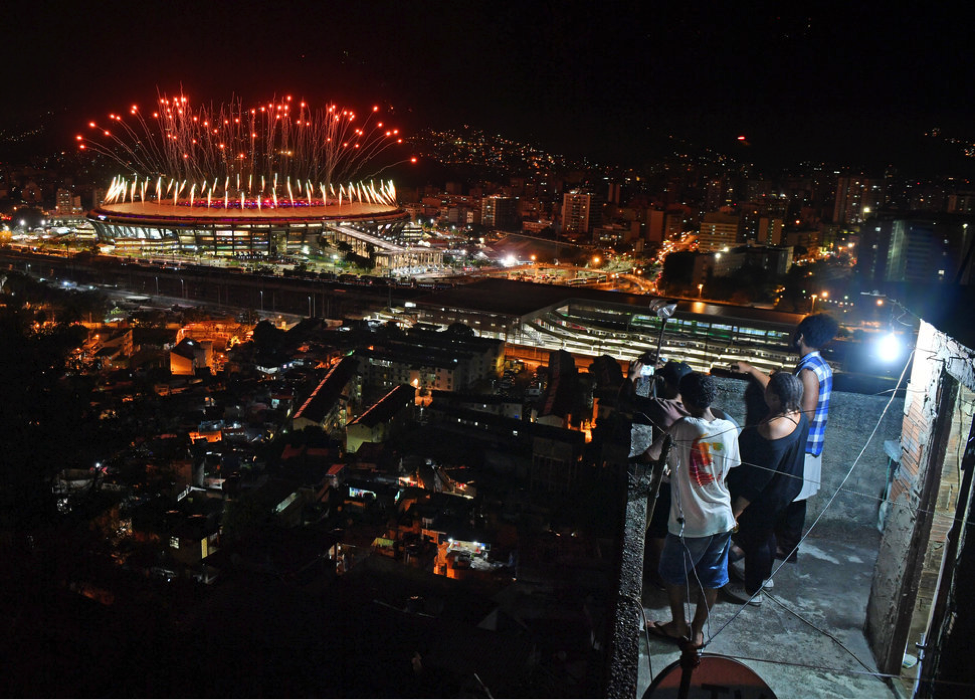
Watching
the opening ceremonies from the favelas – Andrej Isakovic via Getty Images
“A New World” for Favela Residents
While the world
has been preoccupied with Zika, the Brazilian corruption crisis, the cesspool
that is Guanabara Bay, and the worrying state of some of the sporting venues,
the displacement of persons is perhaps the largest problem not only facing the
Games, but is the largest one caused (or at least exacerbated) by the Games
themselves. Since Rio de Janeiro was selected to be the host of the Olympic
Games in 2009, over
77,000 individuals (22,000 families) have been evicted from their homes.
Most, if not all, of these individuals were evicted from their homes in the
favelas, or slums, communities that began to appear in earnest in the 1970s as
Brazil, and Rio de Janeiro in particular, began to urbanize. Currently, favelas
are home to 1.4
million people, or about 22% of Rio’s population. It is very likely that
not all of these evictions were related to the Games directly. City
officials have stated that only Vila Autodromo was directly-affected by the
Games, as this particular favela was turned into a parking lot for the Olympic
Park and twenty
homes for those who refused to leave (Reuters
provides a good before/after comparison).
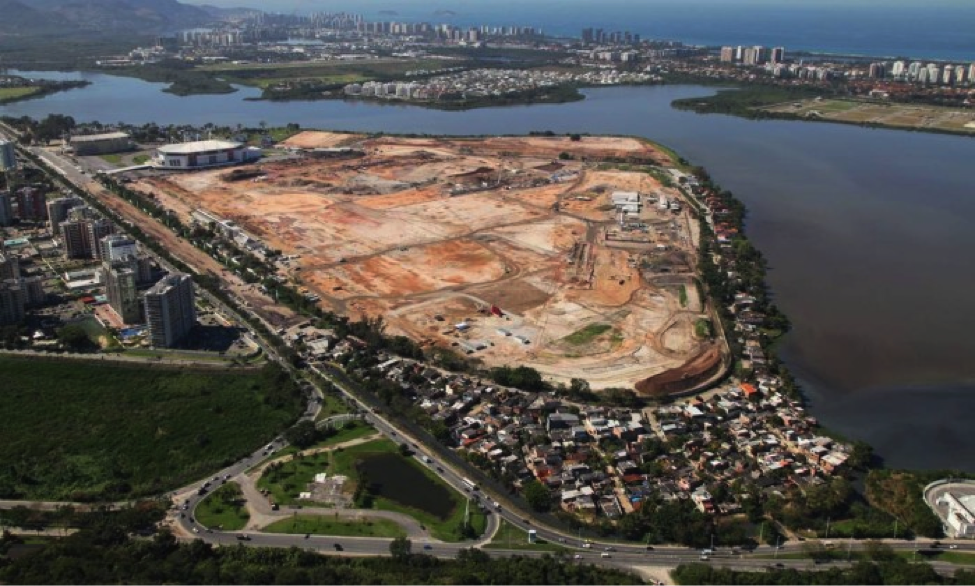
Vila
Autodromo (Olympic Park under construction) - Genilson Araújo / Parceiro/O Globo
However,
seemingly taking their cue from Rio 2016’s slogan, “Um mundo novo” (“A New
World”), city officials have used the Olympic Games as an excuse to
‘re-imagine’ the city on a broader scale. In a 2012 interview, the mayor of Rio
stated that “The
Olympics pretext is awesome; I need to use it as an excuse for everything…Now
all that I need to do, I will do for the Olympics. Some things could be really
related to the Games, others have nothing to do with them.” As such, people
from favelas that have nothing to do with the Games have been evicted from
their homes, with the Games creating the pseudo-state of ‘emergency’ that has,
in other cities that have hosted the Games, been used as an excuse to bypass normal procedures
and do away with normal protections, in the mold of Naomi Klein’s “shock
capitalism”.
The Rio
government has claimed to offer financial packages and resettlement options for
those who were displaced. These compensation packages were imperfect, as the
government offered less
than market value for the homes, and those who were relocated may have been
relocated anywhere from several
to dozens of kilometers away from their former residence, uprooting their
businesses or employment, and their social and family lives. However, the relocation
policy appears to be the velvet glove concealing the iron fist. For those who
resisted relocation, the city
cut off their water, and halted garbage pickup and postal service, while violent
clashes between residents and police have also been reported. While not
directly-related to evictions, but closely related to conditions in the favelas,
there has been a reported
spike in police killings of street children to “clean the streets” ahead of the
Games. While new housing is being built in Rio,
much of it is set to be high-end condos, not affordable housing.
International Standards Regarding Housing
The focus of
this particular blog post is not the legality of the displacement, per se. That is an issue best addressed
by Brazilian lawyers. However, there are international standards that Brazil
should live up to. The Universal Declaration of Human Rights recognises a right
to own property, and prohibits the arbitrary deprivation of property. Another
international instrument of wide application, the International Covenant on
Economic, Social, and Cultural Rights (ICESCR), recognises a right to an
adequate standard of living. The ICESCR Committee, in its General Comments in 1991 and 1997, has interpreted this
standard to include a right against forced evictions. If an eviction does
occur, rights to information and participation by those who are affected arise.
Finally, when an eviction does take place, a right to compensation and adequate
resettlement attaches.
The case of Rio
seems to suggest that forced evictions have likely occurred, based on the sheer
scale of those who were evicted. Given the timeline of preparing for the Games,
provisions on notice and information appear to have been curtailed or cancelled
altogether, given that the city went to work on evicting persons immediately
after Rio was awarded the right
to host the Games in 2009. While some residents, particularly of Vila
Autodromo, received compensation and alternative housing, in many cases there
appears to be disagreement as to whether compensation has been offered at all
with locals saying they have not received compensation, while city authorities deny
evicting families without compensation. Actions such as police raids, and
cutting off public services also suggest the evictions approach the threshold
of ‘forced’ rather than voluntary/negotiated. Regardless of whether the letter
of these international standards has been violated, the scope and pace of the
evictions is of great concern.
IOC Stance
Regarding Displacement
In particular,
it should be distressing to readers to see the International Olympic Committee
(IOC) seemingly stand by while these evictions occur in the name of the Games.
And it is not as if the IOC has no clue that evictions take place due to the
Games. For many Games, at least some displacement occurs to make way for
infrastructure, while the 2008 Beijing Games saw an estimated 1.25
million people evicted due to Olympic-related projects.
The IOC has
responded to the problems of displacement, pledging in 2009 to intervene with
the Organising Committee for the Olympic Games (the OCOG – the actual body that
is responsible for Games’ preparations) in situations
where people who were displaced due to Olympic venue construction were ‘mistreated’. However, the IOC has not said anything publicly in
regards to the evictions, and there is no public information regarding any IOC
intervention.
Following the
IOC’s Agenda 2020, and its recommendations on ‘social sustainability’, the
IOC now
requires cities bidding to host the Olympics to identify projects that may
require displacement of existing communities, and to confirm that the
procedures used to displace persons will conform to national and/or
international standards. However, promises made by host cities are not always
lived up to, as can be seen by Rio’s failed promises to treat 80% of the water
flowing into Guanabara Bay, and treating
only 21% on the eve of the Games. Rio is apparently also able to get away
with such failed promises consequence-free, despite the risk of harm to
athletes competing in and around the waters.
The Games Cannot
Fix All Ills, But They Should Avoid Creating New Ones…
Ultimately, the
largest problem with the Olympic Games is a lack of accountability. The IOC, an
organisation based in Switzerland, holds the rights to the Games and selects
the host city, but does not actually organise the Games. As such, the IOC often
appears to act as though what happens ‘on the ground’ is neither its concern
nor its responsibility. Those who actually organise the Games, particularly the
OCOG and Host City (the National Olympic Committee of the host country also
participates, but is not relevant here), often have limited accountability to
those who are harmed by the Games. The OCOG disbands shortly after the Games are
over, leaving the Host City holding the bag. The Host City’s accountability is
entirely dependent on the political and legal structures of the country, and in
countries like Russia (Sochi 2014, World Cup 2018), China (Beijing 2008,
Beijing 2022), but even in more established democracies, Host City officials
may have limited accountability.
Now is the time
that commentators jump up-and-down to shout that hosting the Olympic Games in a
single site would fix all of the problems. By placing the Games in Athens (no
permanent Winter Games host is ever suggested), there wouldn’t be a need to
host the Games in countries with questionable human rights records, or to watch
as every
single Olympic Games goes over-budget. However, rarely are suggestions made
as to who will pay for the infrastructure, which will likely need to be
periodically updated (it might be a bit hard for the Greek government to afford
it at this point), cope with the criticism that the Games would be cemented as
a Euro-centric enterprise, or the other problems that would arise with a
permanent host. The Olympic Games are going to continue to be held in countries
with imperfect human rights records (which would be pretty much all of them),
and in countries with poor human rights records.
All of this is
to say that the IOC needs to begin to actually enforce its ideals, and its own
mandate of ensuring an Olympic Games that is socially sustainable. The IOC and
the Olympic Games should not be the solution to human rights problems in a host
country, for they cannot be. However, the IOC does have a minimum moral
responsibility to ensure that the Olympic Games themselves are prepared for
with the utmost consideration for human rights. And the IOC already has the
powers to enforce this mandate through the Host City Contract, whether by
withholding money from the Host City, or at the most extreme end, by removing
the Games altogether. The IOC has also arguably set a precedent of withholding
its support for a country to host future sporting events as a result of the
Russian doping scandal, and it could do the same for Olympic host cities that
engage in practices that violate human rights in the name of the Games. Of
course, this is ultimately up to the IOC itself, barring pressure from states
or sponsors.
The Olympic
Games were never going to fix Brazil’s or Rio’s problems. Many of Rio’s
problems, including Zika, ongoing sanitation issues, corruption, and political
and economic instability, have little to no connection to the Games, and were
certainly not caused by the Games. In that vein, it is naïve to believe that
the Games could be anything more than a temporary papering-over of the deep
divisions in Brazilian society (for more on this point, I suggest reading Dave
Zirin’s book, Brazil’s Dance with the Devil). What
the Olympic Games can do is serve as an example of how to carry out a
socially-sustainable project in an emerging market economy. This applies not
only to the displacement of persons, but also to the treatment of those who
work on construction projects related to the Games (as opposed to the forced
labour used in Beijing and Sochi), the environmental sustainability of the
Games, and governmental policies and procedures that enhance accountability.
While the IOC has
made tentative steps to address these issues, as I have addressed before in
this space, it is insufficient. The IOC cannot solve all the world’s ills,
but it can at least ensure that the Games, carried out under its name, live up
to its own standards. The Rio Olympic
Games could have served as an example of how to carry out a
socially-sustainable project in an emerging market economy.
[1] Although
the Paralympics will arrive on 7 September, and while London 2012 did an
excellent job of promoting those Games it remains to be seen if Rio will follow
suit.