Asser International Sports Law Blog

Our International Sports Law Diary
The Asser International Sports Law Centre is part of the T.M.C. Asser Instituut

FFP for Dummies. All you need to know about UEFA’s Financial Fair Play Regulations.

Football-wise, 2014 will not only be remembered for the World Cup in Brazil. This year will also determine the credibility of UEFA’s highly controversial Financial Fair Play (FFP) Regulations. The FFP debate will soon be reaching a climax, since up to 76 European football clubs are facing sanctions by the UEFA Club Financial Control Body (CFCB). This large number of clubs includes two heavyweights: Manchester City and Paris Saint-Germain. On paper they face a potential disqualification from one or more editions of the UEFA Champions League. This would most certainly jeopardize the great ambition their billionaires-owners have for them and would vindicate FFP as a powerful mechanism capable of reigning in even the world’s richest football clubs. Whether this will indeed occur shall remain uncertain until the beginning of May, when UEFA is expected to announce the details of the (potential) disciplinary sanctions. However, in order to grasp the likely consequences of a sanction we offer you the definitive short introduction to FFP.

It is in the view of curtailing the, sometimes dramatic, losses made by an increasing number of football clubs, that UEFA’s Executive Committee decided to introduce the FFP Regulations in May 2010. The stated aims of FFP, stipulated in Article 2 of the Regulation include, inter alia, improving the economic and financial capability of the clubs; increasing their transparency and credibility; introducing more discipline and rationality in club football finances; encouraging clubs to operate on the basis of their own revenues; and protecting the long-term viability and sustainability of European club football. On UEFA’s own website a further aim was mentioned, namely to decrease pressure on salaries and transfer fees.

To achieve these aims, UEFA has introduced the break-even requirement[1]. By this requirement, clubs must demonstrate that their revenue exceeds or equals expenditure. The club’s spending on transfers and employee benefits (including wages) will be counted as expenditure, whereas income from gate receipts, TV revenue, advertising, merchandising, sales of players, and prize money is regarded as revenue. Any money spent on infrastructure, training facilities or youth development will not be included in the assessment.

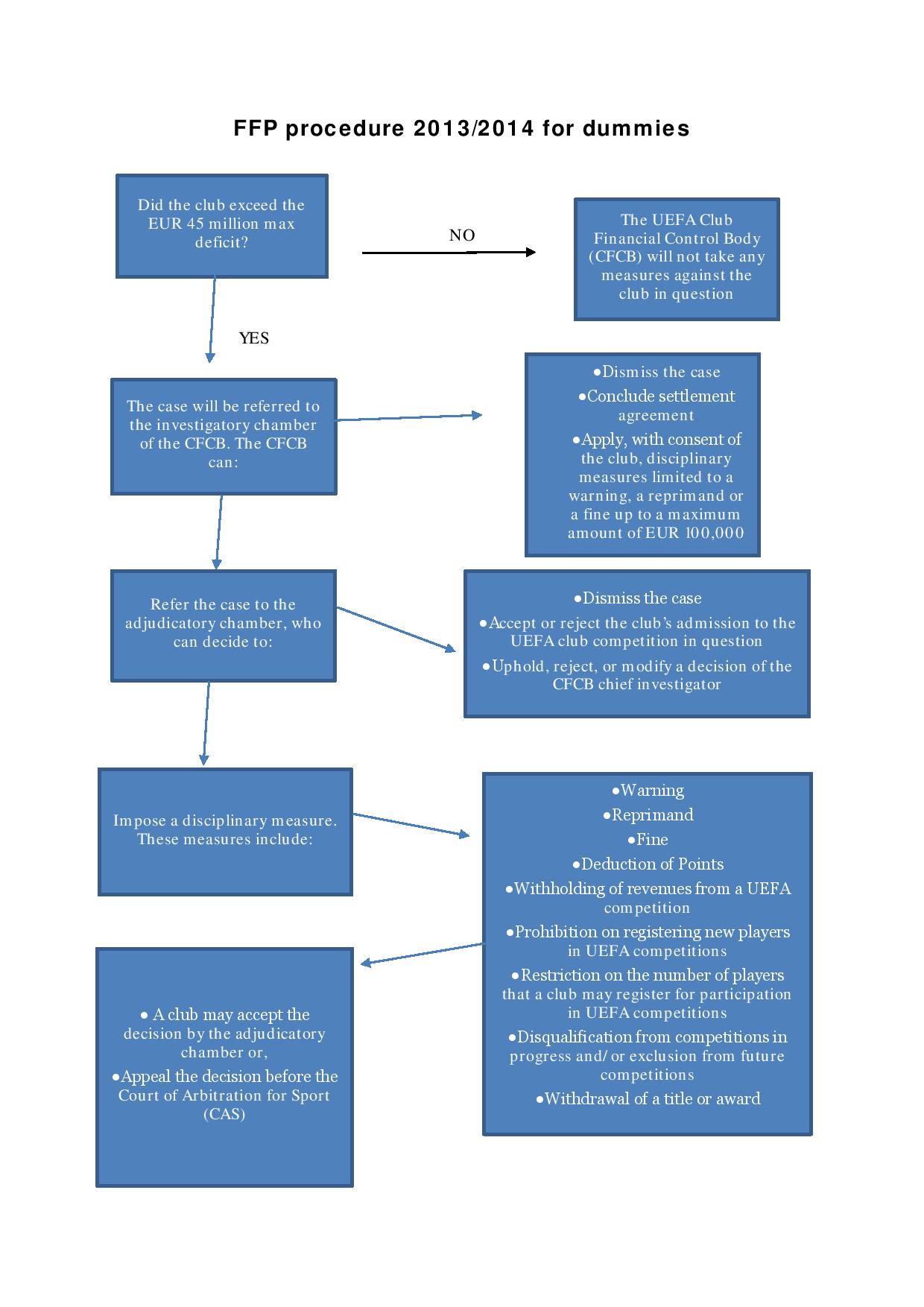
In accordance with article 68 of FFP Regulations and article 3 of the Procedural rules governing the UEFA Club Financial Control Body, the CFCB is competent to inter alia determine whether clubs fulfil the break-even requirement and impose disciplinary measures in the event of non-fulfilment of the requirement. A first assessment is undertaken by the investigatory chamber, which leads the monitoring process, the investigation proceedings, and collects evidence. At the end of the investigation, the CFCB chief investigator, Jean-Luc Dehaene, after having consulted with the other members of the investigatory chamber, may decide to: (a) Dismiss the case; (b) Conclude, with the consent of the club in question, a settlement agreement; (c) Apply, with the consent of the club in question, a disciplinary measure limited to a warning, a reprimand or a fine up to a maximum amount of EUR 100,000; or (d) Refer the case to the adjudicatory chamber.[2] It should be noted that this is the phase the 76 clubs find themselves in right now.

Should the investigatory chamber decide to refer the case to the adjudicatory chamber, then the adjudicatory chamber can decide to: (a) Dismiss the case; (b) Accept or reject the club’s admission to the UEFA club competition in question; (c) Impose disciplinary measures; or (d) Uphold, reject, or modify a decision of the CFCB chief investigator[3]. A final decision by the adjudicatory chamber will be made before the end of the current season at the latest.

Concerning more specifically the disciplinary measures, Article 29 of the Procedural rules provides a long list of potential measures including fines, deduction of points, withdrawal of a title or award and disqualification from competitions in progress and/or exclusion from future competitions. Undoubtedly, for teams like Manchester City and Paris Saint-Germain whose greatest ambition is to be successful in Europe’s most prestigious tournaments, a disqualification from European competitions would be the most severe disciplinary sanction possible.

Furthermore, the Procedural rules governing the UEFA Club Financial Control Body give the sanctioned party the possibility to appeal against the decision. The appeal should be launched in accordance with article 34 of the Procedural rules, which states that final decisions of the CFCB may only be appealed before the Court of Arbitration for Sport (CAS) in accordance with the relevant provisions of the UEFA Statutes.

Whether the CAS will have to pronounce itself on a specific case regarding FFP in the upcoming months will largely depend on the scope of the decisions adopted by the investigatory chamber later this week and then by the adjudicatory chamber in the upcoming month. The effectiveness, credibility and, more broadly, the future of the FFP Regulations are at stake. This is either the beginning of the end for FFP or the end of the beginning. 

A story to be continued…


[1] UEFA Club Licensing and Financial Fair Play Regulations. Edition 2012, Articles 58-63

[2] UEFA Procedural rules governing the UEFA Club Financial Control Body. Edition 2014, Articles 12-14

[3] Ibid, Article 27

Comments are closed
Asser International Sports Law Blog | Call for Papers - FIFA and Human Rights: Impacts, Policies, Responsibilities - 8 May 2019 - Asser Institute

Asser International Sports Law Blog

Our International Sports Law Diary
The Asser International Sports Law Centre is part of the T.M.C. Asser Instituut

Comments are closed
Asser International Sports Law Blog | The Evolution of UEFA’s Financial Fair Play Rules – Part 1: Background and EU Law. By Christopher Flanagan

Asser International Sports Law Blog

Our International Sports Law Diary
The Asser International Sports Law Centre is part of the T.M.C. Asser Instituut

The Evolution of UEFA’s Financial Fair Play Rules – Part 1: Background and EU Law. By Christopher Flanagan

Editor's Note: Christopher is an editor of the Asser International Sports Law Blog. His research interests cover a spectrum of sports law topics, with a focus on financial regulatory disputes, particularly in professional football, a topic on which he has regularly lectured at the University of the West of England.


It is five years since the Union of European Football Associations (UEFA) formally introduced ‘Financial Fair Play’ (FFP) into European football through its Club Licensing and Financial Fair Play Regulations, Edition 2012. With FFP having now been in place for a number of years, we are in a position to analyse its effect, its legality, and how the rules have altered over the last half decade in response to legal challenges and changing policy priorities. This article is split into three parts: The first will look at the background, context and law applicable to FFP; Part Two will look at the legal challenges FFP has faced; and Part Three will look at how FFP has iteratively changed, considering its normative impact, and the future of the rules.


Background

Certain aspects of FFP were incredibly controversial from the outset. To a neutral observer, this might seem confusing: FFP is, ostensibly, a set of rules designed to make sure clubs pay their bills on time, stay solvent, and do not need to look to external benefactors to cover their losses. Leading sports economist Stefan Szymanski described insolvency as “a chronic problem in the world of professional Association football”, so, superficially at least, a regulatory response to this would seem natural and appropriate. Where the market fails, it is the regulator’s duty to respond.

UEFA’s President at the time, Michel Platini, said “You, we, the fans and football lovers, have no interest in seeing clubs, the real heritage of European football, disappear due to risky management”. This is a sentiment with which most fans would agree.

Accordingly, UEFA incorporated FFP into its existing licensing requirements, meaning any club that wished to compete in a UEFA competition would be required to meet the financial standards set by FFP. These standards would be overseen and enforced by a new body within UEFA’s administration called the ‘Club Financial Control Body’. The Club Financial Control Body would be further segregated into an Investigatory Chamber and an Adjudicatory Chamber.

So, why the controversy? The contentious aspect of FFP was its ‘break even’ requirement. The ‘break even’ requirement is a de facto soft salary cap, tying the maximum amount a club can spend (with defined exceptions) to its revenue generation. An overview of the break even requirement as originally conceived can be found here. In essence, “The break-even result for a reporting period is calculated as relevant income less relevant expenses’’.[1] “Income” includes receipts such as gate receipts, sponsorship, broadcasting rights, commercial activities and player sales; “expenses” includes wages, the cost of purchasing players and the cost of finance.[2]

Crucially, when FFP was first introduced, losses could not be met or offset by equity participants (i.e. owners). This was pertinent to the prevailing financial climate in football, in which certain clubs across Europe were spending unprecedented sums with the support of wealth benefactors, who would cover the clubs’ losses. Such spending was seen at clubs such as Chelsea, Manchester City, Paris Saint Germain, Monaco, Malaga and Anzhi Makhachkala, with mixed results on and off the pitch.

Thus FFP was accused of calcifying football’s competitive hierarchy[3] and foreclosing smaller clubs from sporting and consequent business success. This debate has been played out over the last five years in the academic literature[4] and in various legal fora. The rules and the mechanisms for enforcing the rules have become increasingly sophisticated as the years have passed. UEFA, perhaps in response to these challenges, has made gradual, iterative changes to FFP that have seen the rules soften to accommodate exogenous equity input in defined permissible circumstances. These changes will be looked at in greater depth in Part Three.


The challenge of EU law

FFP has been described ‘legally fragile’, which is an apt description. This is because the rules cannot be said to be unquestionably permissible under European Union (EU) law; nor can they be said to be categorically in breach of EU law. The rules exist in a regulatory ‘grey’ area – FFP, in its particularly in its original, more restrictive, guise, may or may not have been illegal. This is a question for a competent (judicial) authority to decide; however, as will be discussed in more detail in Part Two, the route to such a decision has been far from straight forward, and in the intervening years, FFP has changed substantially.

The essential legal questions to determine the legality of FFP are:

  1. Does FFP breach EU competition law?
  2. Does FFP breach EU free movement law?
  3. Is there a sanctuary for any breach of EU law under the doctrine of the specificity of sport?


EU competition law

Article 101 of the Treaty of the Functioning of the European Union (TFEU) prohibits agreements that have as their object or effect “prevention, restriction or distortion of competition within the internal market”.[5] This puts regulatory associations such as UEFA in a difficult position. It is the very nature of regulation that competition is restricted or distorted; indeed, it is the very purpose of regulatory rules that participants subject to those rules alter their behaviour accordingly, which has an inevitable consequence on the competitive landscape.

Consideration should also be given to Article 102 TFEU, which prohibits undertakings (and in some circumstances collections of undertakings, i.e. oligopolies) that are in a dominant position from abusing their market dominance.

In view of this friction, the European courts have developed, through the case of Wouters, the concept of regulatory ancillarity.[6] This is the doctrine under which, subject to a test of proportionality, reasonability and necessity, even in circumstances where there is a prima facie breach of competition law by a regulatory body (in that particular case by the Dutch Bar Association), this may be permissible under EU competition law where the regulatory body in question “could reasonably have considered that that regulation, despite the effects restrictive of competition that are inherent in it, is necessary for the proper practice of the [relevant profession]”.

The applicability of Wouters to a sporting regulatory context is confirmed and clarified in the landmark Meca-Medina case. In considering whether a regulatory rule breaches competition law, the European courts must determine: 

  1. Whether the rules are necessary for the proper conduct of the sport;
  2. Whether the penalties are inherent to the restrictions in questions; and
  3. Whether the effects of the rules are proportionate to the aims pursued.

Should UEFA be unable to meet the test under the regulatory ancillarity doctrine, there is an alternative exemption with a lower threshold to which it could look. Within Article 101(3) TFEU, there is an exemption for agreements which promote “technical or economic progress, while allowing consumers a fair share of the resulting benefit” as long as such restrictions do not (a) impose on the undertakings concerned restrictions which are not indispensable to the attainment of these objectives; or (b) afford such undertakings the possibility of eliminating competition in respect of a substantial part of the products in question.

It is open to UEFA to argue that FFP dampens inflation in football in a way that is for the improvement of the game and passes a benefit to ‘consumers’ (i.e. fans) by, for example, reducing the need for ticket price increases to sustain escalating players’ wages. This would perhaps be difficult for UEFA to establish, but the economics of FFP are complicated and second order effects should be borne in mind.


EU free movement – workers, services and/or capital 

The EU is built upon certain deeply enshrined freedoms. These include the free movement of workers (Article 45 TFEU), the free movement of services (Article 56 TFEU), and the free movement of capital. Any agreement that acts as an impediment to these freedoms is susceptible to a finding of illegality.

In order to be permissible under EU law, any rule or agreement that restricts any fundamental freedom must be:

  1. Justified by a necessary objective in the general interest;
  2. Suitable for achieving that objective; and
  3. Proportionate.

In the case of sporting rules, the European courts have determined that the rule in question must not “go beyond what is necessary for achieving the aim pursued”,[7] which is to reiterate that it must be proportionate – a recurrent theme in considering the legality of rules made by the governing bodies of sport, such as UEFA.

The criteria to be met by UEFA in establishing that FFP does not breach EU fundamental freedoms is in line with the threshold to be met in establishing compliance with EU competition law: FFP must be necessary, suitable and proportionate.

However, in the case of free movement law, it is far from obvious that FFP will have a substantive impact on fundamental freedoms. In previous writing on the subject, I have made the following analogy:

The restriction does not emanate from the rule per se, rather by the size of the club’s turnover; players are no more restricted from moving between clubs by FFP than this author is denied a Ferrari by his credit rating.[8]


The specificity of sport under EU law

In the event that a competent adjudicative authority makes a prima facie finding that FFP is in breach of EU competition law or EU free movement law, there is still a possibility of an overall finding that FFP is not illegal under the doctrine of the specificity of sport; however, this would require the adjudicative body in question to row back considerably from the current position, and general trajectory, of the level of latitude granted to the governing bodies of sport by the European courts.

The concept of specificity will be familiar to all those with an interest in sports law and policy. It is the hypothesis under which, at its starkest interpretation, suggests governing bodies, not courts (or governments or other legislative bodies), are best placed to determine how sport should be run. Sports, it is argued, should have rule making autonomy. A more moderate view on specificity holds that due regard should be paid to the idiosyncrasies of the sports sector and the legitimate governance function played by governing bodies. 

The role of sports governing bodies, whose rules, as was the case with FFP, are often enacted in a broadly consensual way, with engagement, input and consent from key stakeholders, should be acknowledged and some due reverence should be paid to governing bodies' ability to regulate the sporting aspects under their aegis.

Indeed, the European Union had no express competence to in respect of sport until the introduction of Article 165 TFEU, a soft competency, which states that, “The Union shall contribute to the promotion of European sporting issues, while taking account of the specific nature of sport, its structures based on voluntary activity and its social and educational function.”

However, the distinction between elite football as being ‘purely sport’ and elite football as a business has become blurred in to the point of being indistinguishable; and the EU clearly has express competence to deal with business.

The general trend in decisions of the European courts has been to circumscribe self-determination by the governing bodies of sport. Through cases such as Bosman,[9] Meca-Medina, and Bernard,[10] the European courts have made it clear that sport cannot avoid or cherry-pick the applicability of EU law. This is acutely relevant in the case of FFP, which, after all, deals with how football clubs are run financially. There are obvious sporting consequences to this, but it is difficult to characterise FFP as anything other than a rule restrictive of the business of sport.

UEFA’s position on Article 165 is that “while sport is not ‘above the law’, there is now a provision in the Treaty itself recognising that sport cannot simply be treated as another ‘business’, without reference to its specific characteristics”. This is not an unreasonable position; sport is a unique industry in which, unlike other industries, the survival of competitors is important for any given club to flourish. Perhaps the courts could be persuaded that a carve-out based on specificity should be applicable to FFP – but this would require a seismic change of direction.

So it is incredibly unlikely that specificity as a discrete sui generis doctrine would give sanctuary to FFP were the rules deemed to be otherwise in breach of EU law. However, facts peculiar to the football industry (i.e. its specificity) should be considered as part of an assessment as to whether FFP is a proportionate mechanism to pursue UEFA’s objectives. As noted above, proportionality is a limb of the tests for derogations to EU competition and fundamental freedom law.

I have previously commented that: 

For football clubs, there is a strong correlational link between spending money and playing success. This has encouraged clubs to risk financial vulnerability in pursuit of improved match results, despite the mathematical impossibility of all clubs being able to improve their fortunes on the field. This innate instability has resulted in persistent insolvencies despite the remarkable growth in turnover seen in the professional game. Regrettably, when balance sheets weaken, the risk of insolvency increases; and once a club becomes insolvent, its survival is subject to the predilections of its creditors. The game’s governing bodies should aim to militate against…this volatility.

UEFA would doubtless argue that, given the specific nature of the industry it regulates, instituting a soft salary cap such as that implemented by FFP is a proportionate response. In that sense at least, the specificity of sport might be of consideration in the legality of FFP.


Conclusion 

It is difficult to say with any degree of conclusiveness whether FFP is legal or not. There are strong arguments either way. The marginal nature of the legal position has been problematic for UEFA and has undoubtedly led to the legal challenges to FFP over the last five years, which are discussed in greater depth in Part Two of this series.

The uncertain legal position, and the challenges generated by that lack of clarity has also, in all likelihood, shaped UEFA’s policy decisions as FFP has evolved in the years since its inception. These are discussed in Part Three of this series.

FFP has certainly been fertile ground for debate, and will likely continue to be so until such a time as there has been a determinative, binding view of its legality. When or whether this will happen remains to be seen.


[1] Annex X, Club Licensing and Financial Fair Play Regulations, Edition 2012.

[2] Ibid.

[3] Thomas Peeters and Stefan Szymanski , 'Financial Fair Play in European Football ' [2014] 29(78) Economic Policy 343-390

[4] See, for example, Serby, T. (2016) The state of EU sports law: lessons from UEFA’s ‘Financial Fair Play’ regulations, International Sports Law Journal 16(1–2):37–51; Flanagan, C (2013) A tricky European fixture: an assessment of UEFA’s Financial Fair Play regulations and their compatibility with EU law, International Sports Law Journal 13(1):148; Lindholm, J (2010) The Problem with Salary Caps Under European Union Law: The Case Against Financial Fair Play, Texas Review of Entertainment and Sports Law, Vol. 12.2, pp. 189-213

[5] Noting that UEFA certainly constitute an association of undertakings in the relevant legal sense, see for example Case T-193/02 Piau (2005) ECR I-209, (2005) 5 CMLR 42 or EU Commission decision 2003/778/EC, 23 July 2003, Case COMP C.2-37.398 - Joint selling of the commercial rights of the UEFA Champions League §§ 106-107

[6] As identified and defined by Whish and Bailey in Competition Law (OUP, 8th)

[7] Case C-176/96, Jyri Lehtonen and Castors Canada Dry Namur- Braine ASBL v Fédération Royale Belge des Sociétés de Basketball ASBL (FRBSB) ECR (2000) I-2681

[8] Flanagan, C (2013) A tricky European fixture: an assessment of UEFA’s Financial Fair Play regulations and their compatibility with EU law, International Sports Law Journal 13(1).

[9] Case C-415/93 Union Royale Belge des Socie ́te ́s de Football Association ASBL v Jean-Marc Bosman (1995) ECR I-4921.

[10] C-325/08 Olympique Lyonnais v Olivier Bernard and Newcastle United FC (2010) ECLI:EU:C:2010:143.

Comments are closed
Asser International Sports Law Blog | The Evolution of UEFA’s Financial Fair Play Rules – Part 2: The Legal Challenges. By Christopher Flanagan

Asser International Sports Law Blog

Our International Sports Law Diary
The Asser International Sports Law Centre is part of the T.M.C. Asser Instituut

The Evolution of UEFA’s Financial Fair Play Rules – Part 2: The Legal Challenges. By Christopher Flanagan

The first part of this series looked at the legal framework in which FFP sits, concluding that FFP occupied a ‘marginal’ legal position – perhaps legal, perhaps not. Given the significant financial interests in European football – UEFA’s figures suggest aggregate revenue of nearly €17 billion as at clubs’ 2015 accounts – and the close correlation between clubs’ spending on wages and their success on the field,[1] a legal challenge to the legality of FFP’s ‘break even’ requirement (the Break Even Requirement), which restricts a particular means of spending, was perhaps inevitable.

And so it followed.

Challenges to the legality of the Break Even Requirement have been brought by football agent Daniel Striani, through various organs of justice of the European Union and through the Belgian courts; and by Galatasaray in the Court of Arbitration for Sport. As an interesting footnote, both Striani and Galatasaray were advised by “avocat superstar” Jean-Louis Dupont, the lawyer who acted in several of sports law’s most famous cases, including the seminal Bosman case. Dupont has been a vocal critic of FFP’s legality since its inception.


Mr Striani’s Complaints

Initially, Mr Striani made a complaint to the European Commission to the effect that the Break Even Requirement breached European competition law, and that it restricts several fundamental freedoms of the European Union guaranteed by the Treaty of the Functioning of the European Union (TFEU); namely, the right to free movement of people (Article 45 TFEU), the right to free movement of capital (Article 56 TFEU), and the right to free movement of services (Article 63 TFEU).

In his complaint to the Commission, Mr Striani identified five anti-competitive effects of the Break Even Requirement:

  1. It restricts external investment into football;
  2. It will have the effect of calcifying the hierarchy of the game, preventing ‘small’ clubs from competing at higher levels;
  3.  It will depress the transfer market;
  4.  It will depress players’ wages; and
  5. It will therefore adversely affect players’ agents’ revenue.

Superficially at least, each point above has merit and internal logic. Equally, there are coherent rebuttals. For balance, some (of the various) potential counter arguments are listed below:

  1. From the outset, FFP has not altogether restricted exogenous investment into football and loss making (regardless of quantum) has been permissible for certain expenditure. Rather than restricting investment, FFP funnels loss-making investment in certain directions such as stadium and infrastructure spending.
  2. There is little movement in football’s sporting hierarchy under any model. The evidence suggests that those clubs who spend the most on wages tend to experience the most success on the pitch;[2] however, it is questionable whether there is inherent merit in supplanting the clubs that are best able to maximise revenue generation with those that have the owners most willing to fund losses. Under either model, those with the most money to expend on players’ wages will usually win.[3]
  3. It is reductive to equate a healthy, functioning transfer market with clubs’ rights to make losses; nor is it of intrinsic value to the sport for transfers to be significant in magnitude, whether in cost or volume.
  4. Owners’ equity inputs are far from the only source of salary growth. In any event, further consideration should be given as to whether, if a deflationary effect can be established, this is a function of the top end of the salary scale being depressed reducing mean salary, or whether the impact is felt by in modal or median salary. Ultimately, FFP could depress wages on an aggregate basis but still benefit most players should median or modal wages improve in a more financially stable environment.
  5. Players’ intermediaries may not have a sufficiently proximate interest in the financial regulatory aspects of clubs’ spending. UEFA’s rule-making power is given effect and legitimacy by way of complex contractual relationship between players, clubs and the sport’s governing bodies and intermediaries do not have privity of contract with UEFA insofar as FFP is concerned.

Mr Striani also brought a claim, on similar legal basis, in the Belgian national courts (Mr Striani being based in Belgium). In part because of these collateral proceedings, the Commission rejected Mr Striani’s complaint. In a press release, Mr Dupont confirmed that the Commission had given its view to the effect that Mr Striani, being an agent and therefore not directly subject to FFP, lacked a legitimate interest in the rules, and that the Belgian national courts, already having been seized of the case, were a suitable forum for a hearing of the merits.

Mr Striani was joined by various other parties in his claim in the Belgian courts. However, Mr Striani (along with his co-complainants) was again frustrated on technical grounds outwith the substantive issues of his dispute.  The Belgian court found that it did not have jurisdiction to hear the dispute, because, to put it simply, under the relevant jurisdictional rules (the Lugano Convention), UEFA was entitled to be sued in the courts of its place of domicile, i.e Switzerland. Ben van Rompuy goes into more detail on the jurisdictional nuances here.

Somewhat oddly, given its self-proclaimed jurisdictional incompetence, the Belgian Courts did make an order referring the case to the Court of Justice of the European Union (CJEU).

Perhaps unsurprisingly, the CJEU rejected the referral on the basis that it was “manifestly inadmissible,” and also “observing that the national court had failed to provide any of the necessary information to enable the European Court to address European competition law issues.”[4]

This puts Mr Striani’s complaint into no man’s land. Rejected by the Commission; rejected by the Belgian national courts; and rejected by the CJEU; all without any substantive adjudicative decision as to the legality of the Break Even Requirement. Irrespective of one’s views on FFP, it is a source of frustration that five years on from FFP’s introduction, its legality remains an unresolved question despite vigorous and not frivolous challenge. Mr Striani’s challenges have, to date, proven impotent in settling the (increasingly academic) debate.

Evidently frustrated at the Commission’s refusal to formally review the legality of FFP, Mr Striani went on to make a complaint to the EU Ombudsman alleging maladministration by Vice President of the Commission at the material time, Joaquín Almunia. The complaint centred on Mr Almunia’s association with Athletic Bilbao and his prior statements perceived as endorsing FFP. However, the Ombudsman found no maladministration to have occurred. 


Galatasaray’s CAS Appeal

There is, however, a forum in which a decision has been made as to the legality of the Break Even Requirement; namely the Court of Arbitration for Sport (CAS) in Galatasary v UEFA (CAS 2016/A/4492). Galatasaray, like Mr Striani, were represented by Mr Dupont; and, like Mr Striani, the basis of Galatasaray’s case was that the Break Even Requirement breached EU competition law and illegally trammelled EU fundamental freedoms as to workers, services and capital.

The context of the dispute was as follows: Galatasaray was investigated by the UEFA Club Financial Control Body (CFCB), which, as mentioned in Part One, oversees and enforces adherence to FFP, in respect of a potential breach of FFP, and in particular the Break Even Requirement. The procedural rules governing the CFCB allow clubs to enter into a ‘settlement agreement’ at the discretion and direction of the CFCB Chief Investigator.

The CFCB Chief Investigator determined that Galatasaray had breached the Break Even Requirement and a settlement agreement was reached that provided, inter alia, that the Turkish club must “be break even compliant…at the latest in the monitoring period 2015/16,” and that the club must not increase its aggregate wage bill, which stood at €90m.

Galatasaray hopelessly failed to meet either stipulation, increasing their wage bill by €5.5m and exceeding the acceptable deviation figure in Break Even Requirement by €134.2m. These figures were audited and verified by independent consultants.

In view of this egregious breach of the settlement agreement, the Investigatory Chamber referred Galatasaray to the Adjudicatory Chamber, who, on 2 March 2016, issued a decision ordering, inter alia, that Galatasaray reduce their wage bill to a maximum of €65m over the next two FFP reporting periods, and banning the club from any European competitions for which they otherwise qualified on sporting merit for the next two seasons.

Galatasaray appealed this decision to the CAS, arguing that the sanctions levied by UEFA were illegal because the rules on which they were based, i.e. the FFP rules, were illegal.

If the basis of Galatasaray’s appeal (breach of competition law, breach of fundamental freedoms) is familiar to those with a knowledge of the legal issues FFP presents, so too will be UEFA’s defence of the Break Even Requirement. UEFA argued that the Break Even Requirement constitutes rules that “are prudential rules necessary for the proper functioning of football clubs,” and “Any restriction they may cause pursues legitimate governance objectives and is proportionate to their achievement.”[5] (Emphasis added.) 

UEFA’s view is clearly intended to align FFP with the legal tests identified in Part One of this series; namely that FFP must be:

  1. Necessary (for the proper conduct of the sport);
  2.  Suitable (as a means to pursue that necessary objective); and
  3. Proportionate (to the aims pursued).

Applicability of EU Law

The non-application of EU law by the CAS has previously been called ‘an absurdity’ by this blog “in light of the Bosman (and prior Walrave) case law of the CJEU, which made clear that EU law is applicable to the regulations of Sports Governing Bodies”.

In this case, UEFA postulated that EU law was “irrelevant” to the dispute – the parties both being from Turkey and Switzerland respectively, i.e. nations outside of the EU – but “did not argue” that FFP is “not subject to the invoked provisions of EU law or can be applicable even if contrary to these provisions.”[6] Galatasaray argued that EU law applied as FFP constitutes mandatory rules in EU territory. The parties agreed that Swiss law applied.

The CAS panel of arbitrators (the Panel) found that EU law, being a foreign mandatory rule, applied pursuant to Article 19 of the Swiss Federal Act on Private International Law, under which arbitral tribunals must consider foreign mandatory rules where:

i.       such rules belong to a special category of norms which need to be applied irrespective of the law applicable to the merits of the case;

ii.      there is a close connection between the subject matter of the dispute and the territory where the mandatory rules are in force; and

iii.    in view of Swiss legal theory and practice, the mandatory rules must aim to protect legitimate interest and crucial values and their application must lead to a decision which is appropriate.


The Panel found that this test had been met on the facts in this instance. As an interesting side note, the CAS also followed this line of reasoning in the subsequent Third Party Ownership case discussed by Antoine Duval here.

Article 101 TFEU

The first hurdle for Galatasaray in establishing the illegality of the Break Even Requirement is to show that it fits within the boundaries of the prohibition laid down in Article 101 TFEU, i.e. that it has as its object or effect the prevention, restriction or distortion of competition within the European internal market.

The Panel found that FFP did not have anti-competitive intent as its object. On its face, this seems a reasonable conclusion; after all, FFP is not intended to stymie inter-club competition. However, it should not be treated as axiomatic. As Weatherill has highlighted, “UEFA’s own website (though not the FFP Regulations themselves) identify as one of the principal objectives to decrease pressure on salaries and transfer fees and limit inflationary effect”. Whether such effect was an independent goal of UEFA in instituting FFP rather than mere political bluster is open to question, but the objectives of UEFA should be subject to further interrogation.

In this instance, the Panel found that Galatasaray “failed to demonstrate that the object of [FFP] would not be stated in its Article 2 [dealing with FFP objects]”. Having considered the question, the Panel “did not find convincing evidence that the object of [FFP] would be to distort competition, i.e. to favour of disfavour certain clubs rather than to prevent clubs from trading at levels above their resources”.

Thus in order to be caught within the prohibition under Article 101 TFEU, Galatasaray would need to show that FFP had an anti-competitive effect. As FFP did not fall within the examples given in the Commission’s guidance on anti-competitive agreements (horizontal/vertical), the burden of proof fell on Galatasaray to demonstrate FFP’s anti-competitive effects.

They did not do so. However – and frustratingly for those with an interest in the topic – Galatasaray did not actually adduce any detailed empirical analysis as to the effects of FFP on competition (para. 74).

Irrespective of the lack of empirical evidence put forward, the Panel expressed a view that “competition is not distorted by ‘overspending’” (para. 76); nor does FFP ossify the structure of the market as “dominant clubs have always existed and will continue to exist”. The latter point is superficially correct; however, it fails to address the fact that the Break Even Requirement may have prevented clubs from entry to the ‘dominant club’ position of superiority. 

The Panel went on to cite with approval the applicability of the carve-out for regulatory rules developed in Wouters, as discussed in more detail in Part One of this series.

Article 102 TFEU

Galatasaray produced evidence that UEFA was a dominant undertaking (which, given UEFA is a governing body with total authority over the rules of elite European football, is a case easily made), but it did not show how it was abusing its position in the case of FFP. Thus the Panel found that Galatasaray did not demonstrate an abuse of dominance by UEFA.

Fundamental Freedoms

Galatasaray argued that the Break Even Requirement violated fundamental freedoms of the EU as to the free movement of workers, the free movement of capital, and the free movement of services. However, it submitted “very little argumentation” in support of these claims (para. 85).

The Panel highlighted the fact that FFP does not discriminate based on nationality, as the rules apply equally to all clubs participating in UEFA competitions; that the rules apply equally to “domestic operations” (para. 86); and “do not restrict fundamental freedoms: players can be transferred (or offer services cross-border without limitations; capitals can move from a EU country to another without any limit.”

Ergo, the Panel found Galatasaray had not shown any breach of a fundamental freedom of the EU.

Swiss Law

Galatasaray did not invoke the relevant provisions of Swiss competition law in detail; however, the Panel noted that the substantive nature of Swiss competition law was analogous to EU competition law, diverging only in respect of reference to the domestic market. Accordingly, the Panel’s reasoning “would be the same” (para. 89). 

The CAS’s Finding

Galatasaray did not establish its case and as such its appeal was not upheld by the CAS and the CFCB’s decision was confirmed. UEFA successfully defended the first hearing on the substantive legal issues of the Break Even Requirement. 


An Illusory Victory for UEFA?

UEFA may have successfully fended off a binding determination of the legal issues at play in challenges brought in domestic and European courts, albeit on procedural grounds; and it may have won the first serious challenge to the substantive legal issues at play in the CAS, albeit aided by a lack of proper particularisation of some of the issues by Galatasaray; but it is debatable whether it was able to altogether insulate FFP from the effect of these challenges. In the years since its inception, the nature and content of the rules has gradually shifted towards a more liberal approach to external investment, and in all probability this was influenced by the vehemence of the legal challenges to the rules.

At the outset of Mr Striani’s challenge to FFP, his lawyer, Mr Dupont, said "What my client hopes is that Uefa will be forced to review this rule and go for more proportionate alternatives”.  He may not have achieved this through a favourable determination of the courts; however, as will be examined in greater detail in Part Three of this series, he may have ultimately been successful in his objectives to some extent.


[1] See, for example, Kuper, S and Szymanski, S 2012 Soccernomics 2nd ed. London: HarperSport at p14

[2] See Kuper, S and Szymanski, S 2012 Soccernomics 2nd ed. London: HarperSport

[3] It should be noted, however, that Mr Dupont has argued that a flat salary cap – in many ways more restrictive than the Break Even Requirement – would be preferable, see Stefano Bastianon, 'The Striani Challenge to UEFA Financial Fair-Play A New Era after Bosman or Just a Washout?' [2015] 11(1) The Competition Law Review 7-39 at p18

[4] Daniel Geey, LawInSport and BASL Sport Law Year Book 2015 - 2016 (Sean Cottrell ed, LawInSport 2016) at p108

[5] Para 50

[6] Para 39

Comments are closed
Asser International Sports Law Blog | A Question of (dis)Proportion: The CAS Award in the Luis Suarez Biting Saga

Asser International Sports Law Blog

Our International Sports Law Diary
The Asser International Sports Law Centre is part of the T.M.C. Asser Instituut

A Question of (dis)Proportion: The CAS Award in the Luis Suarez Biting Saga

The summer saga surrounding Luis Suarez’s vampire instincts is long forgotten, even though it might still play a role in his surprisingly muted football debut in FC Barcelona’s magic triangle. However, the full text of the CAS award in the Suarez case has recently be made available on CAS’s website and we want to grasp this opportunity to offer a close reading of its holdings. In this regard, one has to keep in mind that “the object of the appeal is not to request the complete annulment of the sanction imposed on the Player” (par.33). Instead, Suarez and Barcelona were seeking to reduce the sanction imposed by FIFA. In their eyes, the four-month ban handed out by FIFA extending to all football-related activities and to the access to football stadiums was excessive and disproportionate. Accordingly, the case offered a great opportunity for CAS to discuss and analyse the proportionality of disciplinary sanctions based on the FIFA Disciplinary Code (FIFA DC). 


I.               Admissibility: Can FC Barcelona join the appeal?

As a preliminary matter, FIFA was contesting the right of FC Barcelona to take part in the appeal against the decision. The Panel judged that “in light of the specific circumstances of the case, taking into account the impact of the specific sanction imposed, the Panel finds that the Club is sufficiently affected by the Appealed Decision and that the Club has a tangible interest of financial and sporting nature at stake” (par. 47). In other words, “in a case where the FIFA authorities are issuing a sanction against a player and such sanction affects direct financial interests of a club, such club must have the possibility to appeal (within the applicable deadline) such decision in order to be able to protect its legal interests, even if this interests became actual after the challenged decision was issued” (par.48). In short, the right to appeal to CAS is extended to the club of the player, even when he is not party to the original proceedings.


II.             Merits: Is it the right sanction?

a.     The applicability of Art. 57 FIFA DC

The first problem raised was “whether the actions of the Player at the Match constitute […] an unsporting behaviour to be sanctioned […] under art. 57 FIFA DC” (par.69). The club and the player were invoking various well-known principles of criminal law (ne bis in idem and nulla poena sine lege certa) against it, but the arbitrators decided to reject these objections (par.70-74). Interestingly, the Panel held that “it is not necessary for the principles of predictability and legality to be respected that the football player should know, in advance of his infringement, the exact rule he may infringe, as well as the measure and kind of sanction he is liable to incur because of the infringement”. Furthermore, “[t]he fact that the competent body applying the FIFA DC has the discretion to adjust the sanction mentioned in the rules deemed applicable to the individual behaviour of a player breaching such rules is not inconsistent with those principles” (par.73). Yet, the Panel was also of the opinion that “the wording of art. 57 FIFA DC shows that this provision contains a mere general clause, trying to cover all possible conducts against fair play, which are not yet covered by other articles, or “consumed” by the application of any other provision, of the FIFA DC”. Hence, “to the extent the action of biting (in the circumstances in which it occurred at the Match) falls within the scope of art. 48 par. 1 lit. d) FIFA DC (as all the parties concede), since the kinds of “assaulting” therein described (“elbowing, punching, kicking”) are expressly not exhaustive (“... etc.”), the same action could not be comprised in the scope of art. 57 FIFA DC, even though the Player’s assaulting in the case at hand, being a misconduct, is also against fair play”. Thus, “the punishment of the Player is already and fully covered by the application of art. 48 par. 1 lit. d) FIFA DC – with no room left for art. 57 FIFA DC, wrongly applied by the FIFA disciplinary bodies” (par.77). In short, article 48 par. 1 lit. d) FIFA DC is deemed the lex specialis to art. 57 FIFA DC. Therefore, “any sanction going beyond those allowed by art. 48 par. 1 lit. d) FIFA DC would be inappropriate to the peculiarities of the case and would be disproportionate” (par.78).

b.     The existence of mitigating factors and aggravating circumstances

The claimants argued that the FIFA disciplinary bodies did not take in account the mitigating factors and wrongfully assumed aggravating circumstances. The Panel rebuts this line of thinking. Indeed, regarding “the question of the relevance to be given to the Player’s remorse as a mitigating factor, the Panel, looking at the non-contested facts and the Parties’ allegations, finds that the margin of discretion the FIFA Appeal Committee had to judge this case was not exceeded, and that it was correctly exercised” (par.81). The arbitrators find that “the remorse of an offender can hardly be given any weight when the same offender had in precedent occasions committed the same infringement and in those occasions had already expressed its remorse and pledged not to repeat that infringement” (par.83). Moreover, “the remorse and apologies shown by the Player after having already been sanctioned cannot have the same impact as a remorse expressed immediately after the event and before any disciplinary proceeding is started and/or sanction is imposed” (par.83). Additionally, “the disciplinary bodies could take into account the fact that the Player had already committed in two preceding occasions the very same infringement, and irrespective of the level (national) of the competition in which they had occurred” (par.87). Thus, the Panel is of the view that the discretion granted to the FIFA Appeal Committee by art.39 par. 4 FIFA DC in weighing the mitigating factors and aggravating circumstances was properly exercised (par.90). The sanction against Luis Suarez is not based on an erroneous analysis of the factual situation. Indeed, remorse can only come into play if immediately voiced, while the concept of recidivism should be interpreted widely as including a similar wrongdoing in the framework of any football competition. 

c.      The proportionality of the ban

The key argument raised by the appellants against the length (and nature) of the FIFA sanctions imposed on Luis Suarez concerned the proportionality of the sanctions (par.91-108). In that regard, FC Barcelona and Suarez argued that “the biting of the Player is not an act of extreme violence and that there was no damage or injury caused to the opposing player, as he was able to continue to play without medical assistance” (par.93), while FIFA dismissively stated that “CAS should not correct any of its decisions if it is not considered to be “evidently and grossly disproportionate to the offence”” (par.94). The Panel rejected both analyses. On the one hand, it held that “biting is absolutely foreign to football and therefore to be considered as a sort of aggravated assault” and “the fact that the opposing player was not injured could not be considered a mitigating factor in the case at hand “(par.95). However, on the other hand, it also held that “the Player is responsible (only) for the violation of art. 48 par. 1 lit. d) FIFA DC” (par.96). Therefore, “the four (4) month ban on taking part in any football-related activity and the prohibition of entering the confines of any stadiums, not allowed for a violation of art. 48 par. 1 lit. d) FIFA DC, could not be applied” (par.96). Nevertheless, due to its specific nature as an intentional assault, the biting “deserves a sanction well above the minimum level of a two match suspension and a fine indicated as such in art. 48 FIFA DC” (par.97).

In conclusion, “the Panel finds that the four (4) month ban of the Player on taking part in any football-related activity and the prohibition of entering the confines of any stadiums are not contemplated by art. 48 par. 1 lit. d) FIFA DC, and are also not appropriate to the infringement committed by the Player on the pitch” (par.104). Moreover, “the FIFA Disciplinary Committee and the FIFA Appeals Committee did not take into consideration that with the four (4) months ban of the Player on taking part in any football-related activity and from entering the confines of any stadiums, the Player actually was prohibited to train with a team and keep his fitness in order to be ready to start playing for the Club after and above this four (4) month ban” (par.105). Furthermore, “this prohibition appears to impact, without any legitimate justification in the case at hand, on the general possibility for the Player to derive profits from his image as football player – beyond the simple participation in football matches” (par.105). Besides, “no justification was offered in the Appealed Decision (beyond a generic reference to the gravity of his actions) in support of the specific sanction of the stadium ban– a measure usually imposed to hooligans, which in the case of the Player does not seem to pursue any legitimate purpose” (par.106). In light of all of this, the Panel decides “to replace the sanction of the prohibition on exercising any football-related activity for four (4) months with the sanction of a match ban (applicable to official matches played at any level) for the same period” (par.107). 


Conclusion

Luis Suarez is long back on the pitch and the practical relevance of this discussion is very limited for his future career. Yet, interesting insights can be derived from this award. Litigants in disciplinary cases involving FIFA will be interested to know that a Club, even if it is not directly part to a dispute in front of FIFA’s disciplinary bodies, might have a legitimate right to appeal a decision rendered against one of its players. More importantly, the systematic interaction between article 48 and 57 FIFA DC has been clarified. Article 48 FIFA DC constitutes a lex specialis to article 57 FIFA DC and, thus, both cannot be applied cumulatively to sanction a player more heavily. This is not to say that a very peculiar offense, like the one at hand, will not face a tough sanction. Nonetheless, a sanction imposing a drastic stadium or football-related activity ban, threatening the player’s ability to derive any revenues from his work, will be deemed disproportionate unless it is thoroughly justified. This is a clear warning not only to FIFA’s disciplinary bodies but also to any Sports Governing Body: the harsher you get, the stronger the supporting reasoning must be.

Comments are closed