The Pechstein ruling
of the
Oberlandesgericht (OLG) München rocked the sports arbitration world earlier
this year (see our initial commentary of the decision here and a longer version here). The decision has been appealed to the German
Bundesgerichtshof (BGH), the highest German civil court, and the final word on
the matter is not expected before 2016. In any event, the case has the merit of
putting a long-overdue reform of the Court of Arbitration for Sport (CAS) back
on the agenda. The last notable reform of the structure and functioning of the
CAS dates back to 1994, and was already triggered by a court ruling, namely the
famous Gundel case of the Swiss Federal Tribunal
(SFT). Since then, the role of the CAS has shifted and its practical
significance has radically changed (the growth of CAS’s caseload has been exponential). It has become the most visible
arbitration court in Switzerland in terms of the number of awards appealed to
the SFT, but more importantly it deals with all the high-profile disputes that
arise in global sport: think, for instance, of Pistorius, the recent Dutee Chand decision or the upcoming FIFA
elections.More...
Editor's note:
Dr
Borja
García joined the School of Sport, Health and Exercise Sciences at Loughbourough University in January
2009 as a Lecturer in Sport Management and Policy. He holds a PhD in Politics,
International Relations and European Studies from Loughborough University
(United Kingdom), where he completed his thesis titled ‘The European Union and
the Governance of Football: A game of levels and agendas’.
In
this leafy and relatively mild autumn, we are celebrating two important
anniversaries. Recently, we just passed ‘Back to the Future day’, marking the
arrival of Marty McFly to 2015. In a few weeks, we will be commemorating the
20th anniversary of the Bosman ruling. Difficult to decide which
one of the two is more important. As we move well into the 21st century’s
second decade, these two dates should mark a moment to consider innovation.
They are perhaps occasions to take stock and reflect how much sport has evolved
to reach this new future… or not. More...
Editor's note:
Gesa Kuebek holds an LLM and graduated from the University of Bologna, Gent and Hamburg as part of the Erasmus Mundus Master Programme in Law and Economics and now work as an intern for the Asser Instituut.
On Monday, 9 November,
the German Football Association (DFB) announced in a Press Release the
resignation of its head, Wolfgang Niersbach, over the 2006 World Cup
Affair. In his statement, Niersbach argued that he had “no
knowledge whatsoever” about any “payments flows” and is now being confronted
with proceedings in which he was “never involved”. However, he is now forced to
draw the “political consequences” from the situation. His resignation occurred
against the backdrop of last week’s raid of the DFB’s Frankfurt headquarters
and the private homes Niersbach, his predecessor Theo Zwanziger and
long-standing DFB general secretary Horst R. Schmidt. The public prosecutor’s
office investigates a particularly
severe act of tax evasion linked to awarding the 2006 World
Cup. The 2006 German “summer fairy-tale” came under pressure in mid-October
2015, after the German magazine “Der Spiegel”
shocked Fußballdeutschland by
claiming that it had seen concrete evidence proving that a €6.7 million loan,
designated by the FIFA for a “cultural programme”, ended up on the account of
Adidas CEO Robert-Louis Dreyfuß. The magazine further argued that the money was
in fact a secret loan that was paid back to Dreyfuß. Allegedly, the loan was
kept off the books intentionally in order to be used as bribes to win the 2006
World Cup bid. The public prosecutor now suspects the DFB of failing to
register the payment in tax returns. German FA officials admit that the DFB
made a “mistake” but deny all allegations of vote buying. However, the current
investigations show that the issues at stakes remain far from clear, leaving
many questions regarding the awarding of the 2006 World Cup unanswered.
The present blog
post aims to shed a light on the matter by synthetizing what we do know about
the 2006 World Cup Affair and by highlighting the legal grounds on which the
German authorities investigate the tax evasion. More...
Introduction: The new WADA Code 2015
Day 1: The impact of the revised World Anti-Doping Code on the work of National Anti-Doping Agencies
Day 2: The “Athlete Patient” and the 2015 World Anti-Doping Code: Competing Under Medical Treatment
Day 3: Proof of intent (or lack thereof) under the 2015 World Anti-Doping Code
Editor's note
Mike Morgan is the founding partner of Morgan Sports
Law LLP. His practice is focused exclusively on the sports sector. He
advises on regulatory and disciplinary issues and has particular experience
advising on doping and corruption disputes.
Mike acted on behalf of National Olympic Committees at
three of the last four Olympic Games and has represented other sports bodies,
clubs and high profile athletes in proceedings before the High Court, the FIFA
Dispute Resolution Chamber, the American Arbitration Association and the Court
of Arbitration for Sport. More...
Introduction: The new WADA Code 2015
Day 1: The impact of the revised World Anti-Doping Code on the work of National Anti-Doping Agencies
Day 2: The “Athlete Patient” and the 2015 World Anti-Doping Code: Competing Under Medical Treatment
Day 4: Ensuring proportionate sanctions under the 2015 World Anti-Doping Code
Editor's note
Howard Jacobs is solo practitioner in the Los Angeles
suburb of Westlake Village, California. Mr. Jacobs
has been identified by various national newspapers and publications as one of
the leading sports lawyers in the world. His law practice focuses on the
representation of athletes in all types of disputes, with a particular focus on
the defense of athletes charged with doping offenses.Mr. Jacobs has represented numerous
professional athletes, Olympic athletes, world record holders, and
amateur athletes in disputes involving doping, endorsements, unauthorized use
of name and likeness, salary issues, team selection issues, and other
matters. He is at the forefront of many cutting edge legal issues that
affect athletes, winning cases that have set precedents that have benefited the
athlete community. More information is available at www.athleteslawyer.com. More...
Introduction: The new WADA Code 2015
Day 1: The impact of the revised World Anti-Doping Code on the work of National Anti-Doping Agencies
Day 3: Proof of intent (or lack thereof) under the 2015 World Anti-Doping Code
Day 4: Ensuring proportionate sanctions under the 2015 World Anti-Doping Code
Editor's Note
Marjolaine Viret: An attorney-at-law at the Geneva bar, specialising in sports and health law. Her doctoral work in anti-doping was awarded a summa cum laude by the University of Fribourg in early 2015. She gained significant experience in sports arbitration as a senior associate in one of Switzerland’s leading law firms, advising clients, including major sports federations, on all aspects of anti-doping. She also holds positions within committees in sports organisations and has been involved in a variety of roles in the implementation of the 2015 WADC. Her book “Evidence in Anti-Doping at the Intersection of Science & Law” is scheduled for publication in 2015.
Emily Wisnosky: An attorney-at-law admitted to the California bar, she currently participates in the WADC 2015 Commentary research project as a doctoral researcher. She also holds an LLM from the University of Geneva in International Dispute Settlement, with a focus on sports arbitration. Before studying law, she worked as a civil engineer. More...
Introduction: The new WADA Code 2015
Day 2: The “Athlete Patient” and the 2015 World Anti-Doping Code: Competing Under Medical Treatment
Day 3: Proof of intent (or lack thereof) under the 2015 World Anti-Doping Code
Day 4: Ensuring proportionate sanctions under the 2015 World Anti-Doping Code
Editor's note
Herman Ram is the Chief Executive Officer of the Anti-Doping Authority the Netherlands, which is the National Anti-Doping Organization of the country. He has held this position since 2006. After working twelve years as a librarian, Herman Ram started his career in sport management in 1992, when he became Secretary general of the Royal Netherlands Chess Federation. In 1994, he moved on to the same position at the Netherlands Badminton Federation. He was founder and first secretary of the Foundation for the Promotion of Elite Badminton that was instrumental in the advancement of Dutch badminton. In 2000 he was appointed Secretary general of the Netherlands Ski Federation, where he focused, among other things, on the organization of large snowsports events in the Netherlands. Since his appointment as CEO of the Anti-Doping Authority, he has developed a special interest in legal, ethical and managerial aspects of anti-doping policies, on which he has delivered numerous presentations and lectures. On top of that, he acts as Spokesperson for the Doping Authority. Herman Ram holds two Master’s degrees, in Law and in Sport Management. More...
Day 1: The impact of the revised World Anti-Doping Code on the work of National Anti-Doping Agencies
Day 2: The “Athlete Patient” and the 2015 World Anti-Doping Code: Competing Under Medical Treatment
Day 3: Proof of intent (or lack thereof) under the 2015 World Anti-Doping Code
Day 4: Ensuring proportionate sanctions under the 2015 World Anti-Doping Code
On
1 January, a new version of the World Anti-Doping Code (WADC or Code) entered
into force. This blog symposium aims at taking stock of this development and at
offering a preliminary analysis of the key legal changes introduced. The
present blog will put the WADC into a more general historical and political
context. It aims to briefly retrace the emergence of the World Anti-Doping
Agency (WADA) and its Code. It will also reconstruct the legislative process
that led to the adoption of the WADC 2015 and introduce the various
contributions to the blog symposium.More...
Editor's note
Zlatka Koleva is a graduate from the Erasmus University Rotterdam and is currently an Intern at the ASSER International Sports Law Centre.
The decision on appeal in the case
of O’Bannon v. NCAA seems,
at first sight, to deliver answers right on time regarding the unpaid use of
names, images and likenesses (NILs) of amateur college athletes, which has been
an ongoing debate in the US after last year’s district court decision that
amateur players in the college games deserve to receive compensation for their
NILs.[1]
The ongoing struggle for compensation in exchange for NILs used in TV
broadcasts and video games in the US has reached a turning point and many have
waited impatiently for the final say of the Court of Appeal for the 9th
circuit. The court’s ruling on appeal for the 9th circuit, however,
raises more legitimate concerns for amateur sports in general than it offers
consolation to unprofessional college sportsmen. While the appellate court
agreed with the district court that NCAA should provide scholarships amounting
to the full cost of college attendance to student athletes, the former rejected
deferred payment to students of up to 5,000 dollars for NILs rights. The
conclusions reached in the case relate to the central antitrust concerns raised
by NCAA, namely the preservation of consumer demand for amateur sports and how
these interests can be best protected under antitrust law. More...
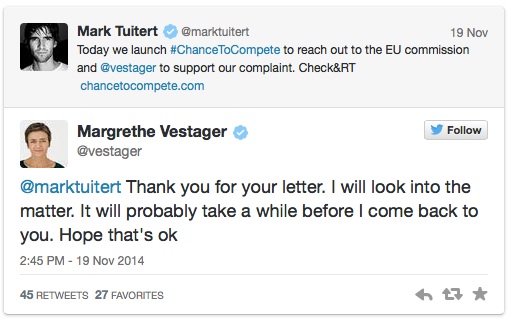
In June 2014, two prominent Dutch speed skaters, Mark Tuitert
(Olympic Champion 1500m) and Niels Kerstholt
(World Champion short track), filed a competition law complaint against the
International Skating Union (ISU) with the European Commission.
ChanceToCompeteTwitter.png (50.4KB)
Today, the
European Commission announced that it has opened a
formal antitrust investigation into International Skating Union (ISU) rules
that permanently ban skaters from competitions such as the Winter Olympics and
the ISU World and European Championships if they take part in events not organised
or promoted by the ISU. The Commissioner for Competition, Margrethe Vestager, stated that the Commission "will
investigate if such rules are being abused to enforce a monopoly over the
organisation of sporting events or otherwise restrict competition. Athletes can
only compete at the highest level for a limited number of years, so there must
be good reasons for preventing them to take part in events."
Since
the case originates from legal advice provided by the ASSER International
Sports Law Centre, we thought it would be helpful to provide some
clarifications on the background of the case and the main legal issues at
stake. More...