Asser International Sports Law Blog

Our International Sports Law Diary
The Asser International Sports Law Centre is part of the T.M.C. Asser Instituut

Free Webinar - The impact of the Diarra case on the football transfer system - 18 October 2024 - 15:00 CET

The Court of Justice of the European Union has recently handed down its judgement in the Lassana Diarra case (C-650/22 FIFA v. BZ).

Given the importance of this case to the sports industry, LawInSport, the Asser Instituut and the Association for the Study of Sport and the EU (Sport & EU) are hosting a joint webinar to bring together experts to unpack and provide clarity on the complex legal, regulatory & commercial issues stemming from this case. This free webinar will be hosted from 14:00 UK time (15:00 CET) on 18 October 2024.


Register HERE 


Speakers

Our expert speakers come from academia, law and sport. Our confirmed speakers are:


Register HERE 

Conference - ISLJ Annual Conference 2024 - 24-25 October - Asser Institute - The Hague

On 24 and 25 October 2024, the Asser Institute in The Hague will host the 2024 edition of the  International Sports Law Journal (ISLJ)  Conference. The ISLJ is the leading academic journal in transnational sports law and governance and is proud to provide a platform for transnational debates on the state of the field. The conference will address a number of issues of interest to the ISLJ and its readers. 

Register HERE

Drivers and effects of reform in transnational sports governance 

Transnational sports governance seems to be in a permanently unstable state of crisis and reform. At regular interval, international sports governing bodies face scandals triggered by corruption investigations or human rights violations, as well as adverse judidicial decisions. These are often followed by waves of institutional reforms, such as the creation of new bodies (E.g. the Athletics Integrity Unit), the adoption of new codes and regulation (such as Codes of Ethics) or human rights commitments (e.g. FIFA and the IOC’s Human Rights Policy/Strategy). This dynamic of crisis and reform will be at the heart of this year’s ISLJ conference, as a number of panels will critically investigate the triggers, transformative effects and limited impacts of reforms in transnational sports governance.  

Football in the midst of international law and relations 
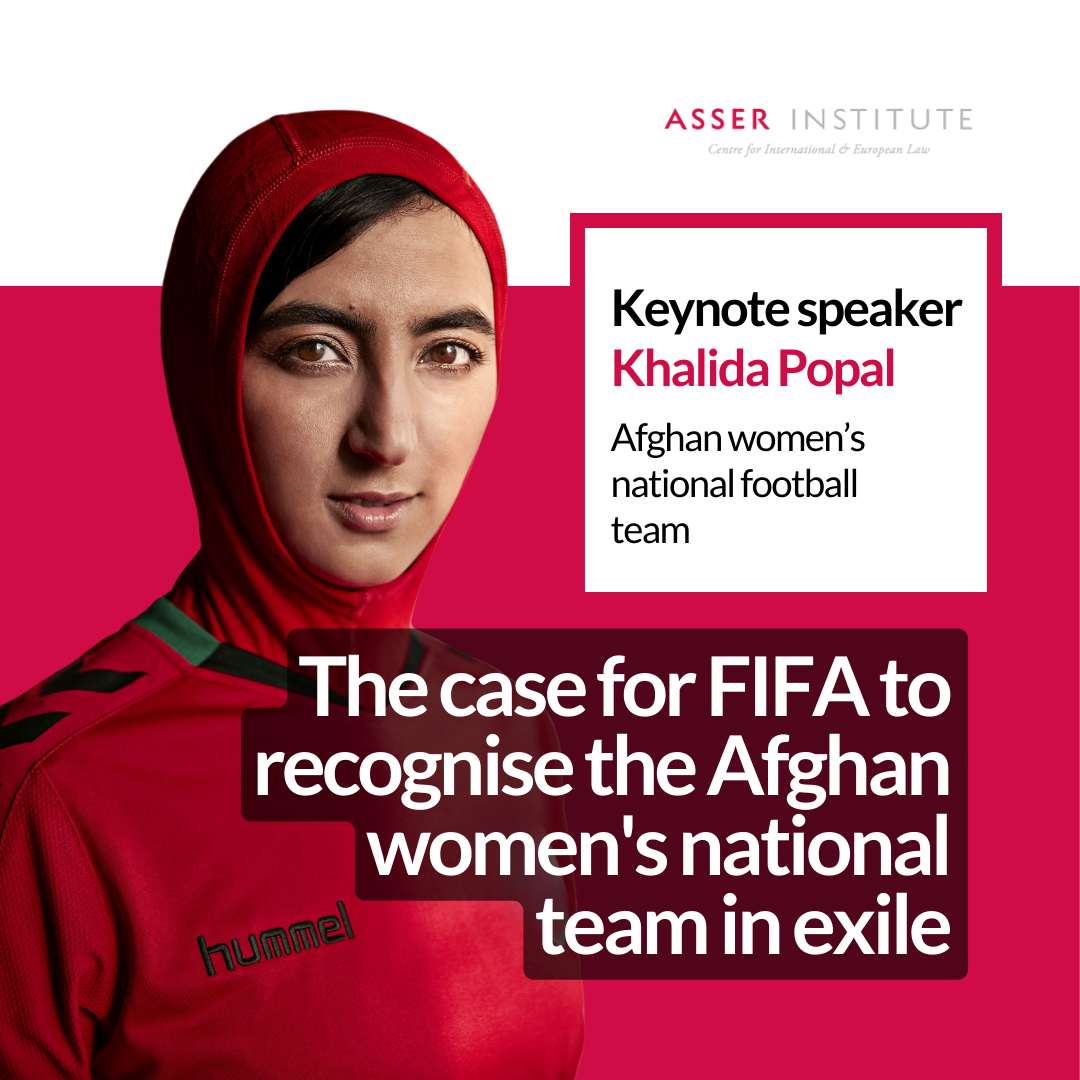
As the war in Gaza and Russia’s invasion of Ukraine continue to rage, it has become even clearer that the football world can hardly be entirely abstracted from international relations. Yet, FIFA and UEFA continue to insist on their neutrality and to deny that their governance is (or should be) affected by the world’s political affairs. During the conference, we will engage with case studies in which football is entangled with international politics and law. In particular, the speakers will delve into the role of FIFA and UEFA in such situations and on the legal standards and processes that should be applied throughout their decision-making.  

Olympic challenges of today and tomorrow 
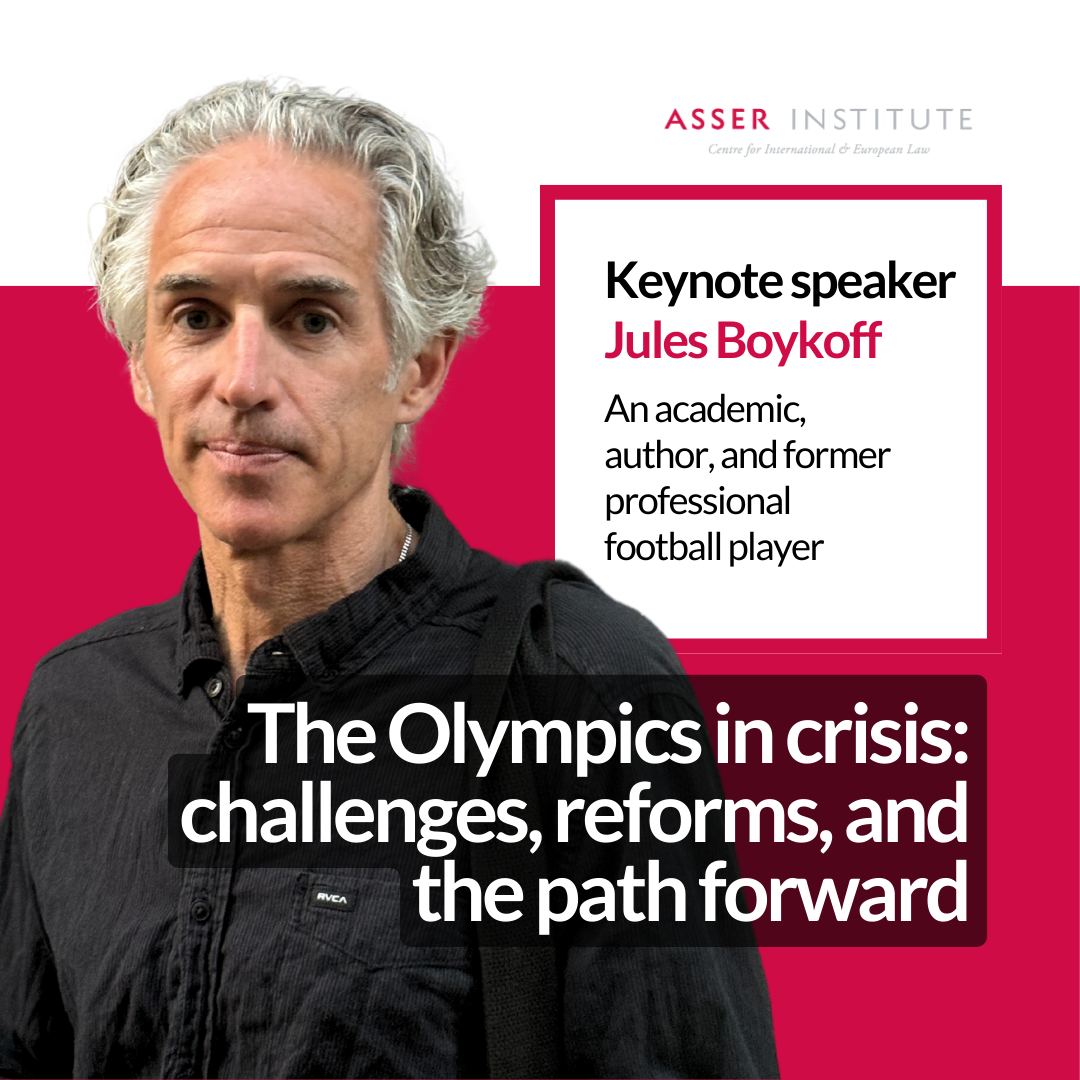
While the Paris 2024 Olympics have come to a close, the legal questions they have raised are far from exhausted. Instead, the Olympics have highlighted new issues (such as the question of the legality of the hijab ban imposed by the French Federation on its athletes) or old ones (such as the question whether Olympians should be remunerated by the IOC or the international federations), which will be discussed by our speakers. Finally, with the help of our keynote speaker, Prof. Jules Boykoff, a longstanding critique of the current Olympic regime, we will explore the IOC’s capacity to adapt to challenges while resisting radical change to the current model of olympism.   

Download the full programme 

Online participation available 
Following the success of our webinar option in the past years, we are once again allowing online participation to the conference at an affordable price. Thus, we hope to internationalise and diversify our audience and to reach people who are not in a position to travel to The Hague.  

We look forward to welcoming you in person in The Hague or digitally to this new iteration of the ISLJ conference. 

Register HERE

Speakers 


Register HERE

Conference - Empowering athletes’ human rights: Global research conference on athletes’ rights - Asser Institute - 23 October

The newly launched ‘Global Sport and Human Rights Research Network’, an initiative jointly hosted by the T.M.C. Asser Instituut and the Centre for Sport and Human Rights, together with the European Union-funded project ‘Human Rights Empowered Through Athletes Rights (H.E.R.O.)' is organising an in-person conference on October 23 at the Asser Institute in The Hague, to map the field of athletes' rights and engage in critical discussions on protection of these rights and how to prevent rights violations.

The one-day conference will kick off with a presentation by the H.E.R.O. team on their research results, followed by a short panel discussion. The rest of the day will be filled with four panels on different aspects related to the topic of athletes’ human rights, with speakers from academic institutions around the world.

Check out the full programme HERE and register for free HERE

undefinedundefined

Co-funded by the European Union logo in png for web usage

Luxembourg calls…is the answer from Nyon the way forward? Assessing UEFA’s response to the ECJ’s ISU judgment - By Saverio Spera


Editor's note: Saverio P. Spera is an Italian qualified attorney-at-law. He has practiced civil and employment law in Italy and briefly worked at the Asser International Sports Law Centre before joining FIFA in 2017. Until May 2024, he has worked within the FIFA legal division - Litigation Department, and lectured in several FIFA sports law programmes. In the spring of 2024 he has co-founded SP.IN Law, a Zurich based international sports law firm.


On 21 December 2023 a judicial hat-trick stormed the scene of EU sports law. That day, the European Court of Justice (the “ECJ”) issued three decisions: (i) European Superleague Company, SL v FIFA and UEFA (Case C-333/21); (ii) UL and SA Royal Antwerp Football Club v Union royale belge des sociétés de football association ASBL (Case C-680/21)and (iii) International Skating Union (ISU) v. European Commission – Case C-124/21.

These judgments were much scrutinised (see herehere and here) in the past 6 months. For the reader’s relief, this paper will not venture into adding another opinion on whether this was a fatal blow to the foundation of EU sports law or if, after all, the substantive change is minimal (as persuasively argued here). It will analyse, instead, UEFA’s recent amendments of its Statutes and Authorisation Rules governing International Club Competitions (the “Authorisation Rules”) and whether these amendments, clearly responding to the concerns raised in the ISU judgment with respect to the sports arbitration system,[1] might pave the way for other Sports Governing Bodies (SGBs) to follow suit and what the implications for CAS arbitration might be. More...

The International Cricket Council and its human rights responsibilities to the Afghanistan women's cricket team - By Rishi Gulati

Editor's note: Dr Rishi Gulati is Associate Professor in International Law at the University of East Anglia (UK) and Barrister in Law. He has a PhD from King’s College London, Advanced Masters in Public International Law from Leiden University, and a Bachelor of Laws from the Australian National University. Amongst other publications, he is the author of Access to Justice and International Organisations (Cambridge University Press, 2022). He has previously worked for the Australian Government, has consulted for various international organizations, and regularly appears as counsel in transnational cases.

On 1 December 2024, Jay Shah, the son of India’s powerful Home Minister and Modi confidante Amit Shah, will take over the role of the Independent Chair of the International Cricket Council (ICC). This appointment reflects the influence India now has on the governance of cricket globally. A key test Jay Shah will face is whether or not the ICC should suspend the Afghanistan Cricket Board (ACB) from its membership as Afghanistan no longer maintains a women’s cricket team contrary to the organization’s own rules, as well as its human rights responsibilities. More...

Women’s Football and the Fundamental Right to Occupational Health and Safety: FIFA’s Responsibility to Regulate Female Specific Health Issues - By Ella Limbach

Editor's noteElla Limbach is currently completing her master’s degree in International Sport Development and Politics at the German Sport University Cologne. Her interests include human rights of athletes, labour rights in sport, the intersection of gender, human rights and sport and the working conditions in women’s football. Previously, she graduated from Utrecht University with a LL.M in Public International Law with a specialization in International Human Rights Law. This blog was written during Ella's internship at the Asser Institute where she conducted research for the H.E.R.O. project. The topic of this blog is also the subject of her master's thesis.

Women’s football has experienced exponential growth over the past decade, though the professionalization of the women’s game continues to face barriers that can be tied to the historical exclusion of women from football and insufficient investment on many levels. While attendance records have been broken and media coverage has increased, the rise in attention also highlighted the need for special accommodations for female footballers regarding health and safety at the workplace. Female footballers face gender specific circumstances which can have an impact on their health such as menstruation, anterior cruciate ligament (ACL) injuries and the impact of maternity. As the recent ILO Brief on ‘Professional athletes and the fundamental principles and rights at work' states “gender issues related to [occupational health and safety] risks are often neglected (p. 23).” While it could be argued that from a human rights point of view article 13(c) of the Convention on the Elimination of Discrimination of Women stipulates “the right to participate in […] sports [on an equal basis to men],” reality shows that so far practices of men’s football were simply applied to women’s football without taking into consideration the physiological differences between male and female players and the implications that can have for female players’ health. The ILO Declaration on Fundamental Principles and Rights at Work(ILO Declaration, amended in 2022) includes “a safe and healthy working environment” as one of the fundamental rights at work (Art. 2e). This begs the question whether the scope of the right to occupational health and safety at the workplace includes the consideration of female specific health issues in women’s football. More...

[Call for Papers] - International Sports Law Journal - Annual Conference - Asser Institute, The Hague - 24-25 October 2024 - Reminder!

The Editors of the International Sports Law Journal (ISLJ) invite you to submit abstracts for the next edition of the ISLJ Conference on International Sports Law, which will take place on 24 and 25 October 2024 at the Asser Institute in The Hague. The ISLJ, published by Springer and TMC Asser Press, is the leading academic publication in the field of international sports law and the conference is a unique occasion to discuss the main legal issues affecting international sports and its governance with renowned academic experts.

We welcome abstracts from academics and practitioners on all issues related to international and transnational sports law and their impact on the governance of sport. We also welcome panel proposals (including a minimum of three presenters) on specific issues of interest to the Journal and its readers. For this year’s edition, we specifically invite submissions on the following themes and subthemes:


Reformism in transnational sports governance: Drivers and impacts

  • Legal and social drivers of reforms in transnational sports governance   
  • The role of strategic litigation (before the EU/ECtHR/National courts) as a driver of reform;
  • The role of public/fan pressure groups on clubs, competition organisers and governments as a driver of change.
  • The impact of internal reforms in transnational sports governance: Cosmetic or real change? (e.g. IOC Agenda 2020+5, FIFA governance reforms, CAS post-Pechstein changes, WADA sfter the Russian doping scandal)
  • Emerging alternatives to private sports governance – the UK’s Independent Football Regulator.


The organization and regulation of mega sporting events: Current and future challenges 

  • Mega-sporting events as legalized sites of digital surveillance 
  • Greening mega-sporting events (e.g. carbon neutral pledges, environmental footprints of events, the impact of multiple hosting sites)
  • Mega-sporting events and the protection of human rights and labour rights (e.g. Paris 2024 Social Charter, Euro 2024 human rights commitments)
  • The Olympic Games and athletes’ economic rights (remuneration/advertisement)
  • Reviews of the legal issues raised at Euro 2024 in Germany and the Paris 2024 Olympic Games
  • Previews of the legal issues likely to have an impact on the FIFA 2026 World Cup and the Milano-Cortina 2026 Winter Olympic Games


Please send your abstract of 300 words and CV no later than 15 July 2024 to a.duval@asser.nl. Selected speakers will be informed by 30 July.

The selected participants will be expected to submit a draft of their paper by 1 October 2024. Papers accepted and presented at the conference are eligible for publication in a special issue of the ISLJ, subject to peer-review. 

The Asser Institute will provide a limited number of travel & accommodation grants (max. 300€). If you wish to be considered for a grant, please explain why in your submission.


[New Event] Feminist theory and sport governance: exploring sports as sites of cultural transformation - 9 July -15:00-17:00 - Asser Institute


This seminar is part of the Asser International Sports Law Centre's event series on the intersection between transnational sports law and governance and gender. Dr Pavlidis will present her take on feminist theories and sport governance by exploring sports and in particular Australian rules football and roller derby as sites of cultural transformation.

Register HERE

Australian rules football is Australia's most popular spectator sport and for most of its history it has been a men's-only sport, including in its governance and leadership. This is slowly changing. Roller derby on the other hand has been reinvented with an explicitly DIY (Do It Yourself) governance structure that resists formal incorporation by 'outsiders'. This paper provides an overview of sport governance in the Australian context before focusing in on these two seemingly disparate sport contexts to explore the challenges of gender inclusive governance in sport.

Dr Adele Pavlidis is an Associate Professor in Sociology with the School of Humanities, Languages and Social Science at Griffith University in Australia. She has published widely on a range of sociocultural issues in sport and leisure, with a focus on gender and power relations. Theoretically her work traverses contemporary scholarship on affect, power and organisations, and she is deeply interested in social, cultural and personal transformation and the entanglements between people, organisations, and wellbeing.

We look forward to hearing Dr Pavlidis present on this topic, followed by reflections and comments by Dr Åsa Ekvall from the Erasmus Center for Sport Integrity & Transition, and Dr Antoine Duval from the T.M.C. Asser Institute. There will also be a Q&A with the audience.

Download the latest programme here 

Register HERE


[Call for papers] - International Sports Law Journal - Annual Conference - Asser Institute, The Hague - 24-25 October 2024

The Editors of the International Sports Law Journal (ISLJ) invite you to submit abstracts for the next edition of the ISLJ Conference on International Sports Law, which will take place on 24 and 25 October 2024 at the Asser Institute in The Hague. The ISLJ, published by Springer and TMC Asser Press, is the leading academic publication in the field of international sports law and the conference is a unique occasion to discuss the main legal issues affecting international sports and its governance with renowned academic experts.

We welcome abstracts from academics and practitioners on all issues related to international and transnational sports law and their impact on the governance of sport. We also welcome panel proposals (including a minimum of three presenters) on specific issues of interest to the Journal and its readers. For this year’s edition, we specifically invite submissions on the following themes and subthemes:


Reformism in transnational sports governance: Drivers and impacts

  • Legal and social drivers of reforms in transnational sports governance   
  • The role of strategic litigation (before the EU/ECtHR/National courts) as a driver of reform;
  • The role of public/fan pressure groups on clubs, competition organisers and governments as a driver of change.
  • The impact of internal reforms in transnational sports governance: Cosmetic or real change? (e.g. IOC Agenda 2020+5, FIFA governance reforms, CAS post-Pechstein changes, WADA sfter the Russian doping scandal)
  • Emerging alternatives to private sports governance – the UK’s Independent Football Regulator.


The organization and regulation of mega sporting events: Current and future challenges 

  • Mega-sporting events as legalized sites of digital surveillance 
  • Greening mega-sporting events (e.g. carbon neutral pledges, environmental footprints of events, the impact of multiple hosting sites)
  • Mega-sporting events and the protection of human rights and labour rights (e.g. Paris 2024 Social Charter, Euro 2024 human rights commitments)
  • The Olympic Games and athletes’ economic rights (remuneration/advertisement)
  • Reviews of the legal issues raised at Euro 2024 in Germany and the Paris 2024 Olympic Games
  • Previews of the legal issues likely to have an impact on the FIFA 2026 World Cup and the Milano-Cortina 2026 Winter Olympic Games


Please send your abstract of 300 words and CV no later than 15 July 2024 to a.duval@asser.nl. Selected speakers will be informed by 30 July.

The selected participants will be expected to submit a draft of their paper by 1 October 2024. Papers accepted and presented at the conference are eligible for publication in a special issue of the ISLJ, subject to peer-review. 

The Asser Institute will provide a limited number of travel & accommodation grants (max. 300€). If you wish to be considered for a grant, please explain why in your submission.


[Online Summer Programme] - International sports and human rights - 22 - 29 May 2024 - Last spots!

Join us for the first online version of our unique training programme on ‘Sport and human rights’ jointly organised by the Centre for Sport and Human Rights and the Asser Institute taking place on May 22-24 & May 27-29.

After the success of the first editions in 2022 and 2023 the programme returns, focusing on the link between the sport and human rights and zooming in on a number of topics, such as the UN Guiding Principles for Business and Human Rights and their application in sports. We will also adopt a human rights lens to sport governance and address freedom of speech, the rights of athletes, and access to remedy.

Tackling contemporary human rights challenges in sport

The programme brings together the latest in academic research with practical experiences from working in the field in an interactive package, fostering productive exchanges between the speakers and participants. Theoretical knowledge will be complemented by exposure to hands-on know-how.

Participants will have the opportunity to learn from experts from the Asser Institute, the Centre for Sport and Human Rights, and high-profile external speakers from both academia and practice.

What will you gain?

  • An extensive introduction to the emergence of the sport and human rights movement
  • A greater understanding of the normative framework for human rights standards in sport
  • A comprehensive overview of the latest developments in the interplay between gender and sports
  • Practical know-how to govern  human rights in the context of sporting organisations
  • Practical know-how to address  human rights risks in the context of day-to-day sports, including safeguarding
  • Practical know-how to access remedy in human rights disputes
  • The opportunity to engage in discussions and network with leading academics and professionals

Topics addressed in this summer programme include:

  • The emergence of the sport and human rights discussion/movement
  • The integration of human rights in the governance of sport
  • The protection of athletes’ rights
  • Access to remedy for sport-related human rights harms


Read the full programme.

Register HERE


In partnership with:

undefined    undefined

Asser International Sports Law Blog | The BGH’s Pechstein Decision: A Surrealist Ruling

Asser International Sports Law Blog

Our International Sports Law Diary
The Asser International Sports Law Centre is part of the T.M.C. Asser Instituut

The BGH’s Pechstein Decision: A Surrealist Ruling


The decision of the Bundesgerichtshof (BGH), the Highest Civil Court in Germany, in the Pechstein case was eagerly awaited. At the hearing in March, the Court decided it would pronounce itself on 7 June, and so it did. Let’s cut things short: it is a striking victory for the Court of Arbitration for Sport (CAS) and a bitter (provisory?) ending for Claudia Pechstein. The BGH’s press release is abundantly clear that the German judges endorsed the CAS uncritically on the two main legal questions: validity of forced CAS arbitration and the independence of the CAS. The CAS and ISU are surely right to rejoice and celebrate the ruling in their respective press releases that quickly ensued (here and here). At first glance, this ruling will be comforting the CAS’ jurisdiction for years to come. Claudia Pechstein’s dire financial fate - she faces up to 300 000€ in legal fees – will serve as a powerful repellent for any athlete willing to challenge the CAS.

Personally, I have, to put it mildly, mixed feelings regarding this decision. On the one hand, I am relieved that the BGH did not endorse the reasoning used by the Landgericht München in its ruling, challenging the necessity of forced CAS arbitration. But, on the other hand, I am rather disappointed that the BGH failed to endorse the balanced reasoning used by the Oberlandesgericht München in its decision (I translated the relevant parts of the ruling here). I believed this framing of the case would have offered a perfect vantage point to force a democratic reform of the CAS without threatening its existence. For those concerned with a potential flood of appeals, this could easily have been avoided by barring Claudia Pechstein to prevail on the merits of the case (or through preclusion for example). There was room for mild audacity and transnational constitutionalism (as I argued elsewhere), but the BGH opted for conservatism and conformism. I deeply regret it.

Though it is always perilous to comment on a case based only on a preliminary press release, I will offer here some (critical and preliminary) thoughts on the main aspects of the BGH’s legal reasoning.


I.               This is not forced arbitration (or is it?)

Paradoxically (or not), I chose to start with the end of the BGH’s press release discussing the validity of the arbitration agreement. The BGH is also very much drawn to paradoxes in this final paragraph of its press release. In a first sentence it states rather bluntly that Pechstein has freely signed the arbitration agreement in favour of the CAS.[1] Yet, conscious of the absurdity of such a claim (unless one means only that Pechstein was free to decide to become a professional speed-skater), it immediately qualifies its assertion by claiming that in any case the fact that she was forced to sign the agreement does not imply that it is invalid.[2] This is justified on the basis of a balancing exercise (which is not detailed in the press release and will be important to scrutinize in the final judgment) between the athlete’s fundamental right to a judge and her freedom to provide services and the constitutionally protected autonomy of associations (e.g. ISU).[3] This is particularly so, because Claudia Pechstein could appeal a CAS award to the Swiss Federal Tribunal (SFT).[4] Thus, she had access to a national judge and did not necessitate recourse to the German courts.[5]

Hidden in this relatively small paragraph, compared to the overall press release, are many controversial statements and assumptions. First, the claim that Claudia Pechstein (and any other international athlete for that matter) freely submits to CAS arbitration is surreal. So unconvincing, that the BGH itself debunks it in the following phrase. What is it then? Free consent or forced consent? You need to choose! In fact, CAS arbitration is always (in appeal cases) forced arbitration. This should be openly acknowledged by the BGH and the SFT. Instead, they are forced into logical convolutions that can only be perceived, in the SFT’s own words, as “illogical”.[6] Second, the balancing exercise conducted by the BGH should be scrutinized. Unfortunately, there is very little information on this balancing in the press release. Yet, one should not accept a restriction on the freedom of an athlete to provide services and on its fundamental right to access national courts, unless a forced CAS arbitration is shown as absolutely necessary to secure the autonomy of the Sports Governing Bodies (SGBs). Moreover, such a weighty restriction on the fundamental rights of an athlete should imply a strict assessment of the quality of the judicial process at the CAS. In light of the BGH’s assessment of the independence of the CAS (see more on this in part II.), one can doubt that it has taken this balancing exercise seriously. Finally, the claim that access to the SFT could compensate for the loss of Claudia Pechstein’s access to German Courts is ludicrous, or in good German realitätsfremd. Any CAS practitioner knows that the SFT favours (to its credit openly) a “benevolent”[7] approach to the CAS, and that it is extremely reluctant to overturn awards on the basis of procedural or substantial ordre public.[8] Winning an appeal against a CAS award in front of the SFT is a bit like Leicester City winning the Premier League, an oddity.

Based on the BGH’s press release, the ruling seems at best vague and unpersuasive and at worse negligent in its assessment of the factual and legal situation. One can well argue that on balance of interests, forced CAS arbitration might be necessary to preserve the existence of international SGBs and their competitions, but this would imply a way stricter assessment of the institutional independence of the CAS, which is entirely lacking in the press release. 


II.             The (in)dependence of the CAS

The core of the press release concerns the independence of the CAS. The BGH considers that the CAS is a true arbitral tribunal in the sense of German civil procedural law and that it is not structurally imbalanced in favour of the SGBs.[9] Therefore, forcing athletes to arbitrate disputes at the CAS does not constitute an abuse of dominant position. 

I contend that the BGH’s assessment of the independence of the CAS is, based on this press release, imprecise and in some regards even erroneous. It relies on four main arguments:

  • SGBs and athletes share the same interest in the fight against doping
  • SGBs and athletes share the same interest in having a uniform and swift sporting justice
  • The CAS Code allows for sufficient safeguards in case an arbitrator is not sufficient independent/impartial
  • The athlete can appeal to the SFT to challenge the lack of independence of an arbitrator

In the following sections of this blog, I will aim at critically unpacking and deconstructing these four arguments one by one.

A.    The shared interest of athletes and SGBs in the fight against doping

In a first paragraph, the BGH sets out to rebut the OLG’s argument that the CAS is structurally imbalanced in favour of the SGBs, i.e. due to the selection process of CAS arbitrators included in the CAS list. In the past, and still nowadays, it is the ICAS, a body constituted of 20 members nominated overwhelmingly by the SGBs, which decides who gets to be on the CAS list. Currently, based on their official CVs available on the CAS’ website, 13 out of 20 ICAS members have direct links with SGBs. Hence, the OLG’s reasonable assumption that the selection process of arbitrators could lead to the perception that the CAS was in a way captured by the SGBs and prone to favour their interests.

The BGH’s trick to rebut this finding of the OLG is to merge the interests of the athletes and of the SGBs into a shared objective of fighting against doping.[10] This is, bluntly speaking, ludicrous. It would be like arguing that the independence of the criminal justice is redundant, because both the State and the accused citizen share an interest in public safety and security. This is legal nonsense and is not up to the standards of the BGH. It is easy to discern that beyond an undoubtedly shared concern for the fight against doping, the athlete and the SGB involved in a particular dispute over a failed anti-doping test have radically opposite interests. Consequently, the independence of the CAS is crucial to ensure that the SGBs do not abuse their legitimate regulatory and executive powers in an anti-doping dispute. 

B.    The shared interest in a uniform and swift sporting justice

The BGH, thereafter, argues that the CAS would be necessary to ensure the uniformity and swiftness of sporting justice and that this would be also in the interest of the athletes.[11] I actually share the view of the BGH on this need for a uniform sporting justice embodied by the CAS. Still, the German judges fail to comprehend that this argument can be used only to justify the post-consensual foundations of the CAS, but is toothless to promote laxer standards of independence for the CAS. The need for uniformity and swiftness might call for a single institution having mandatory jurisdiction, but not for this same institution to be captured by the SGBs or to fail to ensure due process guarantees. Here, ironically, the BGH is laying the ground for a strict review: the recognized necessity of forced arbitration calls for an impeccable CAS on the due process side.

C.    The CAS Code safeguards the independence/impartiality of CAS arbitrators

In the following sections of its reasoning, the BGH argues that any remaining imbalance of the CAS in favour of the SGBs could be remedied via the procedural safety mechanisms included in the CAS code.[12] In the full judgment it probably refers to article S.18 CAS Code providing that arbitrators have to sign “an official declaration undertaking to exercise their functions personally with total objectivity, independence and impartiality, and in conformity with the provisions of this Code” and to article R.33 CAS Code stating that “[e]very arbitrator shall be and remain impartial and independent of the parties and shall immediately disclose any circumstances which may affect her/his independence with respect to any of the parties.” Based on article R.34 CAS Code, any challenge of an arbitrator on the basis of the latter provision must be submitted to the ICAS Board composed of six members, five of which are or have been in the past involved in executive positions in SGBs. In these conditions, it should be obvious that challenging the independence of an arbitrator vis-à-vis the SGBs is extremely unattractive for an athlete, even more so when considering that in case of failure there is a risk of alienating the arbitrator in question. This is why the CAS’s independence issue is systemic and cannot be solved without re-designing the selection process and composition of the ICAS.

Furthermore, the BGH also argues that both parties can chose an arbitrator and that both arbitrators will then designate the President of the panel.[13] This is plainly wrong. In appeal cases, concerning almost all the anti-doping cases and which was the procedure followed in the Pechstein case, it is the President of the appeal division that designates the President of the panel.[14] The president of the division is also the one in charge of ensuring “that the arbitrators comply with the requirements of Article R33”. [15]  This person is directly nominated by ICAS and it suffices to remind that the previous holder of this position was (until 2013) Thomas Bach (now IOC President, then IOC Executive Board member), to demonstrate how doubtful its independence from the SGBs was and still is. It is difficult to understand how such a basic mistake has found its way into a BGH press release. Even the official CAS Code Commentary by the CAS Secretary General openly justifies this exclusive prerogative of the President of the appeal division by stating that she “can better evaluate if it is preferable to appoint an experienced arbitrator in order to act as chairman of the Panel or a less experienced CAS arbitrator, who is not widely known to the parties but who would have the necessary background to rule on a particular case”.[16] The dilettante manner in which the BGH has conducted its assessment of the CAS’ independence contrasts strongly with the OLG’s thorough discussion of the problematic role of the ICAS and of the president of the appeal division.[17]  

D.    The SFT’s control of the independence/impartiality of CAS arbitrators

Finally, and this is a point already touched upon in the first part of this blog, the BGH insists that the losing party has the possibility to appeal to the SFT, which can annul the award.[18] The problem is, again, that the SFT is a mere paper tiger. Yes, it intervened (mildly) in the famous Gundel case in 1993, because back then the IOC was directly and openly controlling the CAS, but since then it has adopted a very narrow interpretation of the scope for challenges of the independence of CAS arbitrators.[19] Generally, the SFT considers the CAS as a necessary evil that should be (very) benevolently checked. This is hardly a credible avenue to ensure that its decisions abide by the democratic standards called for on the basis of its mandatory global jurisdictions.[20]

Conclusion: A missed opportunity

In work of arts, I am, and remain, a fond admirer of Magritte’s surrealist take on life. Yet, I doubt that a Court should engage in a similar exercise when drafting its judgments. Its role is to get its facts right (or close to right) and find the fitting interpretation of the law in a particular context. In the present case, I believe the BGH failed on both fronts. In its press release it misrepresented basic facts (that can be checked in two clicks via google) on the functioning and institutional structure of the CAS, often concerning facts that were already available in the OLG’s judgment. This is extremely worrying for such a reputable Court. Additionally, it failed to properly understand its constitutional role vis-à-vis the CAS and the need to ensure that basic due process rights of athletes are respected at the CAS. This needed not entail the death of the CAS, nor the end of its mandatory jurisdiction, nor even that Pechstein should be allowed to have her liability claim heard (a flood of appeals could have been easily avoided). Instead, a reform of the CAS could have been simply achieved by a subtle Solange formula stating roughly that forced CAS arbitration is fine ‘as long as’ the independence of the CAS is safeguarded and the due process rights of athletes warranted. Hopefully, the case will move to the Bundesverfassungsgericht (and it is still pending before the European Court of Human Rights), which knows a thing or two about Solange formulas…


[1] “Die Klägerin hat die Schiedsvereinbarung freiwillig unterzeichnet.”

[2] “Dass sie dabei fremdbestimmt gehandelt hat, da sie andernfalls nicht hätte antreten können, führt nicht zur Unwirksamkeit der Vereinbarung.”

[3] “Denn auch insoweit ergibt die Abwägung der beiderseitigen Interessen am Maßstab des § 19 GWB eine sachliche Rechtfertigung der Verwendung der Schiedsklausel, die nicht gegen gesetzliche Wertentscheidungen verstößt. Dem Justizgewährungsanspruch der Klägerin sowie ihrem Recht auf freie Berufsausübung steht die Verbandsautonomie der Beklagten gegenüber.”

[4] “Schließlich ist der Klägerin im Anschluss an das Schiedsgerichtsverfahren Zugang zu den nach internationalem Recht zuständigen schweizerischen Gerichten möglich.”

[5] “Ein Anspruch gerade auf Zugang zu den deutschen Gerichten besteht danach nicht.”

[6] “Qu'il y ait un certain illogisme, en théorie, à traiter de manière différente la convention d'arbitrage et la renonciation conventionnelle au recours, sous les rapports de la forme et du consentement, est sans doute vrai.” BGE 133 III 235, at 245.

[7] “Exprimée d'une autre façon, cette logique veut que le maintien d'une possibilité de recours constitue un contrepoids à la "bienveillance" avec laquelle il convient d'examiner le caractère consensuel du recours à l'arbitrage en matière sportive.”

[8] See on this difficulty A. Rigozzi, Challenging Awards of the Court of Arbitration for Sport, J Int. Disp. Settlement (2010) 1 (1): 217-265.

[9] “Der CAS ist ein "echtes" Schiedsgericht im Sinne der §§ 1025 ff. ZPO.”

[10] “Denn die Verbände und die Athleten stehen sich nicht als von grundsätzlich gegensätzlichen Interessen geleitete Lager gegenüber. Vielmehr entspricht die weltweite Bekämpfung des Dopings sowohl den Interessen der Verbände als auch denen der Athleten.”

[11]“Die mit einer einheitlichen internationalen Sportsgerichtsbarkeit verbundenen Vorteile, wie etwa einheitliche Maßstäbe und die Schnelligkeit der Entscheidung, gelten nicht nur für die Verbände, sondern auch für die Sportler.”

[12] “Ein dennoch verbleibendes Übergewicht der Verbände wird ausgeglichen durch die Verfahrensordnung des CAS, die eine hinreichende individuelle Unabhängigkeit und Neutralität der Schiedsrichter gewährleistet.”

[13] “Der konkret an dem Verfahren vor dem CAS beteiligte Sportverband - hier die ISU - und der Athlet müssen je einen Schiedsrichter aus der mehr als 200 Personen umfassenden Liste auswählen. Diese Schiedsrichter bestimmen gemeinsam den Obmann des Schiedsgerichts. Ist ein Schiedsrichter befangen, kann er abgelehnt werden.

[14] Article R54 CAS Code: “If three arbitrators are to be appointed, the President of the Division shall appoint the President of the Panel following nomination of the arbitrator by the Respondent and after having consulted the arbitrators.”

[15] Article R54 CAS Code.

[16] See footnote 2 in M. Reeb & D. Mavromati, The Code of the Court of Arbitration for Sport. Commentary, cases and materials. Kluwer, 2015, p.479.

[17] See generally A. Duval & B. van Rompuy, The Compatibility of Forced CAS Arbitration with EU Competition Law: Pechstein Reloaded. Available at SSRN: http://ssrn.com/abstract=2621983.

[18] Die unterliegende Partei hat die Möglichkeit, bei dem zuständigen schweizerischen Bundesgericht um staatlichen Rechtsschutz nachzusuchen. Das schweizerische Bundesgericht kann den Schiedsspruch des CAS in bestimmtem Umfang überprüfen und gegebenenfalls aufheben.

[19] See L. Beffa, 'Challenge of international arbitration awards in Switzerland for lack of independence and/or impartiality of an arbitrator – Is it time to change the approach?' (2011) 29 ASA Bulletin, Issue 3, pp. 598–606

[20] Here I implicitly refer to the pathbreaking democratic theory for international courts developped in A. Von Bogdandy & I. Venzke, In Whose Name? A Public Law Theory of International Adjudication, Oxford University Press, 2014.


Comments (4) -

  • K. P. Mohan

    6/9/2016 10:41:12 AM |

    CAS arbitration, whether forced or otherwise, is the only solution to finding quick and, by and large, uniform resolution of doping cases. If CAS arbitrators could be biased in favour of IOC and International Federations, as had been argued through these past months, which country can get absolute neutrality in the appointment of judges? And who will decide which country's courts can rule on doping matters. Should it be only courts in Germany? Just as Germany could be having their own laws other countries could also be having their own laws.Why not those in India and Ghana when their athletes are involved? In India civil court procedures may take up to 20 years. Can doping cases wait that long? Until a clear-cut option is not available, let CAS continue to do the job it has been doing for several years. Reforms can of course come in. And they keep coming in, too.

    • Antoine Duval

      6/9/2016 10:52:25 AM |

      I think you're missing the point. I am strongly in favour of mandatory CAS jurisdiction (see here for example link.springer.com/.../s40318-016-0089-9), but I believe this should come with strings attached (e.g. CAS independence/fair process/easy access for athletes), which are not provided for in the present CAS structure (in this blog I focus only on CAS independence).

      This is not about the re-nationalization of anti-doping disputes. As argued in the blog, Pechstein (and other athletes) could have been blocked from re-litigating them through the use for example of preclusion. The BGH's blind endorsement of the CAS is akin to a blanket check and I doubt that is the right way to proceed to achieve a much-needed democratization (based on general principles shared by many constitutional orders in the world: independence, transparency, access) of the CAS.

      • K. P, Mohan

        6/9/2016 12:14:54 PM |

        As I said reforms are always welcome. But the question is should German courts have the right to re-open cases disposed of by CAS? Or else question the neutrality of CAS arbitrators?Or else suggest (virtually order) restructuring of CAS? If that could be allowed then several courts in several other countries could be ruling on a variety of cases based on the laws of those countries and suggest further reforms in CAS. I view BGH's endorsement of CAS as a welcome step even as I would agree with the points you have raised regarding reforms in CAS. The question "why should athletes be forced to go to CAS at considerable expenses?" had also come up in Indian courts in the past. Should Governments be funding athletes? Or should it be done by National Federations? In both instances won't it look like the "prosecutors" themselves paying for the defence lawyers?

        • Antoine Duval

          6/9/2016 2:35:19 PM |

          You see, we're getting closer ;). The only thing is I believe the 'reforms' of the CAS since 2009 have been rather cosmetic and that to drive a real reform you need an external pressure (as the SFT did in the Gundel case). The BGH had the opportunity to exercise that pressure.

          Moreover, to do so, it didn't have to re-open the case as you think it would. Instead, it needed only to reject Claudia Pechstein's claims on other grounds.

          Finally, CAS must be checked, if not by the Swiss Federal Tribunal, then by other national courts. The most important thing is that they understand that CAS is necessary and that this check should be only (or mainly) on procedural matters.  

Comments are closed