Since yesterday FIFA is back in turmoil (see here
and here)
after the FIFA Council decided
to dismiss the heads of the investigatory (Cornel Borbély) and adjudicatory
(Hans-Joachim Eckert) chambers of the Independent
Ethics Committee, as well as the Head (Miguel Maduro) of the Governance
and Review Committee. It is a disturbing twist to a long reform process (on
the early years see our blogs here
and here)
that was only starting to produce some tangible results. More...
Editor's note: Marine Montejo is a graduate from the College of Europe in Bruges and
is currently an intern at the ASSER International Sports Law Centre.
On 3 June
2015, Sepp Blatter resigned as President of FIFA after another corruption scandal inside the world’s football
governing body was brought to light by the American authorities supported by
the Swiss prosecutor office. Two months after Michel Platini announced he would be a candidate for
the next FIFA Presidential election, on 25 September 2015, the Swiss prosecutor
opened an investigation against S.
Blatter on an alleged disloyal payment he authorised to M. Platini. On 8
October 2015, the FIFA Ethics Committee announced both of them were provisionally
suspended upon their hearings, a suspension that was later confirmed by CAS. In the end, M.
Platini was sanctioned with an eight years ban from
all football activities, later reduced to a six years ban by FIFA
Appeal Commission on 24 February 2016. In the meantime, he withdrew his candidacy to become the
next FIFA President. On 9 May 2016, after M. Platini appealed this sanction, the CAS confirmed the suspension but reduced it
to four years, leading to his resignation from the UEFA presidency and the
announcement of his intention to challenge the CAS award in front of the Swiss
Federal Tribunal.
On 19
September, the CAS finally published the full text of the award in the dispute between M.
Platini and FIFA. The award is in French as M. Platini requested that the
procedure be conducted in that language. You will find below a summary of the ‘highlights’
of the 63-page decision. More...
Editor’s note: This report
compiles all relevant news, events and materials on International and European
Sports Law based on the daily coverage provided on our twitter feed @Sportslaw_asser. You are invited to complete this survey via the comments section
below, feel free to add links to important cases, documents and articles we
might have overlooked.
Marine Montejo is a graduate from the College of
Europe in Bruges and is currently an Intern at the ASSER International Sports
Law Centre.
The Headlines
The Belgian Court of Appeal released its
judgment this month regarding Doyen’s legal battle against the FIFA TPO ban.
The Appeal Court confirmed the first instance decision and ruled out any provisional
measures to block the ban’s implementation (for an in depth review, see
our blog post). More importantly, the Court
reaffirmed that Swiss based sport federations are liable in front of EU Members’
States courts when EU competition law is involved. That means the next
important step for this legal battle is whether or not the European Commission
is going to open a formal proceeding (Doyen
already lodged a complaint) to assess the compatibility,
and more importantly, the proportionality of the TPO ban with EU law. Only a
preliminary ruling by the CJEU could hasten the decision if one of the European
national courts, hearing a case brought by Doyen (France or Belgium), decided
to refer a preliminary question.More...
Rien ne va plus at FIFA. The news that FIFA’s Secretary General Jérôme Valcke
was put on leave and released from his
duties has been quickly overtaken by the opening of a criminal investigation targeting
both Blatter and Platini.
With FIFA hopping from one scandal to the next, one
tends to disregard the fact that it has been attempting (or rather pretending) to
improve the governance of the organisation for some years now. In previous
blogs (here and here), we
discussed the so-called ‘FIFA Governance Reform Project’, a project carried out
by the Independent Governance Committee (IGC) under the leadership of Prof. Dr.
Mark Pieth of the Basel Institute on Governance. Their third and final report, published
on 22 April 2014, listed a set of achievements made by FIFA in the area of good
governance since 2011, such as establishing an Audit and Compliance Committee (A&C).
However, the report also indicated the reform proposals that FIFA had not met.
These proposals included the introduction of term limits for specific FIFA
officials (e.g. the President) as well as introducing an integrity review
procedure for all the members of the Executive Committee (ExCo) and the
Standing Committees. More...
Editor’s
note: Chuck Blazer declined our official interview request but thanks to some trusted
sources (the FIFA indictment and
Chuck’s testimony) we
have reconstructed his likely answers. This is a fictional interview. Any resemblance with real facts is purely coincidental.

Mr
Blazer, thank you for agreeing to this interview, especially considering the
circumstances. How are you doing?
I am facing ten charges concerning, among others,
conspiracy to corrupt and money laundering. But apart from that, I am doing
great (laughs)!
It is
good to know that you have not lost your spirit. And since you’ve been involved
in football, or as you call it soccer, for years could you please first tell us
what was your career at FIFA and its affiliates like?
Let me see… Starting from the 1990s I was employed by and
associated with FIFA and one of its constituent confederations, namely the
Confederation of North, Central American and Caribbean Association Football (CONCACAF).
At various times, I also served as a member of several FIFA standing
committees, including the marketing and television committee. As CONCACAF’s
general secretary, a position I proudly held for 21 years, I was responsible,
among many other things, for negotiations concerning media and sponsorship
rights. From 1997 to 2013 I also served at FIFA’s executive committee where I
participated in the selection process of the host countries for the World Cup
tournaments. Those years at the helm of world soccer were truly amazing years
of travel and hard work mainly for the good of the beautiful game. I might add
that I even managed to document some of my voyages on my blog. I initially
called it “Travels with Chuck Blazer” but Vladimir (Putin) convinced me to
change the name to “Travels
with Chuck Blazer and his Friends”. You should check it out.
More...


Call for papers
20 years of the World Anti-Doping Code in Action
International Sports Law Journal Conference 2025
Asser Institute, The Hague
6 and 7 November 2025
The Editors of the International Sports Law Journal (ISLJ), the Asser Institute and the Research Chair on Responsible Sport of the University of Sherbrooke invite you to submit abstracts for the ISLJ Conference on International Sports Law, which will take place on 6 and 7 November 2025 at the Asser Institute in The Hague. The ISLJ, published by Springer and T.M.C. Asser Press, is the leading academic publication in the field of international sports law and governance. The conference is a unique occasion to discuss the main legal issues affecting international sports with academics and practitioners from all around the world.
The 2025 ISLJ Conference will focus on assessing the first 20 years (2004-2024) of operation of the World Anti-Doping Code (WADC) since its entry into force in 2004, while also discussing its future prospects, in light of the new version of the Code due to be adopted at the Busan Conference in December 2025 and the 10th Conference of the Parties to the International Convention against Doping in Sport, to be held in Paris from 20 to 22 October. The aim of the conference will be to take a comprehensive stock of the operation of the private-public transnational regulatory regime which emerged in the wake of the WADC. This regime is structured around a complex network of national and global institutions engaged in anti-doping work (WADA, NADAs, IFs, accredited laboratories) and guided by an equally complex assemblage of norms located at the global (WADC and the WADA Standards), international (UNESCO Convention against Doping in Sport), regional (Council of Europe Anti-Doping Convention), and national (various national anti-doping legislations) level. This makes for a fascinating and convoluted transnational legal construct in need of being studied, analysed and criticised by scholars.
Reviewing 20 years of implementation of the WADC warrants a special edition of the ISLJ Conference and of the journal, which invites scholars of all disciplines to reflect on the many questions and issues linked with it. We welcome proposals touching on the following subjects (and more):
- The governance of the world anti-doping regime
- The public-private nature of this governance
- The transparency of this governance
- The legitimacy of this governance
- The participatory nature of this governance
- The role of scientific experts in this governance
- The normative content of the WADC and the international standards
- The strict liability principle
- The privacy rights of athletes under the WADC
- The sanctioning policy under the WADC
- The role of the international standards in implementing the WADC
- The compatibility of the WADC with human rights
- The glocal implementation of the WADC
- The role of local institutions (NADOs/Labs/NOCs) in the implementation of the WADC
- The tension between global (WADA) and local (NADOs/Labs/NOCs) in the implementation of the WADC
- The role of the IFs in the implementation of the WADC
- The role of the ITA in the implementation of the WADC
- The role of judicial bodies (national courts, disciplinary committees of IFs, CAS) and their jurisprudence in the implementation of the WADC
- The effectiveness of the world anti-doping regime
- The evaluation and evolution of the effectiveness of the world anti-doping regime in preventing doping
- The role of the media in unveiling the ineffectiveness of the world anti-doping regime
- The role of states in hindering the effectiveness of the world anti-doping regime
- The world anti-doping regime as a regime with a variable geometry of effectiveness
- The future of the world anti-doping regime: Revolution, reform or more of the same?
- Do we need a world anti-doping regime?
- If we do, should it be reformed? How?
Abstracts of 300 words and CVs should be sent no later than 1 June 2025 to a.duval@asser.nl. Selected speakers will be informed by 30 June 2025. The selected participants will be expected to submit a draft paper by 15 October 2025. Papers accepted and presented at the conference are eligible for publication in a special issue of the ISLJ subject to peer-review. The Asser Institute will provide a limited amount of travel and accommodation grants (max. 350€) to early career researchers (doctoral and post-doctoral) in need of financial support. If you wish to be considered for a grant, please indicate it in your submission.
On 4 October, the Court of Justice of the European Union shook the world of football with its Diarra ruling. The decision questions the compatibility of a key provision of the FIFA Regulations on the Status and Transfer of Players (RSTP) with European Union internal market law. The RSTP, and in particular its article 17, are the bedrock of football’s transfer ‘market’ and regulate the conditions for the transnational movement of players between clubs. In 2023, based on FIFA’s numbers, 21 801 players were transferred internationally (of which 3279 with a fee) for transfer fees amounting to USD 9.63 bn. In short, this is a market that affects a considerable number of players and is linked with the movement of large sums of money between clubs and other actors (such as intermediaries).
Register HERE
Join us on 20 November from 16:00 to 18:00 CET to take stock of the ruling's impact and discuss the steps ahead in a free Zoom-In webinar in which there will be time for a Q&A session with the speakers. The ruling has already been much commented on (see here, here, here, and here), and this zoom-in webinar will be an opportunity for participants to engage with two experts on the economic and legal intricacies of the regulation of labour relations in football. We will mostly focus on the aftermath of the judgment and the question, 'what comes next?'
Moderator: Marjolaine Viret (Université de Lausanne)
Speakers:
Register HERE
The Court of Justice of the European Union has recently handed down its judgement in the Lassana Diarra case (C-650/22 FIFA v. BZ).
Given the importance of this case to the sports industry, LawInSport, the Asser Instituut and the Association for the Study of Sport and the EU (Sport & EU) are hosting a joint webinar to bring together experts to unpack and provide clarity on the complex legal, regulatory & commercial issues stemming from this case. This free webinar will be hosted from 14:00 UK time (15:00 CET) on 18 October 2024.
Register HERE
Speakers
Our expert speakers come from academia, law and sport. Our confirmed speakers are:
- Mario Flores Chemor, Head of Sports Legal, European Club Association
- Sinziana Ianc, Antitrust & Foreign Investment Managing Associate, Linklaters
- Carol Couse, Partner, Mills & Reeve
- Pieter Paepe, Partner, Edson Legal (represented FIFPRO & UNFP - French player’s association in this case)
- Dr. Andrea Cattaneo, Senior Lecturer in Law, Edge Hill University
- Dr. Antoine Duval, Senior Researcher, T.M.C. Asser Instituut
- Sean Cottrell, CEO, LawInSport (moderator)
Register HERE

On 24 and 25 October 2024, the Asser Institute in The Hague will host the 2024 edition of the International Sports Law Journal (ISLJ) Conference. The ISLJ is the leading academic journal in transnational sports law and governance and is proud to provide a platform for transnational debates on the state of the field. The conference will address a number of issues of interest to the ISLJ and its readers.
Register HERE
Drivers and effects of reform in transnational sports governance
Transnational sports governance seems to be in a permanently unstable state of crisis and reform. At regular interval, international sports governing bodies face scandals triggered by corruption investigations or human rights violations, as well as adverse judidicial decisions. These are often followed by waves of institutional reforms, such as the creation of new bodies (E.g. the Athletics Integrity Unit), the adoption of new codes and regulation (such as Codes of Ethics) or human rights commitments (e.g. FIFA and the IOC’s Human Rights Policy/Strategy). This dynamic of crisis and reform will be at the heart of this year’s ISLJ conference, as a number of panels will critically investigate the triggers, transformative effects and limited impacts of reforms in transnational sports governance.
Football in the midst of international law and relations
As the war in Gaza and Russia’s invasion of Ukraine continue to rage, it has become even clearer that the football world can hardly be entirely abstracted from international relations. Yet, FIFA and UEFA continue to insist on their neutrality and to deny that their governance is (or should be) affected by the world’s political affairs. During the conference, we will engage with case studies in which football is entangled with international politics and law. In particular, the speakers will delve into the role of FIFA and UEFA in such situations and on the legal standards and processes that should be applied throughout their decision-making.
Olympic challenges of today and tomorrow
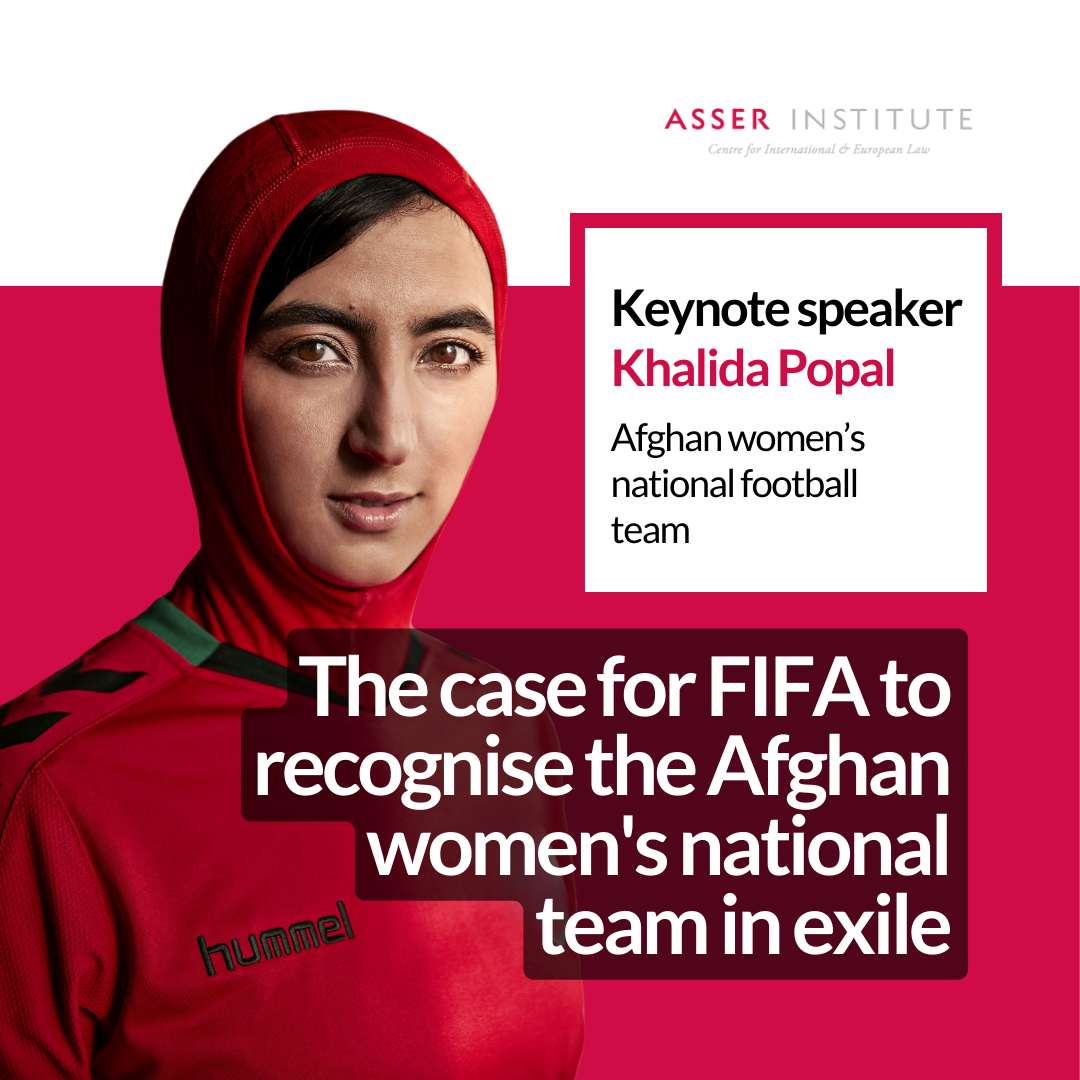
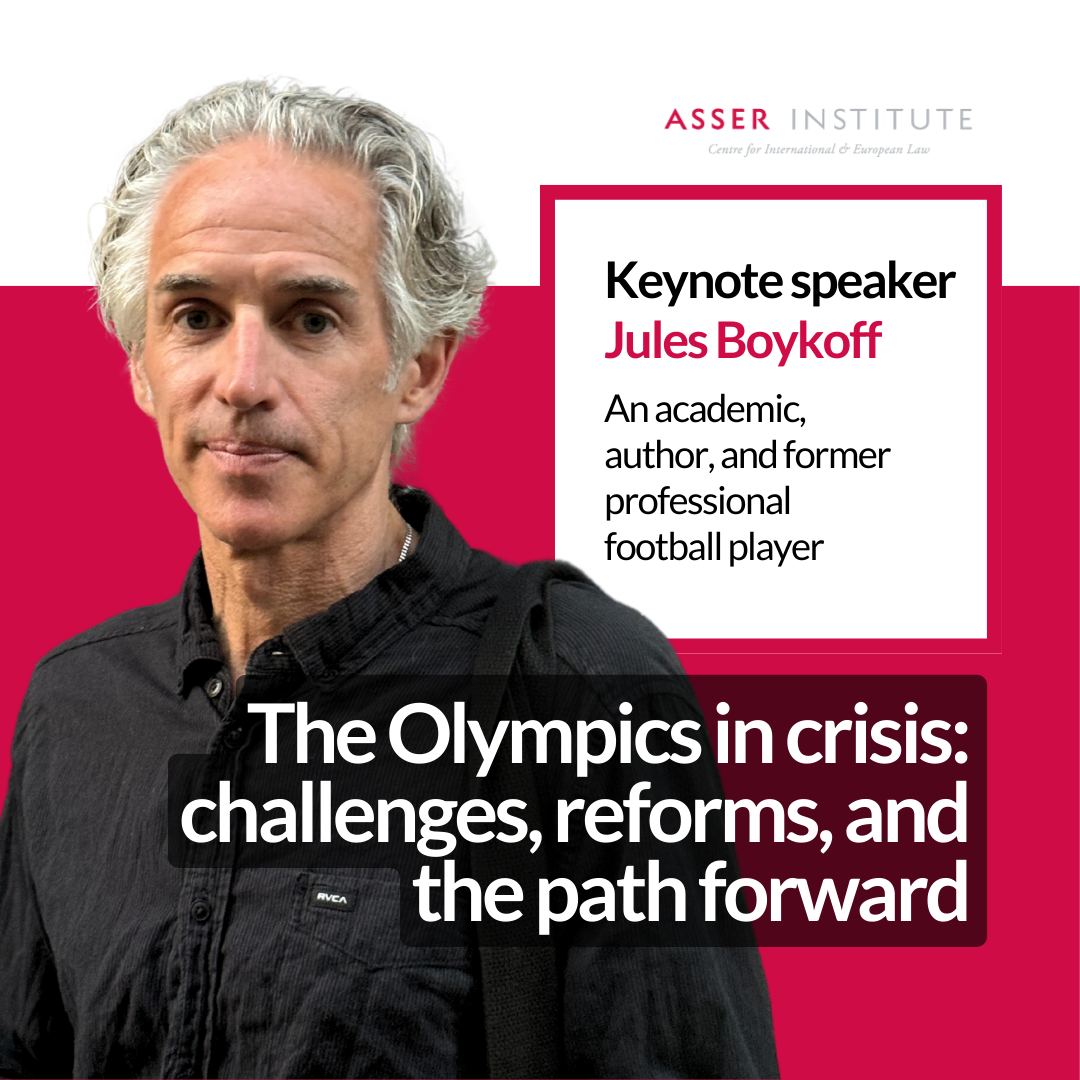
While the Paris 2024 Olympics have come to a close, the legal questions they have raised are far from exhausted. Instead, the Olympics have highlighted new issues (such as the question of the legality of the hijab ban imposed by the French Federation on its athletes) or old ones (such as the question whether Olympians should be remunerated by the IOC or the international federations), which will be discussed by our speakers. Finally, with the help of our keynote speaker, Prof. Jules Boykoff, a longstanding critique of the current Olympic regime, we will explore the IOC’s capacity to adapt to challenges while resisting radical change to the current model of olympism.
Download the full programme
Online participation available
Following the success of our webinar option in the past years, we are once again allowing online participation to the conference at an affordable price. Thus, we hope to internationalise and diversify our audience and to reach people who are not in a position to travel to The Hague.
We look forward to welcoming you in person in The Hague or digitally to this new iteration of the ISLJ conference.
Register HERE
Speakers
Register HERE
The newly launched ‘Global Sport and Human Rights Research Network’, an initiative jointly hosted by the T.M.C. Asser Instituut and the Centre for Sport and Human Rights, together with the European Union-funded project ‘Human Rights Empowered Through Athletes Rights (H.E.R.O.)' is organising an in-person conference on October 23 at the Asser Institute in The Hague, to map the field of athletes' rights and engage in critical discussions on protection of these rights and how to prevent rights violations.
The one-day conference will kick off with a presentation by the H.E.R.O. team on their research results, followed by a short panel discussion. The rest of the day will be filled with four panels on different aspects related to the topic of athletes’ human rights, with speakers from academic institutions around the world.
Check out the full programme HERE and register for free HERE.



The Editors of the International Sports Law Journal (ISLJ) invite you to submit abstracts for the next edition of the ISLJ Conference on International Sports Law, which will take place on 24 and 25 October 2024 at the Asser Institute in The Hague. The ISLJ, published by Springer and TMC Asser Press, is the leading academic publication in the field of international sports law and the conference is a unique occasion to discuss the main legal issues affecting international sports and its governance with renowned academic experts.
We welcome abstracts from academics and practitioners on all issues related to international and transnational sports law and their impact on the governance of sport. We also welcome panel proposals (including a minimum of three presenters) on specific issues of interest to the Journal and its readers. For this year’s edition, we specifically invite submissions on the following themes and subthemes:
Reformism in transnational sports governance: Drivers and impacts
- Legal and social drivers of reforms in transnational sports governance
- The role of strategic litigation (before the EU/ECtHR/National courts) as a driver of reform;
- The role of public/fan pressure groups on clubs, competition organisers and governments as a driver of change.
- The impact of internal reforms in transnational sports governance: Cosmetic or real change? (e.g. IOC Agenda 2020+5, FIFA governance reforms, CAS post-Pechstein changes, WADA sfter the Russian doping scandal)
- Emerging alternatives to private sports governance – the UK’s Independent Football Regulator.
The organization and regulation of mega sporting events: Current and future challenges
- Mega-sporting events as legalized sites of digital surveillance
- Greening mega-sporting events (e.g. carbon neutral pledges, environmental footprints of events, the impact of multiple hosting sites)
- Mega-sporting events and the protection of human rights and labour rights (e.g. Paris 2024 Social Charter, Euro 2024 human rights commitments)
- The Olympic Games and athletes’ economic rights (remuneration/advertisement)
- Reviews of the legal issues raised at Euro 2024 in Germany and the Paris 2024 Olympic Games
- Previews of the legal issues likely to have an impact on the FIFA 2026 World Cup and the Milano-Cortina 2026 Winter Olympic Games
Please send your abstract of 300 words and CV no later than 15 July 2024 to a.duval@asser.nl. Selected speakers will be informed by 30 July.
The selected participants will be expected to submit a draft of their paper by 1 October 2024. Papers accepted and presented at the conference are eligible for publication in a special issue of the ISLJ, subject to peer-review.
The Asser Institute will provide a limited number of travel & accommodation grants (max. 300€). If you wish to be considered for a grant, please explain why in your submission.
The Editors of the International Sports Law Journal (ISLJ) invite you to submit abstracts for the next edition of the ISLJ Conference on International Sports Law, which will take place on 24 and 25 October 2024 at the Asser Institute in The Hague. The ISLJ, published by Springer and TMC Asser Press, is the leading academic publication in the field of international sports law and the conference is a unique occasion to discuss the main legal issues affecting international sports and its governance with renowned academic experts.
We welcome abstracts from academics and practitioners on all issues related to international and transnational sports law and their impact on the governance of sport. We also welcome panel proposals (including a minimum of three presenters) on specific issues of interest to the Journal and its readers. For this year’s edition, we specifically invite submissions on the following themes and subthemes:
Reformism in transnational sports governance: Drivers and impacts
- Legal and social drivers of reforms in transnational sports governance
- The role of strategic litigation (before the EU/ECtHR/National courts) as a driver of reform;
- The role of public/fan pressure groups on clubs, competition organisers and governments as a driver of change.
- The impact of internal reforms in transnational sports governance: Cosmetic or real change? (e.g. IOC Agenda 2020+5, FIFA governance reforms, CAS post-Pechstein changes, WADA sfter the Russian doping scandal)
- Emerging alternatives to private sports governance – the UK’s Independent Football Regulator.
The organization and regulation of mega sporting events: Current and future challenges
- Mega-sporting events as legalized sites of digital surveillance
- Greening mega-sporting events (e.g. carbon neutral pledges, environmental footprints of events, the impact of multiple hosting sites)
- Mega-sporting events and the protection of human rights and labour rights (e.g. Paris 2024 Social Charter, Euro 2024 human rights commitments)
- The Olympic Games and athletes’ economic rights (remuneration/advertisement)
- Reviews of the legal issues raised at Euro 2024 in Germany and the Paris 2024 Olympic Games
- Previews of the legal issues likely to have an impact on the FIFA 2026 World Cup and the Milano-Cortina 2026 Winter Olympic Games
Please send your abstract of 300 words and CV no later than 15 July 2024 to a.duval@asser.nl. Selected speakers will be informed by 30 July.
The selected participants will be expected to submit a draft of their paper by 1 October 2024. Papers accepted and presented at the conference are eligible for publication in a special issue of the ISLJ, subject to peer-review.
The Asser Institute will provide a limited number of travel & accommodation grants (max. 300€). If you wish to be considered for a grant, please explain why in your submission.