Editor’s
note: Shamistha Selvaratnam is a LLM Candidate of the Advanced Masters of
European and International Human Rights Law at Leiden University in the Netherlands.
Prior to commencing the LLM, she worked as a business and human rights
solicitor in Australia where she specialised in promoting business respect for
human rights through engagement with policy, law and practice.
The consumer
goods industry is shaped by businesses’ desire to engage with the best-quality
suppliers at the cheapest price in order to sell goods at a high-profit margin
in the burgeoning consumer markets. Accordingly, they continue to build their
value chains in order to provide goods to consumers. The resulting effect of
this is that potential human rights risks and impacts are likely to arise in
the supply chains of businesses that operate in the industry. Risks that often
arise in this sector include forced labour, non-compliance with minimum wage
laws and excessive work hours, land grabbing and discrimination. Accordingly,
businesses such as Unilever face the challenge of preventing, mitigating and
addressing adverse human rights impacts in their supply chains through
conducting human rights due diligence (HRDD). As Paul Polman (former CEO of
Unilever) has stated:
‘We cannot choose between [economic]
growth and sustainability—we must have both.’
This fourth blog of a series of articles
dedicated to HRDD is a case study looking at how HRDD has materialised in
practice within Unilever’s operations and supply chains. It will be followed by
another case study examining another that has also taken steps to
operationalise the concept of HRDD. To wrap up the series, a final piece will
reflect on the effectiveness of the turn to HRDD to strengthen respect of human
rights by businesses.
Company Background[1]
Unilever PLC (Unilever) is a consumer goods
company that is co-headquartered in the United Kingdom and the Netherlands. It
is considered to be one of the world’s leading consumer goods company, making
and selling around 400 brands (including Dove, Lipton and Magnum) in the
personal care, foods, home care and refreshment categories in more than 190
countries. Unilever is also the second largest advertiser globally and creates
content to market its products using digital channels. It employs more than 155,000
people globally and over two billion people use its products daily.[2]
Unilever has a complex global value chain,
with its global manufacturing operations spanning across approximately 76,000
suppliers and 300 factories in 69 countries in order to produce products of
almost 19 million tonnes. Its products are distributed through a network of
more than 400 warehouses to 26 million retail stores, including large
supermarkets to small convenience stores and e-commerce channels.[3]
Unilever endorsed
the UNGPs in 2011 and recognises that it has ‘the responsibility to respect
human rights and the ability to contribute to positive human rights impacts.’[4]
It states that it follows and supports the OECD Guidelines.[5]
Unilever acknowledges
that there is ‘both a business and a moral case for ensuring that human rights
are upheld across [its] operations and [its] value chain.’ As a result, it seeks to identify human
rights risks that it may be involved in through its activities or business
relationships through conducting HRDD and integrating the responses into its
policies and internal systems, acting on the findings, tracking its actions and
communicating with its stakeholders.[6]
Unilever was the first company to pilot the Shift and Mazars UN Guiding
Principles Reporting Framework, which resulted in its Human
Rights Report 2015 – Unilever’s disclosure to the Reporting Framework in
2015 is accessible here.
Unilever’s human rights work is overseen by
the CEO and supported by the Leadership Executive, including the Chief
Supply Chain Officer, which includes the Chief Supply Chain Officer, Chief
Legal Officer, Chief Sustainability Officer and the Global Vice President for
Social Impact.[7] Unilever’s Procurement Team leads its supply chain efforts. There is
no publically available information on the size and resources of this team, its
role or where team members are located.
Identification and Assessment of Risks
Unilever’s process for identifying its
salient human rights risks started with a workshop facilitated by Shift.
Unilever considered the range of potential human rights impacts resulting from
its activities, and prioritised those likely to be the most severe were they to
occur, based on how grave the impacts to the rights-holder could be, how
widespread they are and how difficult it would be to remedy any resulting harm.[8]
Unilever drew from previous conversations with external bodies, including the
Work Economic Forum Human Rights Global Agenda Council, the Global Social
Compliance Programme and the UN Global Compact.[9]
It also drew from external data sources such as governments, international
agencies and risk organisations that assist it to monitor changes in human
rights situations in the countries in which it operates, as well as from
understanding of the perspectives of affected stakeholders and verification
with expert stakeholders of the salient issues identified.[10]
Following this initial risk assessment,
Unilever conducts regular human rights impact assessments (HRIAs), 'which
include on-site visits by third-party experts who engage and consult
rights-holders and other stakeholders.’[11]
For example, in 2016 it commissioned a human rights impact assessment of its
own operations and value chain in Myanmar in order to identify impacts on
'local right-holders, including workers, their families and other community
members'.[12]
This assessment 'uncovered regular patterns of discriminatory practices within
some suppliers in [its] extended supply chain'. In addition, during the
assessment of the harvesting of palm sugar activity, 'children were found to be
working alongside their parents as they prepared palm juice, whilst palm sugar
tree climbers were using unsafe homemade ladders to pick the fruit'.[13]
Unilever considers that
its suppliers play a critical role in helping it source responsibly and
sustainably.[14]
Accordingly, Unilever developed a Responsible
Sourcing Policy, which sets out Unilever’s
expectations with regards to the respect for the human rights, including labour
rights, of the workers in its extended supply chain. It is based upon 12
fundamental principles that are derived from internationally recognised
standards and include treating all workers equally with respect and dignity,
paying workers fair wages and ensuring working hours of all workers are
reasonable.
Clauses are included in
supplier contracts in an effort to ensure that suppliers respect and comply
with a set of Mandatory Requirements related to each of the fundamental
principles set out in the Responsible
Sourcing Policy.[15] For example, with respect
to workers being paid fair wages, suppliers are required to ensure that all
workers are provided total compensation packages that include wages, overtime
pay, benefits and paid leave which either satisfies or exceeds the legal
minimum standards or industry standards, whichever is the highest. Guidelines
and tips are provided for the implementation of a comprehensive and robust
process so suppliers can meet the Mandatory Requirements and move up the
‘continuous ladder of improvement’ and advance to good practice and then
finally achieve and maintain best practice with respect to each of the fundamental
principles.
Where there are
breaches of the Responsible
Sourcing Policy, they must be reported to
Unilever who will investigate and discuss its findings with the relevant
supplier. If remediation is required, the supplier is required to devise and
inform Unilever of their Corrective Action Plans (CAPs) and implementation
plans and timeline to resolve the breach.
Unilever’s Procurement
Code Committee evaluates and makes recommendations where suppliers are not
willing to comply or move up the continuous improvement ladder, and it reviews
all key incidents raised. Continual non-conformances with no remediation plans
result in an escalation to the Global Procurement Code Committee for a decision
on terminating the business relationship.[16] No information is
publicly available regarding Unilever’s Global Procurement Code Committee.
Engaging with new
and existing suppliers[17]
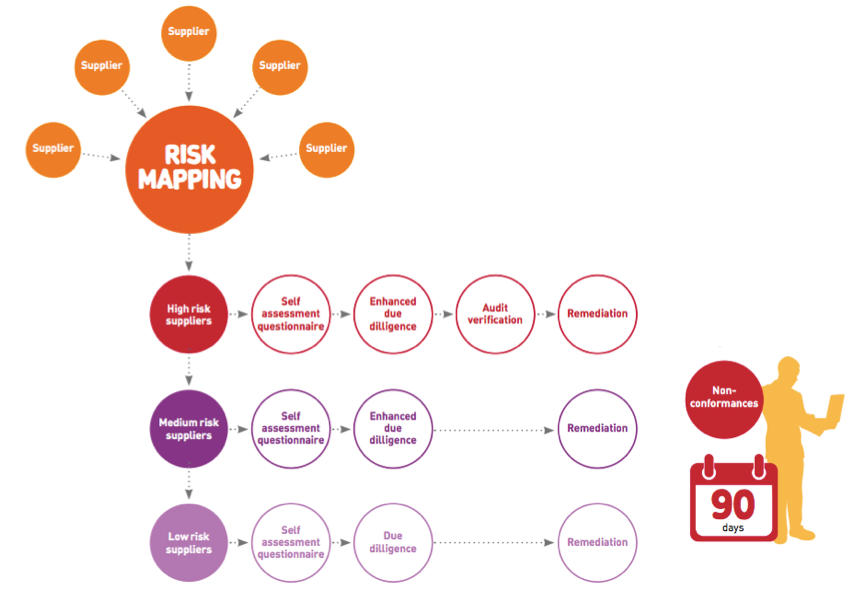
Unilever’s audit approach to evaluating suppliers is depicted
below.
Source: Unilever 2015 Human Rights
Report, p 18
Unilever uses a risk-based approach to evaluate prospective and
existing suppliers. Suppliers are required to complete a self-declaration
regarding their compliance to the Mandatory Requirements of Unilever’s Responsible
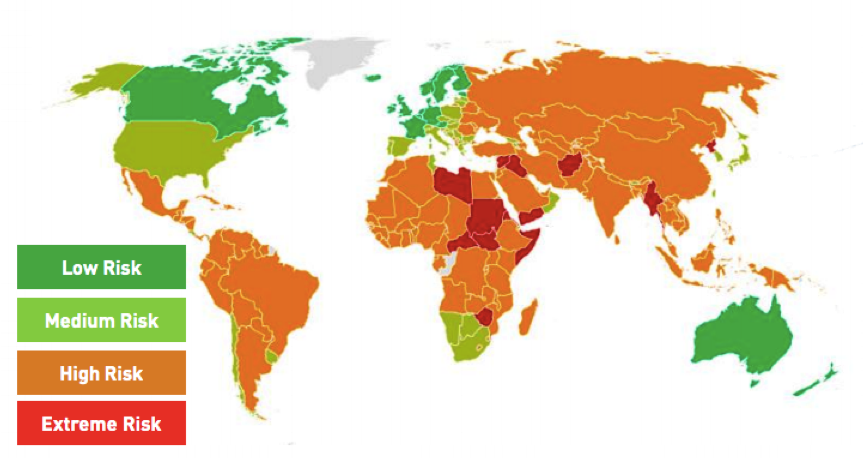
Sourcing Policy. Suppliers are then segmented
based on a risk assessment using externally available indices of business and
human rights risks from expert sources. Country risk is
one element of the risk assessment (see below for the outcome of Unilever’s
2018 country risk assessment).
Source: Unilever’s
Supply Chain, p 17.
Suppliers in the
highest risk segment are required to undergo an independent third-party audit.
Raw material or finished goods suppliers are required to undergo an on-site
audit, while service suppliers need to undergo a remote desktop audit.
During the course of an
on-site audit, all non-conformances are recorded to indicate where a supplier’s
site does not align with the Responsible
Sourcing Policy Mandatory Requirements. A
supplier must provide a time-bound CAP to address and remediate non-conformances, and
the auditor must confirm the remediation has effectively addressed the non-conformance
in a follow-up audit within a 90-day period for the supplier to be Responsible
Sourcing Policy compliant.
Audit frequency can be
every 12, 24, or 36 months, and is determined by the number and type of
non-conformances found in the previous audit. CAPs must be implemented to
address all non-conformances and re verified in a follow-up audit to confirm
and verify that the identified issues have been effectively remediated.[18]
As at May 2018, of the 44,290 suppliers risk assessed to date, 11,287 were
classified as high risk of which 1,667 were identified with issues in the
previous three years of which 1,175 had verified CAPs.[19]
More serious non-conformances
are classified as ‘Critical Incidents’, with the most severe of these termed
‘Key Incidents’. The presence of Critical Incidents automatically means
that the supplier must have a new audit after 12 months. On top of the
requirements for Critical Incidents, the auditor must raise a Key Incident
to Unilever within a 24-hour period. Key Incidents are escalated to either
Director or Vice President level within Unilever to ensure appropriate
attention is given. Within seven days a CAP to remedy the issue
must be provided by the supplier.
Stakeholder Engagement Channels
Unilever engages with its
stakeholders in conducting risk assessments. Stakeholder consultation, dialogue
and action are considered to be a critical part of its risk assessment process
and have been said to deliver ‘enormous value’, given the localised and
culturally specific nature of the issues faced. Unilever has identified its
stakeholders to include its employees, trade unions, customers, NGOs,
communities, suppliers, workers, business partners, advisory boards (such as
the Unilever Sustainable Living Plan Council), governments, intergovernmental
organisations and civil society organisations.[20] Unilever’s Advocacy Team
play a lead role in engaging with its external stakeholders, which is supported
by its External Affairs Team.[21] Unilever also engages
with various organisations including the World
Business Council for Sustainable Development, Consumer Goods Forum, United
Nations Global Compact and the World Economic Forum.
Unilever also captures
and addresses complaints through its grievance mechanisms – it notes that ‘Grievance mechanisms play a critical role in
opening channels for dialogue, problem solving, investigation and, when
required, providing remedy.’[22] With respect to
Unilever’s supply chain, one of the fundamental principles of the Responsible
Sourcing Policy requires all workers to have
access to fair procedures and remedies. Accordingly, suppliers are required to
provide grievance mechanisms to their workers. Unilever monitors the number of
complaints received from workers by suppliers each year in order to monitor its
salient issues and address root causes so that similar grievances will not be
raised in the future.[23] Additionally, Unilever
also provides a hotline that anyone can access to report on responsible
sourcing issues. It has also developed a grievance
procedure for workers in its palm oil supply chain.
A summary of the complaints raised under this procedure can be found here.
Identified risks
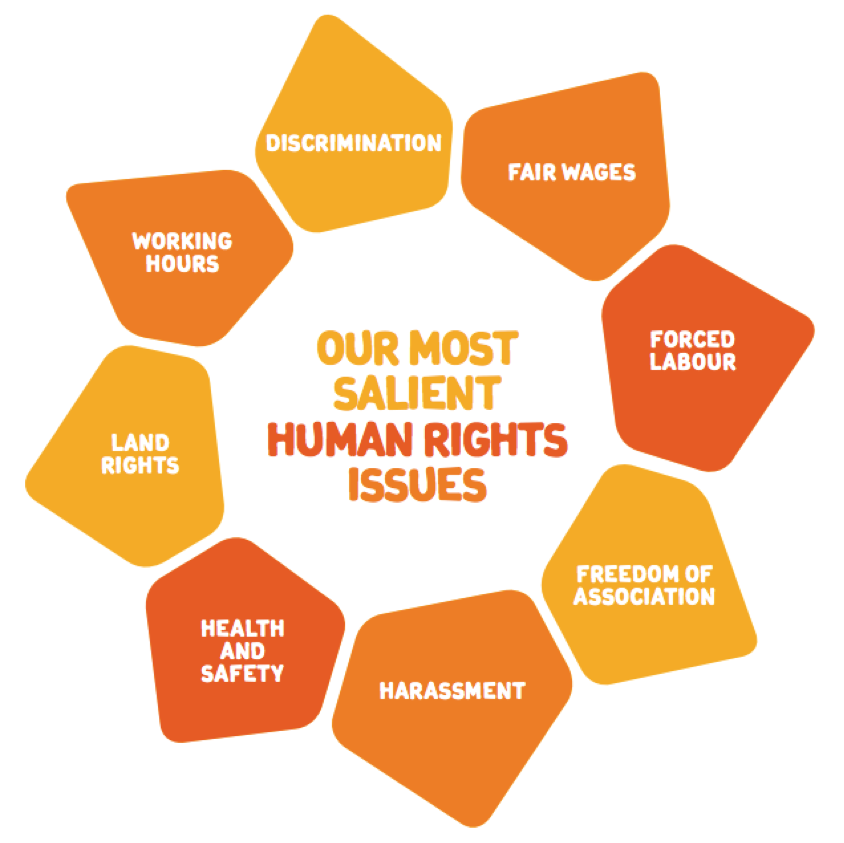
Through its risk
identification and assessment processes, Unilever has identified eight salient
human rights issues within its business, which are depicted in the image below.
Source: Unilever
Human Rights Report 2015, p 26.
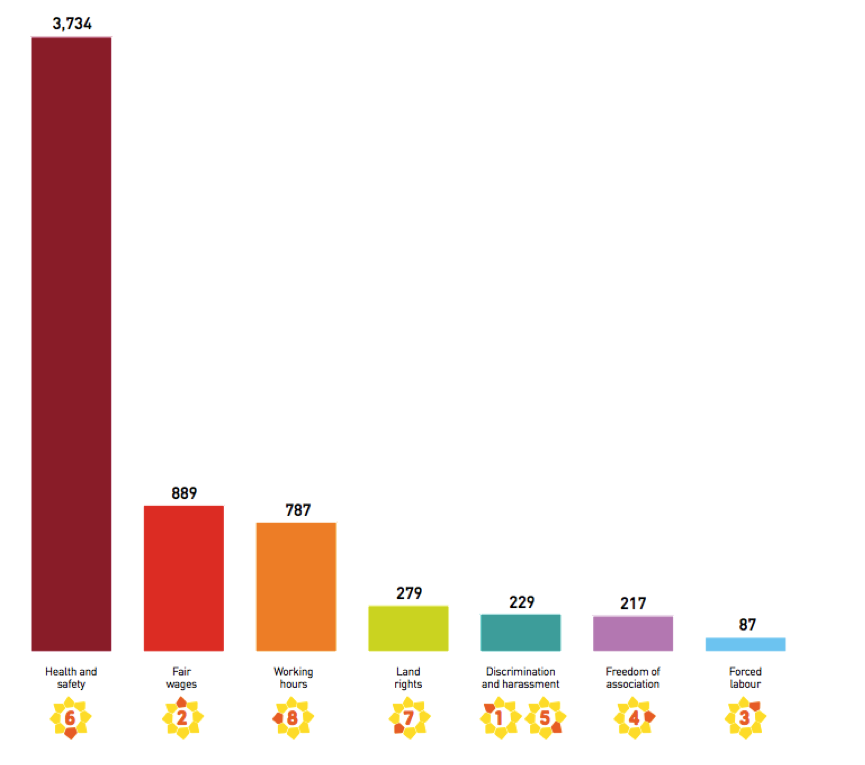
During the course of
2017, Unilever identified the following non-conformances in relation to the
salient issues:
Source: Human
Rights 2018 Supplier Audit Update, p 10.
Integrating and Acting
Unilever recognises that it must take steps to identify and
address any actual or potential adverse impacts with which it may be involved
whether directly or indirectly through its own activities or its business
relationships. It seeks to manage the risks identified in the processes
discussed above by ‘integrating the responses … into [its] policies and
internal systems, acting on the findings, tracking [its] actions, and
communicating with [its] stakeholders about how [it] address impacts.’[24]
Remediation is perceived as important as addressing human rights impacts.
With respect to each of the eight salient issues set out above,
Unilever has taken specific actions and implemented initiatives to prevent and
mitigate those issues from arising in its supply chains. For example, with
respect to forced labour Unilever has, inter alia:[25]
- Developed best practice guidelines on the use of
migrant labour focusing on the recruitment process, contractual terms and the
payment of wages and benefits. These guidelines are not publicly available.
- Incorporated human trafficking explicitly into
its Human Rights Policy Statement, Code of Business Principles and its Respect,
Dignity and Fair Treatment Code Policy, and provided associated training to its
employees globally.I
- Incorporated trafficking guidelines into its Responsible
Sourcing Policy and Responsible Business Partner Policy.
- Published a UK Modern Slavery Statement in 2017, 2018 and 2019.
- Became a founding member of the Leadership Group for
Responsible Recruitment, which promotes responsible recruitment
practices by business.
- Provided training to suppliers in Turkey, Dubai,
India, Bangkok and Malaysia on eradicating forced labour and the responsible
management of migrant labour.
Tracking
Unilever recognises
that ‘the ability to track and monitor issues is a vital part of measuring
progress in remediation and addressing grievances’.[26] The Unilever Board is
responsible for compliance, monitoring and reporting and day-to-day
responsibility lies with senior management. Unilever’s Corporate Audit Team and
external auditors undertake checks on this process. [27]
With respect to
tracking its supply chain, Unilever has an ‘Integrated Social Sustainability
Dashboard’ (Dashboard), which sets out the ‘number of non-conformances for each
fundamental principle of the RSP’.[28] It uses the information
available through the Dashboard to identify salient hotspot issues ‘allowing
use to prioritise, build guidance produce webinars, and support regions where
the need is greatest’.[29] Unilever’s Procurement
Team also monitors supplier compliance levels and identifies when intervention
is required. It works with suppliers to ensure effective remediation. Unilever also
tracks and verifies that CAPs are implemented within the agreed timelines. When
very serious Key Incidents occur, Unilever more directly and actively
participates in developing CAPs and following up on their implementation.[30]
Communicating
Unilever claims that it engages in dialogue
with its employees, workers and external stakeholders who are or could
potentially be affected by its actions.[31]
It particularly focuses on individuals or groups who ‘may be at greater
risk of negative human rights impacts due to their vulnerability or
marginalisation’.[32]
Unilever primarily uses its Human
Rights Report 2015 and Human
Rights Progress Reports to communicate its process of identifying and
assessing human rights risks and impacts, including its salient human rights
issues and the actions taken to prevent and mitigate those issues, as well as
integrating, acting and tracking those issues. Unilever also utilises its
annual Modern Slavery Statements to communicate with stakeholders. Aside from these
reports and statements, Unilever has not clearly stated what other means it
utilises to communicate its human rights impacts, policies and approaches. A
review of its website contains a webpage
detailing its engagement with stakeholders, but fails to recognise exactly how
this engagement is carried out.
With respect to grievances raised through the Palm Oil grievance
procedure, Unilever publishes a Grievance Tracker
online setting out a summary of each grievance raised, the link to Unilever and
the latest actions taken to address the allegations. It also publishes
responses in relation to specific claims – see for example here and here.
The
Gaps Between Theory and Practice
Unilever
has acknowledged that the challenges faced by the
business community with regard to its responsibility to respect human rights
are ‘enormous’, particularly given the scale of their operations and supply
chain. It states that ‘the
risk of systemic human rights abuses exists across our value chain and the
value chains … This is a reality we must confront and work together to
resolve.’ As a result it has claimed
to go beyond respecting human rights to actively promoting them. This approach
has positioned it publicly as a leader and a model from which other businesses
can draw inspiration.[33]
What is clear from a review of Unilever’
human rights approach is that it recognises its responsibility to respect human
rights and has sought to take steps to fulfil this obligation along its entire
value chain. While Unilever’s human rights efforts started to gain some
momentum in 2010 when it launched its Sustainable Living Plan and began
evaluating suppliers, it accelerated its efforts in 2014 by introducing a Human
Rights Policy Statement, formalising its commitment to promoting human rights
across its operations and supply chains, as well as through designing a
five-year human rights strategy.[34]
In 2015, it became the first company to produce a standalone human rights
report.
Nonetheless, despite Unilever’s extensive
human rights work over the past years, including the strengthening of its HRDD
processes in its supply chains, it has drawn and continues to draw criticism in
relation to the human rights abuses that still exist within its value chain.
Key human rights issues that have been placed in the spotlight in various
jurisdictions are discussed below. Information regarding alleged human rights
violations committed by Unilever pre-dating the UNGPs has been included in the
sub-sections below to the extent that such violations have been found to still
be present following Unilever’s actions to increase its efforts to respect
human rights in 2014.
Vietnam
In 2013, Oxfam (together with Unilever)
published a report
in which it assessed the labour standards in Unilever’s operations and supply chain
in Vietnam and developed measures to guide Unilever (and other companies) to
fulfil their social responsibilities. It found that despite Unilever’s
commitment to human rights, its tools and processes for due diligence and
remediation via grievance mechanisms needed to be strengthened. It stated that
Unilever had ‘not been aware that some of its practices were associated with
adverse impacts for workers, including wages that were legal but low, excessive
working hours, and high levels of contract labour.‘[35]
Recommendations were made by Oxfam to Unilever, including policy changes,
strengthening its due diligence processes and better aligning business
processes with its policies. Unilever made a range of commitments in response
to the recommendations.
A progress
report was published in 2016, which found that Unilever’s ‘overall
commitment to respecting human and labour rights has been strengthened as a
result of effective leadership across the business’. Nonetheless, it identified
some ‘critical implementation challenges’ that need to be addressed in order to
‘[translate] the company’s policy commitments into practice and achieve
positive outcomes for … workers’. Specific issues that were identified were:
- There was an ‘unresolved tension’ between the commercial and labour
standards imposed on suppliers. Some suppliers did not see the business case
for their own businesses in improving their labour standards.
- Despite Unilever’s efforts to ensure fair compensation for workers,
there was a lack of evidence to show that worker wages had increased beyond the
legal minimum level in Vietnam.
Additionally, Oxfam highlighted that
multinational more generally need to address the root causes of adverse human
rights impacts in their supply chains in order for ‘good labour standards to
become universal operating conditions.’ Oxfam made further recommendations to
improve the situation for workers in Vietnam.
India
In the 2011
SOMO & ICN Report, SOMO also reported on Indian tea plantations that
supply to Unilever. Issues identified included wages being paid with too little
benefits, workers being discriminated against in relation to promotions and
benefits, the casualization of labour as well as violations of the freedom of
association. In 2016, ICN released a follow
up report on the situation in India. It found that there had been some
improvements in the ‘payment of minimum wages, setting up procedures for safe
handling of chemicals and the provision of basic medical care and educational
facilities for all temporary and permanent workers’. However, there are still
‘many serious non-compliances’ relating to ‘unequal benefits for casual
workers, overtime wages and working hours, advance payments, chemical handling
practices and worker representation.’ Unilever responded
by stating that it was in dialogue with its suppliers in relation to the issues
raised in the follow up report.
Further, in 2015 a BBC investigation
found ‘dangerous and degrading living and working conditions’ in tea estates
that supply to some of Unilever’s brands (Lipton and PG Tips). Unilever stated that it
regarded the issues raised in the investigation as ‘serious’ and had made
progress to rectify these issues through ‘working with [its] suppliers to
achieve responsible and sustainable practices’.
Turkey
In 2014, an external organisation engaged by
Unilever carried out an independent
assessment of its tea supply chain in Turkey. The assessment found, inter
alia, that workers worked excessive hours during the harvest, various health
and safety issues (e.g. lack of protective equipment) and migrant worker
accommodation did not meet the required standards in some instances. As a
result, Unilever decided to remediate the identified issues at the individual
site level and also work with external multi-stakeholder groups to address more
systemic challenges. It also started a capacity
building initiatives in Turkey that focuses on human rights and held training
in 2016 focusing on the key non-compliances found.
Indonesia
In 2016, Amnesty International published a report
in relation to labour exploitation on plantations in Indonesia that provide
palm oil to Wilmar, which then supplied to Unilever.[36]
It was found that serious human rights violations were occurring on the
plantations of Wilmar and its suppliers, including ‘forced labour and child
labour, gender discrimination, as well as exploitative and dangerous working
practices that put the health of workers at risk’, which resulted from
systematic business practices (e.g. low wages and the casualisation of labour).
Unilever issued a detailed
response to a letter from Amnesty International in relation to the report
recognising that ‘more attention needs to be paid to social issues at palm oil
plantations and that current processes and policies need to be improved to
ensure they address issues effectively and create more transparency.’ It also
noted that it was in contact with Wilmar regarding the issues raised and
committed to continuing to engage to take steps to ‘close the gaps identified’.
Unilever also issues a public
statement once the report was released, committing to investigating the
grievances raised in the report and addressing them. Unilever has continued to
engage with Wilmar and Amnesty International on these issues – see for example here
(2016), here
(2017) and here
(2018).
Conclusion
What is clear from these examples of human
rights violations in Unilever’s supply chains is that despite its extensive
HRDD process that it seeks to roll out across its value chain, in practice
there remain weaknesses and blind spots in this process. For example, Unilever
does not have a third party grievance mechanism allowing workers to raise
complaints directly to the company (except in relation to palm oil). Instead
workers must raise their grievances through supplier provided mechanisms, which
can discourage the communication of human rights issues. Also, Unilever
assesses prospective suppliers through the use of a self-declaration, which is
extremely problematic as it relies on potential culprits to assess their own
compliance with the Mandatory Requirements for doing business with Unilever, in
some cases without verification by Unilever or an independent third party. Weaknesses
such as these make it evident that Unilever has far to go on its journey to
respecting human rights within its supply chains, despite being a ‘leader’ in
implementing HRDD globally. Unilever needs to look beyond remedying human
rights abuses as they are alleged and reported. It must also examine the
systemic failings in its HRDD process that result in these human rights risks not
being identified and therefore prevented or mitigated.
[1] Unless otherwise statement, the information in this section has
been obtained from the Unilever
2018 Annual Report and the Unilever
Human Rights Report 2015.
[4] Unilever
Human Rights Policy Statement, p 4.
[5] Ibid, p 1; Unilever, Advancing Human Rights in our
Own Operations; Unilever
Human Rights Report 2015, p 1.
[6] Unilever
Human Rights Policy Statement.
[7] Business and Human Rights Resource Centre Action Platform, Unilever.
[18] Unilever’s
Supply Chain, p
17.
[19] Ibid.
[20] Unilever
Human Rights Report 2015, pp 22-23; Unilever, Engaging with Stakeholders.
[21] Business and Human Rights Resource Centre Action Platform, Unilever.
[22] Ibid.
[25] Unilever
Human Rights Report 2015, p 32; Unilever, Sharing Best Practice in
Fighting Forced Labour; The Consumer Goods Forum, Business Actions Against
Forced Labour, p 36; Unilever
Human Rights Progress Report
2017, p 32.
[34] Unilever
Human Rights Report 2015, p 3.
[35] Oxfam, Business
and Human Rights: An Oxfam Perspective on the UN Guiding Principles, p 7.