Asser International Sports Law Blog

Our International Sports Law Diary
The Asser International Sports Law Centre is part of the T.M.C. Asser Instituut

International and European Sports Law – Monthly Report – October 2020 - By Rhys Lenarduzzi

Editor’s note: Rhys Lenarduzzi is a final semester Bachelor of Law (LL.B) and Bachelor of Philosophy (B.Phil.) student, at the University of Notre Dame, Sydney, Australia. As a former professional athlete, then international sports agent and consultant, Rhys is interested in international sports law, policy and ethics. He is currently undertaking an internship at the T.M.C. Asser Institute with a focus on Transnational Sports Law.


The Headlines

Aguero and Massey-Ellis incident: An Opportunity for Change and Education?

In mid-October a clip went viral of Argentinian star Sergio Aguero putting his hands on sideline referee, Sian Massey-Ellis. A heated debate ensued in many circles, some claiming that Aguero’s conduct was commonplace, others taking aim at the appropriateness of the action, around players touching official and a male touching a female with an unsolicited arm around the back, the squeeze and pull in. Putting the normative arguments aside for a moment, the irony of the debate was that all sides had a point. Football, almost exclusively, has grown a culture of acceptance for touching officials despite the regulations. Male officials who have let such conduct slide, have arguably let their female colleague down in this instance.

Whilst a partial defence of Aguero might be that this kind of conduct takes place regularly, the incident could serve as a learning experience. If Massey-Ellis’ reaction was not enough, the backlash from some of the public might provide Aguero and other players the lesson, that touching a woman in this way is not acceptable.

Returning to football, the respect and protection of officials in sport, the key here appears to be cracking down on touching officials entirely. This is not a foreign concept and football need only look at the rugby codes. Under no circumstances does the regulations or the culture permit that a player from the rugby codes touch a referee. It is likely the case that the obvious extra level of respect for officials in these sports derives from a firm culture of no touching, no crowding officials, communicating with officials through the team captain only, with harsh sanctions if one does not comply.

The Football Association of England has decided no action was necessary, raising questions of how seriously they take the safety of officials, and gender issues. This is ultimately a global football issue though, so the confederations or international bodies may need step in to ensure the protections that appear at best fragile.  


Rugby Trans issue

The World Rugby Transgender guideline has been released and contains a comprehensive unpacking of the science behind much of the regulatory framework. Despite many experts applauding World Rugby on the guidelines and the extensive project to reach them, the England Rugby Football Union is the first to defy the World Rugby ruling and transgender women will still be allowed to play women’s rugby at all non-international levels of the game in England for the foreseeable future. This clash between national bodies and the international body on an important issue is concerning and will undoubtedly be one to keep an eye on.


CAS rejects the appeal of Munir El Haddadi and the Fédération Royale Marocaine de Football (FRMF)

The refusal to authorise a footballer to change national federation is in the headlines with the CAS dismissing the appeal of the player and Moroccan federation, confirming the original determination of the FIFA Players’ Status Committee.

This has been given considerable recent attention and seemingly worth following, perhaps best summed up by FIFA Director of Football Regulatory, James Kitching, where in a tweet he notes: “The new eligibility rules adopted by the FIFA Congress on 18 September 2020 have passed their first test. We will be publishing our commentary on the rules in the next fortnight. Watch this space.”


Major International Sports Law Decisions

CAS Decisions (September)


Official Documents and Press Releases

CAS

FIFA

FIFPro

IOC

UEFA

WADA

World Athletics

Other Civil Society Organizations/Unions

  • Asian Racing Federation council on anti-illegal betting & related financial crime – Quarterly Bulletin


In the News

Rugby

Doping

eSports 

Gymnastics

Other


Academic Materials

International Sports Law Journal

Oxford Human Rights Law Review


Blog

Asser International Sports Law Blog

 Law in Sport

Play the Game

Sport Integrity Initiative 


Podcasts

LawInSport

Play On the Morgan Sports Law Podcast

Comments are closed
Asser International Sports Law Blog | A Bridge Too Far? Bridge Transfers at the Court of Arbitration for Sport. By Antoine Duval and Luis Torres.

Asser International Sports Law Blog

Our International Sports Law Diary
The Asser International Sports Law Centre is part of the T.M.C. Asser Instituut

A Bridge Too Far? Bridge Transfers at the Court of Arbitration for Sport. By Antoine Duval and Luis Torres.

FIFA’s freshly adopted TPO ban entered into force on 1 May (see our Blog symposium). Though it is difficult to anticipate to what extent FIFA will be able to enforce the ban, it is likely that many of the third-party investors will try to have recourse to alternative solutions to pursue their commercial involvement in the football transfer market. One potential way to circumvent the FIFA ban is to use the proxy of what has been coined “bridge transfers”. A bridge transfer occurs when a club is used as an intermediary bridge in the transfer of a player from one club to another. The fictitious passage through this club is used to circumscribe, for example, the payment of training compensation or to whitewash a third-party ownership by transforming it into a classical employment relationship. This is a legal construction that has gained currency especially in South American football, but not only. On 5 May 2015, in the Racing Club v. FIFA case, the Court of Arbitration for Sport (CAS) rendered its first award involving directly a bridge transfer. As this practice could become prevalent in the coming years we think that this case deserves a close look.


I. Facts and procedure

Fernando Ortiz is an Argentine professional football player who entered into an employment contract with Vélez Sarsfield, valid until 30 June 2012. After the expiration of the contract, Ortiz signed an employment contract with the Uruguayan team, Institución Atlética Sud América on 11 July 2012, valid until 30 June 2017. Institución was playing in the Second Division in Uruguay at that time. A week later, on 20 July 2012, Ortiz was transferred from Institución back to Argentina. Institución and Racing Club, Ortiz’ new club, agreed a transfer fee (which was not disclosed). The first instalment should be made before 24 July 2012. Ortiz’ new employment contract was valid until 30 June 2014. Both transfers were duly registered in the FIFA Transfer Matching System (TMS). First, on 23 July 2012, the Argentine Federation (AFA) provided the Uruguayan Federation (AUF) the International Transfer Certificate (ITC). After the transfer from Institución to Racing, the AUF sent the same paperwork to the AFA on 3 August 2012. At that time, no payments were made.

Meanwhile, in view of the number of similar transfers, AFA and the Argentine Tax Authorities agreed that the players concerned would not be allowed to play in the Argentine league. This resulted in the parties (Institución, Ortiz and Racing) concluding a Rescission Agreement of the transfer contract, stating that they had “nothing to claim from each other”.[1] This agreement was not uploaded at that time in the TMS. On 23 November 2012, the FIFA TMS body sent a letter[2] to Racing asserting that they were not aware of any proof of payment of the transfer fee, and that this transfer could constitute an infringement of the TMS rules. Racing replied[3] by enclosing the rescission agreement and confirming that no payments were to be made. On June 2013, FIFA TMS opened disciplinary proceedings against Racing, claiming a violation of articles 3 and 9.1 of Annexe 3 RSTP[AD1] . In response Racing blamed Ortiz for trying to benefit himself from such operation and argued that the club had a true sporting interest in signing Ortiz and did not receive any economic benefit out of the transfer. On 14 August 2013, the FIFA TMS body submitted the disciplinary proceeding to the FIFA Disciplinary Committee (FIFA DC) for a proper investigation of the facts.

In its decision of 5 March 2014, the FIFA DC analysed the two transfers and concluded that they lacked a sporting objective. Even if, from a formal point of view, the first of the two transfers did not involve Racing directly, the FIFA DC considered, taking into account the chronological unfolding of the transfers, that the transfer of Ortiz to Institución would not make sense (according to the playing level of Institución and Ortiz), if his subsequent transfer to another club, in this case Racing Club, was not already planned. Accordingly, the FIFA DC found that the two “parts of the operation” cannot be considered separate. Hence, the whole bridge transfer scheme was deemed known to all parties involved. Thus, the FIFA DC concluded that Racing was involved in the operations carried out and therefore liable to face sanctions.[4]

Moreover, the FIFA DC drew attention to the effects the rescission agreement should have had in a rational context. Indeed, in a normal constellation, one would have expected Ortiz to return to Institución, instead the fact that he stayed on to play at Racing corroborated the non-sporting interest of the transfer. The FIFA DC considered that the aim of the TMS rules is to create transparency (Article 1 Annexe 3 RSTP) in players’ international transfers. In the view of the FIFA DC, Racing, however, used the TMS fraudulently to give a sporting appearance to such a transfer. Therefore, Racing is found to have infringed Articles 3(1)[5] and 9.1(2)[6] Annexe 3 FIFA RSTP, since the transfer was conducted through the TMS for illegitimate purposes and it did not act in good faith. As a consequence of this infringement, the Argentine club was fined CHF 15,000 and warned in accordance with the FIFA Disciplinary Code.[7] In the same proceedings, the Uruguayan club was sanctioned with a transfer ban for two complete and consecutive transfer periods and a fine of CHF 40,000.

Racing Club decided to appeal the decision to the CAS. The Argentine club based its appeal[8] on the grounds that there is no legal basis in the FIFA Regulations to sanction the club for correctly registering a transfer without a sporting reason in the FIFA TMS system.  


II. Commentary

First, we need to explicate in greater details the functioning and purposes of bridge transfers. Before, tackling the substance of the award rendered by the CAS.


A.    What is a bridge transfer?

As explained by Ariel Reck[9] (who was Racing’s lawyer in the present case), a bridge transfer has three main characteristics:

  • A bridge transfer is made for no apparent sporting reason, there is a non-sporting purpose underlying the move.

  • Secondly, there are three clubs involved in this triangular structure: on the one hand the club where the player was firstly registered (club of origin); secondly, the so-called ‘bridge club’, which will usually be a club of a lower level than the player involved and the final club of destination, i.e. the club where the player was intended to play for from the beginning. The lack of balance between the player and the bridge club is usually evident.

  • The last feature is the short period of time that the player is engaged with the bridge club. Frequently, such a player does not play any game at all with this club.

There are three important reasons why football clubs enter into a triangular agreement that constitutes a bridge transfer:

  1. The bridge transfer helps to reduce the cost of training compensation or payments to be made under FIFA’s solidarity contribution mechanism.

  2. The bridge transfer allows the use of a club to circumvent the FIFA rule that prohibits TPO.[10]

  3. The bridge transfer is used to evade taxes.


1.   Reducing training compensation

As far as the reduction of the value of the training compensation is concerned, it should be noted that there is already an award dealing with this matter, though without making an explicit reference to the notion of “bridge transfer”. In 2009, CAS rendered an award in a dispute between MTK Budapest and FC Internazionale. In this case, Inter was interested in signing a Hungarian player from MTK Budapest. After negotiations between the two clubs broke down, the player entered into a professional contract with a Maltese club. Yet, after nine days at the Maltese club, the player was transferred to Inter. According to the FIFA’s training compensation rules[11], if the player would have been transferred directly from MTK Budapest to the Italian club, the payable amount to the Hungarian team, for the three seasons that the player was trained by MTK Budapest, would have been €160,000.[12] The Panel, found this transfer to be irrational and considered that the training efforts of MTK Budapest should in any case be rewarded. Therefore, it decided that Inter should pay a training compensation to the Hungarian team.

On the other hand, by means of a comparable manoeuvre, the solidarity mechanism can also be manipulated. The RSTP provisions on the solidarity mechanism are only applicable to international transfers (Article 1(1) RSTP). The transfers between two clubs of the same association are “governed by specific regulations issued by the association concerned” (Article 1(2) RSTP). Thus, one can reduce the amount of the solidarity contribution via a bridge construction. The first (international) transfer is concluded for a low amount, which would be subject to the solidarity contribution. Later, a second (national) transfer is concluded for the real amount.[13]


2.   Circumventing the FIFA TPO ban

Another purpose for the use of bridge transfers is to circumvent the FIFA rules prohibiting agents (or intermediaries) or other third parties to acquire economic rights from players. This is “a way to anchor a players economic rights to a club”[14] instead of a mere third party (agent or a company). By controlling a club, the former third-party owners are able to continue investing in players while making sure that this investment is at least formally in conformity with the RSTP. With this mechanism, a third party, who controls a club (a bridge club), also enjoys the legal protection awarded by the FIFA RSTP to clubs, for example, in case of breach of the contract without just cause (17 RSTP).


 3.   Reducing Taxes

Bridge transfers are also designed to reduce taxes or hide the financial beneficiary of the amounts.[15] Bridge clubs, in these cases, are based in “tax heavens”. Consequently, two transfers need to be concluded: One from the team of origin to the bridge club, and the other one from the bridge club to the club of destination. If the bridge transfer is made with the sole purpose of reducing taxes, the fee for the first transfer would be low because this transfer fee is highly taxed. The second transfer would be concluded for a higher amount and the fee will be taxed at a low rate.

Secondly, a bridge transfer could also be used to disguise a compensation for a player (this mechanism is generally used by free agents) or payments to third parties. Usually, players who move to a new club as free agents tend to receive higher salaries than players who have been transferred to another club while still on a contract with their old club. In order to prevent the payment of high income taxes, a player and a bridge club agree to share the transfer payment made by the club of destination. Thus, the bridge club is rewarded for taking part in the bridge transfer; this reward is usually limited to a small share of the total transfer sum.[16]

The third alternative is the configuration at play in the Racing case. In Uruguay, clubs are considered cultural institutions and according to the Article 69 ‘Constitución Nacional’ (National Constitution), they are exempted from paying taxes, even on transfers of players. The clubs take the legal form of either ‘Sports Association’ or ‘Sociedad Anónima Deportiva (Public limited sports company), the latter being considered a cultural institution as well. A recent Uruguayan judgment[17] extended the tax exemption to the ‘Socidades Anónimas Deportivas’. However, since bridge transfers have no sporting interest and are aimed at an economic profit derived from reducing the tax burden, the Uruguayan court also held that bridge transfers are not to be tax exempted.  


B.    The Racing case: FIFA’s interpretative bridge too far

1.     The argument of the parties

Racing Club argued in front of CAS that neither Article 3(1), nor Article 9.1(2) of Annexe 3 FIFA RSTP could constitute a sufficient legal basis to impose sanctions in case of a bridge transfer. Basically, “neither the Regulations nor the TMS generates a new substantive law”.[18] No provision states that transfers with a purely economic purpose violate any FIFA provision, which “precludes any sanction based on such concept”.[19] Racing Club also pleaded the ‘principle of estoppel’. As neither FIFA nor the FIFA TMS have sanctioned bridge transfers in the past, Racing Club is of the opinion that the FIFA DC is estopped from sanctioning them in the case at hand.

FIFA recognises that “although (the FIFA regulations) are not applicable to the present matter, (they) present an unambiguous view of what falls within the scope of the Regulations in general terms”.[20] The body argues that this loophole might be covered by the association’s usual practice or, if not, by the rules that they would lay down if they were acting as legislators. Also, FIFA argues that the FIFA Disciplinary Code (FDC) has to be read in accordance with the language used, the grammar and syntax of the provisions, the historical background and the regulatory context. In other words, FIFA pleads that the Panel must sanction the club interpreting the FIFA rules by analogy, if the wording of articles 76 FDC[21] and 62 FIFA Statutes[22] in connection with the TMS rules invoked is not sufficient to ground the decision of the FIFA DC.


2.     The decision of the Panel

In the view of the Panel, the FIFA DC was competent to render a decision in this matter. However, this decision must be grounded on a legal basis found in the FIFA regulations. The key question in the present case is whether Articles 3(1) and 9.1(2) Annexe 3 FIFA RSTP can constitute such a legal basis.

Therefore, taking into account that Racing was sanctioned for having violated the provisions of Annexe 3 by having entered untrue or false data and/or having misused the TMS for illegitimate purposes in bad faith by concluding a “bridge transfer”, the Panel must decide whether the transfer breached these provisions, and if it did so, whether the sanction is proportionate according the TMS rules.

The Panel considers that it is “undisputed that the present case involves a transfer structure which, […], is to be considered as a “bridge transfer”.[23] The Panel considers that Racing Club could not ignore that it was involved in a bridge transfer and was not acting in good faith when arguing that the transfer via Institución was conducted exclusively on the basis of a sporting interest. However, this does not imply per se that Racing acted in bad faith as far as the TMS registration of the Player’s transfer from Institución to Racing is concerned.[24] Indeed, FIFA had to satisfy its burden of proof and demonstrate to the comfortable satisfaction of the Panel that Racing Club had entered untrue or false data and/or misused the TMS for illegitimate purposes. In this regard, the Panel finds that “insufficient evidence is available to prove that the Appellant must be assumed not to have acted in good faith in connection with Player’s transfer registration in the TMS”, as “it has not been proven that the Appellant has registered misleading or false information in the TMS”.[25]

If FIFA is to outlaw the recourse to bridge transfers it must do so in an express fashion. In other words, “the parties involved, in conformity with the principle of legality, shall be provided with specific guidelines in order to know how to act when international transfers of players take place”.[26] Critically, “the lack of such clear and specific set of rules does not justify, in the eyes of the Panel, the “secondary use” of the TMS rules for these purposes”[27]. The principle of legality implies that a sanction must be based on a previously existing legal rule. The CAS had emphasized this principle at various instances in its earlier jurisprudence.[28] Consequently, the Panel found that the “bridge interpretation” used by the FIFA DC to sanction Racing for taking part in a transfer construct qualified as a bridge transfer was going too far and could not be followed. In short, “the current TMS rules represent neither an appropriate nor an effective tool for combating and/or sanctioning bridge transfers”.[29] Hence, the arbitrators decided to reduce the sanction imposed to a mere reprimand.

This is not to say that the Panel endorses the recourse to bridge transfers. Instead, it clearly states that it “concurs entirely with the Respondent (FIFA) that measures should be applied against bridge transfers when such transfers are conducted for the purpose of engaging in unlawful practices, such as tax evasion, or to circumvent the rules concerning, for instance, the payment of training compensation or solidarity contributions, or to assure third party's anonymity in relation to the relevant authorities”.[30]

Yet, the basic rule of law principle requiring that FIFA must first devised clearly positivized rules on the basis of which it can then adopt the required sanctions must be respected. This is a bold move by the Panel in light of the bad reputation of bridge transfers. FIFA, as any public or private authority, cannot free itself from the duty of acting in the framework of the regulations it has adopted. The decision is an important reminder of the limits faced by the discretionary power of International Sports Governing Bodies when CAS Panels review their disciplinary decisions. These Bodies do not have an absolute discretion to exercise the disciplinary power that they derive from their statutes. This power is checked by reference to the same legal principles restricting State power in a national context. Thus, it is the duty of FIFA to make sure that it disposes of an appropriate legal basis to act. Consequently, in the (near) future, instead of jumping an interpretative bridge too far, it is advisable that FIFA adopts specific rules to tackle the potential ethical and legal challenges posed by the surging use of bridge transfers.


[1] CAS 2014/A/3536 Racing Club Asociación Civil v. FIFA, paragraph 2.9

[2] Ibid, paragraph 2.10

[3] Ibid, paragraph 2.13

[4] Ibid, paragraph 2.19

[5]All users shall act in good faith.”

[6] “Sanctions may also be imposed on any association or club found to have entered untrue or false data into the system or for having misused TMS for illegitimate purposes.”

[7] Articles 10.c) and 15 for the fine and Articles 10.a) and 13 for the warning.

[8] CAS 2014/A/3536 Racing Club Asociación Civil v. FIFA, paragraph 7.2.2

[9] World Sports Law Report – April 2014, by Ariel Reck.

[10] CAS 2014/A/3536 Racing Club Asociación Civil v. FIFA, paragraph 7.3.2(o)

[11] Article 20 and Annexe 4 FIFA Regulations on the Status and Transfer of Players.

[12] CAS 2009/A/1757 MTK Budapest v. Internazionale Milano, paragraph 24.

[13] Ariel Reck, “What is a ‘bridge transfer’ in football”.

[14] Ibid.

[15] Ibid.

[16]El otro triángulo de las Bermudas: los pases fantasmas a Uruguay y Chile”, 18 August 2012, Perfil.com

[17] Tribunal Contencioso Administrativo (Uruguay), fallo no. 301, 16 abril 2015.

[18] CAS 2014/A/3536 Racing Club Asociación Civil v. FIFA, paragraph 7.2.2.d)

[19] Ibid.

[20] CAS 2014/A/3536 Racing Club Asociación Civil v. FIFA, paragraph 7.3.2.k)

[21] “The FIFA Disciplinary Committee is authorised to sanction any breach of FIFA regulations which does not come under the jurisdiction of another body.”

[22] “1.The function of the Disciplinary Committee shall be governed by the FIFA Disciplinary Code. The committee shall pass decisions only when at least three members are present. In certain cases, the chairman may rule alone. 2. The Disciplinary Committee may pronounce the sanctions described in these Statutes and the FIFA Disciplinary Code on Members, Clubs, Officials, Players, intermediaries and licensed match agents. 3. These provisions are subject to the disciplinary powers of the Congress and Executive Committee with regard to the suspension and expulsion of Members. 4. The Executive Committee shall issue the FIFA Disciplinary Code.”

[23] Ibid, para.9.11

[24] Ibid, par. 9.14

[25] Ibid, para.9.15

[26] Ibid, par. 9.18

[27] Ibid.

[28] "In the Panel’s opinion, this provision of the Olympic Charter is to be properly read in accordance with the “principle of legality” (“principe de légalité” in French), requiring that the offences and the sanctions be clearly and previously defined by the law and precluding the “adjustment” of existing rules to apply them to situations or behaviours that the legislator did not clearly intend to penalize. CAS arbitrators have drawn inspiration from this general principle of law in reference to sports disciplinary issues, and have formulated and applied what has been termed as “predictability test”. Indeed, CAS awards have consistently held that sports organizations cannot impose sanctions without a proper legal or regulatory basis and that such sanctions must be predictable. In other words, offences and sanctions must be provided by clear rules enacted beforehand." CAS 2008/A/1545 Andrea Anderson, LaTasha Colander Clark, Jearl Miles-

Clark, Torri Edwards, Chryste Gaines, Monique Hennagan, Passion Richardson v. International Olympic Committee (IOC), award of 16 July 2010, para.30. See also CAS 2011/A/2670 Masar Omeragik v. Macedonian Football Federation (FFM),  award of 25 January 2013, para.8.13.

[29] Ibid. Para.9.19

[30] Ibid, para.913


Comments are closed
Asser International Sports Law Blog | Investment in Football as a Means to a Particular End – Part 1: A non-exhaustive Typology - By Rhys Lenarduzzi

Asser International Sports Law Blog

Our International Sports Law Diary
The Asser International Sports Law Centre is part of the T.M.C. Asser Instituut

Investment in Football as a Means to a Particular End – Part 1: A non-exhaustive Typology - By Rhys Lenarduzzi

Editor's note: Rhys is currently making research and writing contributions under Dr Antoine Duval at the T.M.C. Asser Institute with a focus on Transnational Sports Law. Additionally, Rhys is the ‘Head of Advisory’ of Athlon CIF, a global fund and capital advisory firm specialising in the investment in global sports organisations and sports assets.

Rhys has a Bachelor of Laws (LL.B) and Bachelor of Philosophy (B.Phil.) from the University of Notre Dame, Sydney, Australia. Rhys is an LL.M candidate at the University of Zurich, in International Sports Law. Following a career as a professional athlete, Rhys has spent much of his professional life as an international sports agent, predominantly operating in football.

Rhys is also the host of the podcast “Sportonomic”.


Introduction

In the following two-part blog series, I will start by outlining a short typology of investors in football in recent years, in order to show the emergence of different varieties of investors who seek to use football as a means to a particular end. I will then in a second blog, explore the regulatory landscape across different countries, with a particular focus on the regulatory approach to multi-club ownership. Before moving forward, I must offer a disclaimer of sorts.  In addition to my research and writing contributions with the Asser Institute, I am the ‘Head of Advisory’ for Athlon CIF, a global fund and capital advisory firm specialising in the investment in global sports organisations and sports assets. I appreciate and hence must flag that I will possess a bias when it comes to investment in football.

It might also be noteworthy to point out that this new wave of investment in sport, is not exclusive to football. I have recently written elsewhere about CVC Capital Partners’ US$300 million investment in Volleyball, and perhaps the message that lingers behind such a deal.  CVC has also shown an interest in rugby and recently acquired a 14.3 per cent stake in the ‘Six Nations Championship’, to the tune of £365 million.  New Zealand’s 26 provincial rugby unions recently voted unanimously in favour of a proposal to sell 12.5 per cent of NZ Rugby’s commercial rights to Silver Lake Partners for NZ$387.5 million.  Consider also the apparent partnership between star footballer’s investment group, Gerard Pique’s Kosmos, and the International Tennis Federation.  Kosmos is further backed by Hiroshi Mikitani’s ecommerce institution, Rakuten, and all involved claim to desire an overhaul of the Davis Cup that will apparently transform it into the ‘World Cup of Tennis’. Grassroots projects, prizemoney for tennis players and extra funding for member nations are other areas the partnership claims to be concerned with. As is the case with all investment plays of this flavour, one can be certain that a return on the capital injection is also of interest.

So, what are we to conclude from the trends of investment in sport and more specifically for this blog series, in football? A typology elucidates that a multiplicity of investors have in recent years identified football as a means to achieve different ends. This blog considers three particular objectives pursued; direct financial return, branding in the case of company investment, or the branding and soft power strategies of nations.

From Associations and Member Owned Clubs, to Corporate Structures

It is important to point out that the ability to use football as an investment tool is only possible due to the ways in which football has transformed from associations to corporations over recent decades. For the purpose of this short blog, I will give the simplistic and short story, though I would urge those interested to go beyond this blog on the history of football ownership models and trends.

Essentially what I hope to emphasise, is the influx of private ownership and the advent of substantial television rights deals cannot be divorced. At this pivotal turn for football ownership, private ownership had been taking place in some forms, often a hybrid model with members, and often the case was a private owner coming in and saving or at least supporting a club financially.  Whereas at the start of the 1990s when broadcast deals made headlines, private owners saw a commercial opportunity as football moved into a generation where broadcasting rights were the main source of revenue for clubs.  By the early 2010s in Europe, “approximately three of four professional clubs were majority owned by private investors, and one in six clubs were owned by foreign investors”.[1] Football club owners hence quickly became more business orientated and more market-driven due to the opportunities that broadcasters presented and the benefits leagues and organisers were able to conjure up. “The growing prize money of the UEFA Champions League, the escalating TV revenues for premium competitions, and the internationalization of marketing measures have strengthened the incentives”.[2]

Private owners saw member owned clubs as unable to maximise commercial opportunities, and it is the same kind of sentiment that is aimed towards the less commercially mature sports by Private Equity groups and other institutional players today.  That being, yes, you may know your sport, but you do not know how to take it to the heights it could achieve in the commercial sense.

Investing for Direct Return: Private Equity

Private Equity firms are notorious for being able to identify undervalued businesses that they can further improve the value of by trimming unnecessary or wasteful expenses, as well as reconstruct operations and other inefficiencies. The priority of course is to make money and a return for investors. 

A variety of Private Equity groups have found football appealing in recent years as clubs look for non-traditional means of funding and in some extreme instances, rescuing from bankruptcy. Larger Private Equity groups have come to be known to accrue a portfolio of football clubs and other sports asset investments in order to diversify their sports investment wings, and to maximise returns for investors.  For the boutique firms, the strategies might be more considered and to the observer less audacious, identifying undervalued and underperforming smaller clubs with a history at the top tiers of football or the potential to get there. There may of course be other commercial motivations for specific acquisitions, such as the location of clubs, though in a nutshell, these Private Equity plays are a matter of identifying undervalued football clubs with scope to grow in value, in turn providing an opportunity to make investments and acquisitions at a low entry point and to deliver substantial results for investors. 

Whilst examples of Private Equity investment into football are a plenty, conder the following few for the purpose of this short blog. As an example of a multi-club ownership portfolio, New City Capital, fronted by Chinese American, Chien Lee, now boasts investment and ownership in Barnsley F.C. (England), FC Thun (Switzerland), K.V. Oostende (Belgium), AS Nancy (France), Esbjerg fB (Denmark), and is the former owner of OGC Nice (France); selling the club at the time for a record price in the French context. Lee and his multiple co-investors bring strategies and philosophies to these clubs akin to the “Moneyball” strategies made famous by Billy Beane. With a business background, the investors involved clearly fancy their abilities to maximise value of the clubs, but Lee is additionally conscious of his ability to grow the value of the clubs by the ways in which he has been able to tap into Asia and create new fans and revenue streams based on these connections. “We will try to ‘internationalize’ Barnsley, as we did with Nice. Before we invested in Nice, not many people in Asia had heard of them. Now in Asia -- in China -- people know the club.”

In terms of opportunistic timing strategies, as well as funding arrangements in order to complete an acquisition, one may consider another noteworthy example in the Private Equity space, that of ALK Capital’s takeover of Burnley. A leveraged buyout play, the sports investment arm of ALK, Velocity Sports Partners, acquired majority and controlling shareholding of 84% late 2020. For its part, Redbird Capital has made a variety of investments into football, in a variety of ways. They took a direct stake into Toulouse FC, but have also made an interesting investment into the Fenway Sports Group that owns Liverpool FC. This ultimately highlights an overarching view that football is a good bet for the firm, yet also showing that investment into the world game may come in many shapes and sizes.

It is the case that with the aforementioned examples, the investments have been a success insofar as the assets and portfolios of these firms have experienced growth in value, for example New City Capital sold OGC Nice for a handsome return. However, one must also point at investment failures such as King Street Capital with Girondins Bordeaux. Some of the identifiable distinctions between those firms able to achieve their objectives or at least stay the course, and the King Street Capital debacle, appears to be among other things, a fractured relationship with local government and the distance between the firms ambitions, control over that ambition and those running the club (COVID-19 to an extent as well).

Investing for Nation Branding: Qatar & UAE, Soft Power & Sports Diplomacy

Insofar as football remains the world game, nations are acutely conscious of the consequent power in nation branding via football investment. Nation branding according to Dinnie’s summary, consists of three key objectives; to attract tourists, to stimulate inward investments and to boost exports.[3] For a nation like Qatar, it is additionally about security and standing on the international scene.  To attain such objectives though of course requires certain image and branding achievements. In recent years, it is notable that a variety of states have been using their financial power to invest in football, not for the sake of profit, but in order to improve their image internationally.

State branding via soft power strategies like investment in football has come to be known widely as sports diplomacy. A variety of nations have identified sports diplomacy as way in which to be viewed favourably by other nations and to create positive imagery around an investment that in turn reflects positively on the nations image. Soft power and sports diplomacy has been endorsed by scholars as legitimate strategies, given it is a non-military instrument to compete with much larger and militarily capable states.[4] This is of course key to a nation like Qatar, that desires to move away from oil dependency and has to compete with much larger neighbouring nations. Branding is to make a distinction between one brand and another. For Qatar, it is perhaps it’s ultimate struggle to differentiate and distinguish itself from its neighbouring countries.

One of Qatar’s headline soft power through investment in football strategies is the acquisition of, and post-acquisition operation of European giants, Paris Saint-Germain (PSG). It is almost impossible however to disconnect Qatar’s sports diplomacy strategies with PSG, from its strategies with BeIN Sports the broadcaster, along with being awarded World Cup 2022.  

The Qatari’s acquired PSG in a less than ideal state but have since managed to turn the club into one of the richest and most successful on the planet. PSG’s image remains a priority, because in turn it is seen that Qatar’s image is the beneficiary. The importance of this for Qatar might be best measured by the size of the spend on players since taking over the club. Putting the likes of David Beckham and Zlatan Ibrahimovic aside for the moment, PSG paid both the number one and number two world record transfer fees for Brazilian superstar Neymar (a reported 220 million Euro) and French wonderkid, Kylian Mbappe (a reported 180 million Euro). One media report said “The colossal Neymar deal, funded by Qatar Sports Investments, shows how far governments will go to secure global influence.” That article was headlined - “A £198m transfer is not about football. It’s about soft power”

Now consider the United Arab Emirates (UAE) and how it yields power through the following subsidiaries and stakes therein: Manchester City F.C. (100%), Melbourne City FC (100%), Montevideo City Torque (100%), Lommel S.K. (99%), New York City FC (80%), Mumbai City FC (65%), Girona FC (44.3%), Sichuan Jiuniu F.C. (29.7%), Yokohama F. Marinos (20%), Troyes AC (100%), City Football Academy, City Football Marketing, City Football Services, City Football Japan, City Football Singapore, City Football China, City Football India, CFG Stadium Group, Goals Soccer Centers.

Manchester City FC is certainly the golden child of the group and much like PSG for Qatar, the successful imagery around Manchester City cannot be disconnected from the desired branding in a global sense for the UAE. The growing list of investments of CFG highlights that the UAE is intent on soft power strategies and using sports diplomacy to brand itself widely as a legitimate and well organised nation. Was it a coincidence that just as the City Football Group was arranging its stake in the Chengdu based football club, Sichuan Jiuniu, the UAE’s national airline Etihad announced it “would be enhancing its links with Chengdu’s airport”? That is to say nothing of the Chinese investment into CFG.

Questions remain about whether these soft power strategies have been successful in light of for instance, the widely reported atrocious treatment and deaths of migrant workers in Qatar, or the ongoing reports of slavery in the case of the UAE. In an ugly sense, the success of the soft power investments of these nations in football, is whether they are loud enough to drown out the noise of the atrocities associated with their nations. The paradox for Qatar, is that before using football as a diplomatic tool and winning the right to host the World Cup, the exploitation of migrant workers was not making headlines. Ironically, it is this active use of football as a diplomatic instrument that has shone a light on the issue and effected Qatar’s image substantially.

Black and Peacock point out, when it comes to soft power sports diplomacy one ought to be aware that the values publicly portrayed and associated with an investment in football (i.e. success, courage, commerciality, aspiration) will often not be the actual values of a state but rather merely the values with which a state would preferred to be associated with to fulfil wider objectives.[5]

Investing for Company Branding: Red Bull

The other type of investment aimed primarily at improving the image of the investor (and not recouping a profit directly from the club as an entity) is company branding. In a way, it is the ultimate move of a sponsor, instead of paying an annual yearly contribution to the club, the sponsor takes control of the management of the club in order to maximise the image return for its brand. The paramount example of such a strategy is embodied by Red Bull’s investment in football clubs around the world. The regulatory complexities will be left for blog 2, but it is Red Bull’s stake and influence in four clubs (Red Bull Salzburg, RB Leipzig, Red Bull New York, Red Bull Brasil) that renders it the ultimate example of a company that found investing in football as way to brand at scale. Despite the success that Red Bull football clubs have experienced, sporting and commercial, the purpose for Red Bull investing in football is of course to further promote the brand and sell energy drinks.

Red Bull had previously and in a revolutionary way, tapped into branding via sport and had worked out a way to brand at large using the content production arm of the company. Utilising extreme sports, Red Bull campaigns focussed on associating itself with elite sport, perhaps thus conflating the alleged performance enhancing capabilities of its beverages or at least that its product was trendy and fashionable to drink in the context of sport.

When it came to football, Red Bull followed an ownership strategy rather than a traditional sponsorship method, opening up both the benefits of the ownership over traditional sponsorship models, and, the size, scale and reach of football as opposed to the more niche extreme sports.

Branding through football is seen as almost more covert, as the consumer is less aware that when they watch a branded club in a branded stadium, they are being advertised to;

“the consumer does not perceive that the content is branded. Sport content is predestined for branded entertainment. Engaging sports fascinate and attract people and have proven to be capable of transferring positive images… many niche sports still lack the attention of sport consumers or sponsors and are not covered extensively by the media. Branded entertainment, therefore, can provide niche sport enterprises, athletes, and teams as well as sponsors with consumer attention and prosumer engagement.”[6]

Conclusion & a note on Member Owned Clubs

Per the title of this blog, the typology of investors listed above is not exhaustive, though perhaps the most relevant as I segue into the regulations around multi club ownership. However, a short note on the membership model clubs is worthwhile. Member owned clubs still exist widely and some are in fact popping up in protest over a perceived hyper commercialisation of football. SV Austria Salzburg is a newer member owned club, established in response and in protest to the Red Bull ownership of the former SV Austria Salzburg, that Red Bull subsequently changed the name and colours of. Member owned clubs can be funded by paid memberships and more traditional revenue streams like ticket sales and sponsorship.  Control wise however, the members maintain the controlling stake and more importantly perhaps, the controlling vote. The hybrid model between private ownership and member ownership remains interesting, given what can be maintained in terms of history and culture, and what can be brought in in terms of commercial expertise and the reality that the need and desire for profits can drive success of a football Club.

As is hopefully apparent from the above, the types of investors and indeed the motivations come in all shapes and sizes. It is also worth pointing out, when it comes to the Private Equity groups and the nations and companies concerned with branding, the main reasons for investment does not render it the exclusive reason. Qatar will take the commercial benefits of PSG, BeIN sports and the World Cup. Part owners of CFG, China Media Capital/CITIC Capital (12%) and Silver Lake (10%) would not have invested with such alacrity based on the soft power strategies and state branding aspirations of the UAE, and rather those groups are of course more interested in the commercial benefits. Separate from selling more energy drinks than ever, Red Bull is undoubtedly pleased with taking RB Leipzig from the 5th tier to the Bundesliga, and now valued at EUR560 million, Red Bull has an extremely valuable asset. Likewise, the big funds and institutional players are aware of the positive branding that sport affords them when their football investments are successful.

In the next blog, I consider the current regulatory landscape regarding investment in football with a particular focus on regulations that address multi-club ownership.


[1] Marc Rohde and Christoph Breuer, “The market for football club investors: a review of theory and empirical evidence from professional European football Institute of Sport Economics and Sport Management”, (German Sport University Cologne, Köln, Germany) European Sport Management Quarterly, 2017 VOL. 17, NO. 3, 265–289.

[2] Ibid P267.

[3] Keith Dinnie, “Nation Branding, Concepts, Issues, Practices”, Butterworth-Heinemann, 2008.

[4] Romain Herbreteau, “The use of a football club as a means of state branding: The mixed results of Qatar’s promotion in France” Leiden University - Master Thesis, Master of Arts International Relations, Supervisor: Dr Camillo Erlichman (2018)

[5] David Black and Byron Peacock. "Sport and Diplomacy." Oxford Handbooks Online (2013) 1-21

[6] Reinhard Kunz & Franziska Elsässer & James Santomier, “Sport-related branded entertainment: the Red Bull phenomenon” (2016)  Sport, Business and Management: An international Journal, 6, 520-541.

Comments are closed
Asser International Sports Law Blog | International and European Sports Law – Monthly Report – November 2017. By Tomáš Grell

Asser International Sports Law Blog

Our International Sports Law Diary
The Asser International Sports Law Centre is part of the T.M.C. Asser Instituut

International and European Sports Law – Monthly Report – November 2017. By Tomáš Grell

Editor's note: This report compiles all relevant news, events and materials on International and European Sports Law based on the daily coverage provided on our twitter feed @Sportslaw_asser. You are invited to complete this survey via the comments section below, feel free to add links to important cases, documents and articles we might have overlooked.


The Headlines

FIFA and FIFPro sign landmark agreement

A six-year cooperation agreement concluded between FIFA and FIFPro on 6 November 2017 puts an end to protracted negotiations which began after the latter had filed in September 2015 a complaint with the European Commission, challenging the validity of the FIFA transfer system under EU competition law. This agreement, together with an accord reached between FIFA, FIFPro, the European Club Association, and the World Leagues Forum under the umbrella of the FIFA Football Stakeholders Committee, should help streamline dispute resolution between players and clubs, avoid abusive practices in the world of football, or contribute to the growth of professional women's football. In addition, the FIFA Football Stakeholders Committee is now expected to establish a task force to study and conduct a broader review of the transfer system. As part of the deal, FIFPro agreed to withdraw its EU competition law complaint.

FIFA strengthens its human rights commitment amid reports of journalists getting arrested in Russia

It is fair to say that human rights have been at the forefront of FIFA's agenda in 2017. Following the establishment of the Human Rights Advisory Board in March and the adoption of the Human Rights Policy in June this year, in November FIFA published the bidding regulations for the 2026 World Cup. Under these new regulations, member associations bidding to host the final tournament shall, inter alia, commit themselves to respecting all internationally recognised human rights in line with the United Nations Guiding Principles on Business and Human Rights or present a human rights strategy on how they intend to honour this commitment. Importantly, the human rights strategy must include a comprehensive report that is to be complemented and informed by a study elaborated by an independent expert organisation. Moreover, on 9 November 2017, the Human Rights Advisory Board published its first report in which it outlined several recommendations for FIFA on how to further strengthen its efforts to ensure respect for human rights.

While all these attempts to enhance human rights protection are no doubt praiseworthy, they have not yet produced the desired effect as reports of gross human rights abuses linked to FIFA's activities continue to emerge. Most recently, Human Rights Watch documented how Russian police arrested a newspaper editor and a human rights defender whose work focused on exposing World Cup-related corruption and exploitation of migrant construction workers. On a more positive note, a bit of hope comes with the announcement by a diverse coalition, including FIFA, UEFA, and the International Olympic Committee, of its intention to launch a new independent Centre for Sport and Human Rights in 2018.

More than 20 Russian athletes sanctioned by the Oswald Commission for anti-doping rule violations at the Sochi Games   

November has been a busy month for the International Olympic Committee, especially for its Oswald Commission. Established in July 2016 after the first part of the McLaren Independent Investigation Report had been published, the Oswald Commission is tasked with investigating the alleged doping violations by Russian athletes at the 2014 Winter Olympic Games in Sochi. Its first sanctions were handed down last month. As of 30 November 2017, the Commission chaired by the IOC Member Denis Oswald sanctioned 22 athletes (see here, here, here, here, here, and here) who competed at the Sochi Olympics in the following sports: biathlon, bobsleigh, cross country skiing, skeleton, and speed skating. The Commission published its first full decision on 27 November 2017 in the case against the cross country skier Alexander Legkov, a gold and silver medallist from the Sochi Olympics, who was ultimately banned for life from attending another Olympics.


Sports Law Related Decisions


Official Documents and Press Releases


In the news

Doping

Football

Other


Academic Materials


Blogs

Asser International Sports Law Blog

Law in Sport

Others


Upcoming Events

Comments are closed
Asser International Sports Law Blog | Nudging, not crushing, private orders - Private Ordering in Sports and the Role of States - By Branislav Hock

Asser International Sports Law Blog

Our International Sports Law Diary
The Asser International Sports Law Centre is part of the T.M.C. Asser Instituut

Nudging, not crushing, private orders - Private Ordering in Sports and the Role of States - By Branislav Hock

Editor's note: Branislav Hock (@bran_hock)  is PhD Researcher at the Tilburg Law and Economics Center at Tilburg University. His areas of interests are transnational regulation of corruption, public procurement, extraterritoriality, compliance, law and economics, and private ordering. Author can be contacted via email: b.hock@uvt.nl.


This blog post is based on a paper co-authored with Suren Gomtsian, Annemarie Balvert, and Oguz Kirman.


Game-changers that lead to financial success, political revolutions, or innovation, do not come “out of the blue”; they come from a logical sequence of events supported by well-functioning institutions. Many of these game changers originate from transnational private actors—such as business and sport associations—that produce positive spillover effects on the economy. In a recent paper forthcoming in the Yale Journal of International Law, using the example of FIFA, football’s world-governing body, with co-authors Suren Gomtsian, Annemarie Balvert, and Oguz Kirman, we show that the success of private associations in creating and maintaining private legal order depends on the ability to offer better institutions than their public alternatives do. While financial scandals and other global problems that relate to the functioning of these private member associations may call for public interventions, such interventions, in most cases, should aim to improve private orders rather than replace them.

FIFA example – from gentlemen’s agreements to a rich global regulator

FIFA is the governing body for football (or soccer, as it is known in some countries). Founded in 1904 under Swiss law by seven football associations, just 40 years ago, FIFA was a small gentlemen's club with a staff of 11, far from politics, which produced little cash. Since then, it has evolved into a powerful organization generating billions of dollars in annual revenues through sales of media and marketing rights; now it employs hundreds. The rise of FIFA has been a continuous process that was made possible by the reluctance of states and supra-national organizations such as the European Union (EU) to intervene in the governance of sport, particularly football. Hence, supported by and benefitting from the special treatment of sports, FIFA filled the regulatory gap and strengthened its status as a private regulator.

Besides the rules of the game, FIFA’s legal order includes privately-designed rules of cooperation and a complex organizational structure that spans every involved party including players, clubs, coaches, managers, club investors, officials, sponsors, and spectators. The centerpiece of the relations regulated by the rules of FIFA are employment-related questions. Most importantly, FIFA’s Transfer Regulations create strong tensions between FIFA’s regulatory autonomy and public orders such as the sovereign jurisdictions of FIFA’s member associations and supra-national organizations. Tensions between different levels of employment rules are especially visible in matters related to equality and/or non-discrimination of workers, the treatment and qualification of minors, the freedom to choose employment, and the freedom of movement. For example, the inability of players to terminate their contracts without cause, before expiry and without paying compensation, is in stark contrast with traditional employment laws, according to which employees are free to end employment without cause by prior notice. Figure below illustrates the relationships between the different levels of “football ordering” and public ordering when it comes to labor rules.

The Relationship of Labor Rules in Football
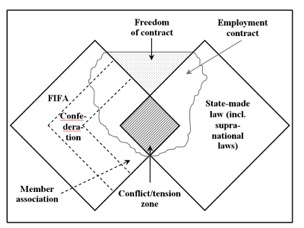
Furthermore, FIFA has also private dispute resolution venues and sophisticated system of sanctions and incentives promoting compliance with the decisions of the private order’s dispute resolution bodies. Possible sanctions vary but they are leveraged by the monopoly power of FIFA. Consider the right of FIFA to suspend a member association for a specific period or expel it fully from FIFA for failure to comply with its obligations, including an obligation to comply with FIFA or CAS decisions. Given FIFA's monopoly, this, in fact, means that national teams and licensed clubs from the suspended or expelled country cannot participate in any organized game. As a consequence, FIFA has been able to maintain cooperation among all involved actors, yet, along with the increasing commercial dimension, the incentives of states and other public orders, particularly the EU, to intervene have grown.

Integrity vs. legal order

The fact that FIFA is undermined by corruption is nothing surprising. Prof. Alina Mungiu-Pippidi shows that the average public integrity in more than 200 countries whose soccer associations are the FIFA constituents “is just 5, on a scale where New Zealand has ten and Somalia 1” […] “Were FIFA a country, it would clearly not be in the upper half, but somewhere near Brazil, whose officials seem to have been waist deep in its corruption, and which ranks around 121, with a 4.2”. FIFA’s administrative structure, certainly, needs reforms that will improve its financial stability and decrease corruption risks within the organization. These reforms, indeed, may require “public nudge” by the enforcement of extraterritorial “anti-mafia” statutes such as the US Racketeer Influenced and Corrupt Organization Act (RICO) that played the central role in the so-called FIFAGate. Moreover, in the light of “the second FIFAGate”—six months after the original scandal, a number of FIFA officials that replaced the old leadership were charged with a 92-count indictment—and after the recent neutralization of its internal corruption investigations (see here), more radical “public nudge” may be desirable. Indeed, these developments, as was discussed in this blog some time ago, may call for a more powerful intervention by, for example, the EU, to impose ‘certain basic “constitutional” requirements’ to FIFA.

Nevertheless, while FIFA may need “public help” to clean its house and improve some areas of its legal order, no public order is a better alternative. Common rules spanning across borders, predictable contractual relations, and incentives to invest in training young players are only some advantages made possible by FIFA’s tailored rules of behavior. These advantages would be lost if public interventions would crash the FIFA order and replace it by a patchwork of national laws, unstable contractual relations, more costly dispute resolution and enforcement mechanisms, and limited ability to encourage talent development. Therefore, while FIFA as an administrative organization may generally be considered as more corrupt than an average government, it has been able to offer harmonized institutions that in many cases are better accustomed to the needs of the involved parties than their state-made alternatives, which often are based on one-size-fits-all approach and lack certainty of application.

Public orders as the reversed civil society

It does not mean that public orders such as the EU and nation states should do nothing. Private entities often need a “public nudge” not only to prevent excesses, but also to maintain incentives to produce rules that reflect new economic and social developments. In numerous writings (for an overview see Katz), law-and economics scholars indicate that while in principle private orders should be best left alone, states should limit the potential of powerful interest groups to undermine the roots of private orders such as FIFA. Who, how, and when should determine the benchmark of what is excessive is difficult, and law-and economics has declined to offer a general theory of the role of public orders in nudging private orders to limit interest groups’ power. Nevertheless, determining the role of public orders is no more difficult than the question what civil society should do when it comes to the performance of nation states.

In the context of nation states, the key role in limiting the power of elites belongs to the civil society. In case of monopolistic orders such as FIFA’s, however, there is often no direct representation of various actors inside such orders. Shouldn’t, then, states and the EU assume the role of a reversed civil society when interacting with large and successful private orders? In practice, particularly the EU is more and more involved in an informal co-determination of football-related regulation (for similar argument see here). For example, the recent social dialogue in European football, brokered by the EU Commission, is an example how public orders can fulfill their role as reversed civil society. The EU Commission, instead of intervening directly and regulating sports, encouraged, and should do so much more, various stakeholder groups, such as the European Club Association and FIFPro, to engage in a dialogue with the purpose of improving the practices of player protection (however, it is true that the EU Commission had a way deeper impact through EU competition law, see Duval). For the private order itself participation in this dialogue and active encouragement of the enforcement of its results is the best way to guarantee its role as a supplier of rules (see generally Colucci & Geeraert). In contrary, refusal to accommodate certain mechanisms, and mainly these that effectively limit FIFA’s executives’ power (e.g. Ethics Committee), may lead to a forceful, but legitimate, public intervention with possibly tragic consequences for the world of football.

Conclusion: Taking over fallen FIFA

What is so fascinating about FIFA is that it exemplifies how a very small number of enthusiastic people could set a mechanism that is ultimately able to create institutions that aim to regulate behavior of involved actors globally as well as to keep them away from regular courts. FIFA is an example of an order that has created huge economic and social value by being able to overcome many hurdles that prevented countless other member associations from creating their own orders (think of lawyers or investment bankers, for example). The fact that such order locks-in all involved football actors, despite some, such as small teams, benefiting significantly less by their participation than others, suggests that there is a value, despite FIFA’s monopoly power, that alternatives cannot offer. Some of them, such as increased certainty, are in the interests of all involved actors, whereas others, such as commitment to enforce contractual practices or training compensation awards, are more preferred by sophisticated actors (i.e. clubs and prominent footballers) and small clubs, respectively. This, though not allowing to state plainly that the private order is maximizing the welfare of all involved actors, also does not justify arguments for abandoning the current system in favor of state laws. In contrary, failure to accommodate mechanisms that limit the power of inside interest groups might undermine the order by giving incentives to interest groups to advocate public orders’ involvement, thereby putting an end to the monopoly of FIFA’s order, and possibly its destruction.

Comments are closed