Asser International Sports Law Blog

Our International Sports Law Diary
The Asser International Sports Law Centre is part of the T.M.C. Asser Instituut

Chess and Doping: Two ships passing in the Night? By Salomeja Zaksaite, Postdoctoral researcher at Mykolas Romeris University (Lithuania), and Woman International Chess Master (WIM)

It may come as a surprise to laymen, but chess players are subjected to doping testing. Naturally, then, the questions follow as to why they are tested, and if they are really tested (at least, with a level of scrutiny comparable to that which physically-oriented athletes are regularly subjected). More...

The International Sports Law Digest – Issue I – January-June 2014 (by Frédérique Faut)

The International Sports Law Digest will be a bi-annual post gathering recent material on International and European Sports Law. This is an attempt at providing a useful overview of the new, relevant, academic contributions, cases, awards and disciplinary decisions in the field of European and International Sports Law. If you feel we have overlooked something please do let us know (we will update the post).

Antoine Duval More...


A Short Guide to the New FIFA Regulations on Working with Intermediaries

This year’s FIFA congress in Sao Paulo should not be remembered only for the controversy surrounding the bid for the World Cup 2022 in Qatar. The controversy was surely at the centre of the media coverage, but in its shadow more long-lasting decisions were taken. For example, the new Regulations on Working with Intermediaries was approved, which is probably the most important recent change to FIFA regulations. These new Regulations will supersede the Regulations on Players’ Agents when they come into force on 1 April 2015. In this blog post we compare the old and the new Regulations followed by a short analysis and prospective view on the effects this change could have. More...

Cannibal's Advocate – In defence of Luis Suarez

Luis Suarez did it again. The serial biter that he is couldn’t refrain its impulse to taste a bit of Chiellini’s shoulder (not really the freshest meat around though). Notwithstanding his amazing theatrical skills and escaping the sight of the referee, Suarez could not in the information age get away with this unnoticed. Seconds after the incident, the almighty “social networks” were already bruising with evidence, outrage and commentaries over Suarez’s misdeed. Since then, many lawyers have weighed in (here, here and here) on the potential legal consequences faced by Suarez. Yesterday FIFA’s disciplinary committee decided to sanction him with a 4 months ban from any football activity and a 9 International games ban. In turn, Suarez announced that he would challenge the decision[1], and plans on going to the Court of Arbitration for Sport if necessary[2]. Let’s be the advocates of the cannibal!More...

Blurred Nationalities: The list of the “23” and the eligibility rules at the 2014 FIFA World Cup. A guest Post by Yann Hafner (Université de Neuchâtel)

In 2009, Sepp Blatter expressed his concerns that half of the players participating in the 2014 FIFA World Cup would be Brazilians naturalized by other countries. The Official list of Players released a few weeks ago tends to prove him wrong[1]. However, some players have changed their eligibility in the past and will even be playing against their own country of origin[2]. This post aims at explaining the key legal aspects in changes of national affiliation and to discuss the regulations pertaining to the constitution of national sides in general[3]. More...

The FIFA Business – Part 2 - Where is the money going? By Antoine Duval and Giandonato Marino

Our first report on the FIFA business dealt with FIFA’s revenues and highlighted their impressive rise and progressive diversification. In parallel to this growth of FIFA’s income, it is quite natural that its expenses have been following a similar path (see Graph 1). However, as we will see FIFA makes it sometimes very difficult to identify precisely where the money is going. Nonetheless, this is precisely what we wish to tackle in this post, and to do so we will rely on the FIFA Financial reports over the last 10 years.
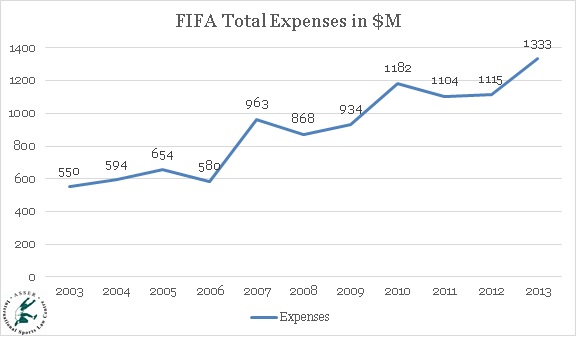


Graph 1: FIFA Expenses in USD million (adjusted for inflation), 2003-2013.

More...


The EU State aid and Sport Saga - A legal guide to the bailout of Valencia CF

After a decade of financial misery, it appears that Valencia CF’s problems are finally over. The foreign takeover by Singaporean billionaire Peter Lim will be concluded in the upcoming weeks, and the construction on the new stadium will resume after five years on hold due to a lack of money. On 3 June Bankia, the Spanish bank that “saved” Valencia CF in 2009 by providing a loan of €81 million, gave the green light for the takeover. However, appearances can be deceiving.More...

Gambling advertising regulations: pitfalls for sports sponsorship - By Ben van Rompuy

In April 2014, the Swedish Gambling Authority (Lotteriinspektionen) warned the organisers of the Stockholm Marathon that it would impose a fine of SEK 2 million (ca. € 221.000) for its sponsorship agreement with online betting operator Unibet. The Authority found that the sponsorship agreement violates §38 of the Swedish Lotteries Act, which prohibits the promotion of gambling services that are not authorized in Sweden.[1] The organisers, however, refused to withdraw Unibet as its sponsor and prominently displayed the Unibet logo at the event, which took place on 31 May 2014. As a result, the organisers of the Stockholm Marathon now face legal action before the Swedish administrative courts. More...

The FIFA Business – Part 1 – Where Does The Money Come From? - By Antoine Duval and Giandonato Marino

On next Thursday the 2014 World Cup will kick off in Sao Paulo. But next week will also see the FIFA members meeting on Tuesday and Wednesday at a much awaited FIFA congress. For this special occasion we decided to review FIFA’s financial reports over the last ten years. This post is the first of two, analysing the reports and highlighting the main economic trends at play at FIFA. First, we will study the revenue streams and their evolution along the 2003-2013 time span. In order to ensure an accurate comparison, we have adjusted the revenues to inflation, in order to provide a level playing field easing the comparative analysis over the years and types of revenues. Our first two graphs gather the main revenue streams into two comparative overviews. Graph 1 brings together the different types of revenues in absolute numbers, while Graph 2 lays down the share of each type of revenues for any given year (the others category covers a bundle of minor revenue streams not directly relevant to our analysis).
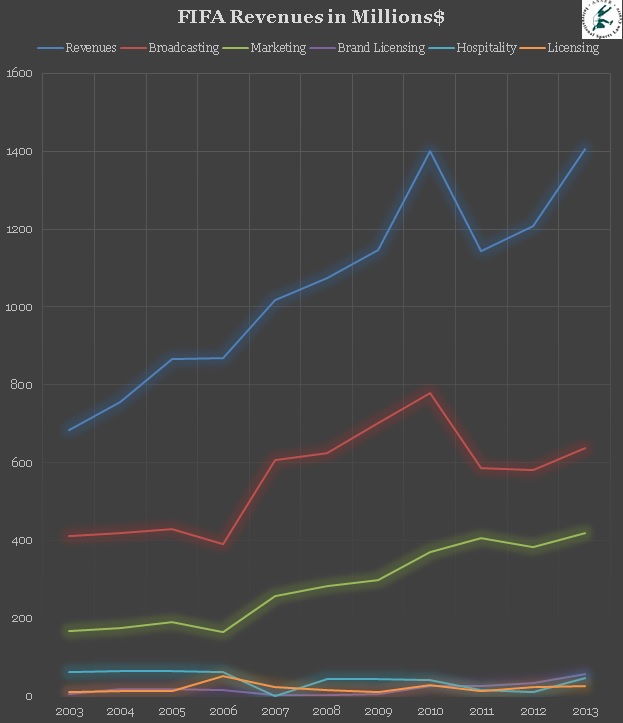


Graph 1: FIFA revenues in Millions of Dollars, 2003-2013 (adjusted for inflation). More...


Losing the UEFA Europa League on the Legal Turf: Parma FC’s bitter defeat by Giandonato Marino

This year the race for UEFA Europa League places in Serie A was thrilling. In the final minutes of the last game of the season, Alessio Cerci, Torino FC striker, had the opportunity to score a penalty that would have qualified his team to the 2014-2015 edition of the UEFA Europa League. However, he missed and Parma FC qualified instead. More...

Asser International Sports Law Blog | International and European Sports Law – Monthly Report – July 2016 - By Marine Montejo

Asser International Sports Law Blog

Our International Sports Law Diary
The Asser International Sports Law Centre is part of the T.M.C. Asser Instituut

International and European Sports Law – Monthly Report – July 2016 - By Marine Montejo

Editor’s note: This report compiles all relevant news, events and materials on International and European Sports Law based on the daily coverage provided on our twitter feed @Sportslaw_asser. You are invited to complete this survey via the comments section below, feel free to add links to important cases, documents and articles we have overlooked. 

The Headlines

The McLaren Report on Russia’s State Doping System

It is difficult not to start this monthly report without referring to the never-ending Russian doping investigation that is shaking the sporting world. On 18 July, the independent investigation on Sochi 2014 winter Olympics led by Prof. McLaren, a Canadian law professor, and requested by the World Anti-Doping Agency (“WADA”), released its report. It confirmed evidence of widespread, State-sponsored doping in Russian sports and called for a full ban on the country from the next Rio Olympics. In response to the report, the International Olympic Committee (“IOC”) vowed to take the “toughest sanctions available”. However, and despite the race against time in the run-up to Rio 2016, the IOC delayed its decision for several days amid a WADA statement and several press articles calling for a ban of Russia from Rio Olympics. Meanwhile, it did open an investigation against Russia’s sports minister, Vitaly Mutko, the head official who allegedly supervised the overall doping cover up and explored all possible legal actions against Russia. On 21 July, the Court of Arbitration for Sport (“CAS”) rejected the appeal of the Russian Olympic Committee and 68 Russian athletes against the International Association of Athletics Federations (“IAAF”) decisions to suspend All Russia Athletics Federation (ARAF) from IAAF membership given the evidence of a state-sponsored doping system. As a consequence, Russian track and field athletes were also banned from Rio 2016 Olympics. With the IAAF welcoming this decision, one could think that nothing was standing in the way of a full Olympic ban for all Russian athletes. While some Russian athletes announced that they would appeal the CAS award to the Swiss Federal Court. Yelena Isinbayeva, the banned pole vault champion, even took it a step further by claiming that she would challenge the IAAF decision as far as the European Court of Human Rights. Yet, it is very improbable that any of these challenges be decided in time for the Rio Games.

On 24 July, the IOC Executive Board finally handed out its decision on the question of the participation of Russian athletes to the Rio Olympics. The decision left no one satisfied,  least of all WADA. In a nutshell, the IOC passed the buck to international federations by deciding that the evidence uncovered by the report is not sufficient to adopt a general ban of the Russian Olympic Committee. Instead, it is for every international sports federation to judge on a case-by-case fashion whether a Russian athlete is eligible to be qualified for the Olympics. Sports governing bodies have to decide following two criteria, namely whether the athlete was previously controlled by laboratories situated outside of Russia and whether he/she was never convicted of anti-doping breach in his/her career. The International swimming federation (“FINA”), for example, decided to ban seven swimmers, some of them have already announced their intention to appeal before CAS. And this is just the beginning. The IOC decision not to decide has been highly criticized (see for example here and here), but it is probably the IOC Olympic ban on Yulia Stepanova, the Russian whistle-blower through whom the scandal emerged, that was criticized the most. A global online petition was set up to draw attention to her case and athletes from around the world launched a crowdfunding appeal. For more information on this sprawling case you can read our blog.

The CAS before German courts

The next very salient sports law issue of the month is the ongoing challenges against CAS awards and their enforcement in Germany. Early July, Claudia Pechstein announced that she would be challenging BGH ruling in front of the German constitutional Court around two main arguments, namely, the access to justice and the freedom to exercise her profession. On 7 June the highest German civil court ruled that CAS was sufficiently independent and that an arbitration agreement in favour of CAS was legal under German civil and competition law (see our blog). CAS swiftly published an English version of the judgment (though we are still waiting for the official translation of the previous OLG München decision) that you can find here. Another important case, but this time concerning the application of EU free movement law in the framework of the enforcement of a CAS award, is the BGH ruling in the SV Wilhemshaven case. The BGH announced early July that it would release its judgment on 27 September. As a quick reminder, this case is concerning an Argentinian-Italian football player transferred to a German club. The latter is refusing to pay training compensations imposed by the FIFA Regulations for the Status and Transfer of Players and challenged the enforceability of the CAS award in this case (see our blog).

EU Commission State Aid Decisions

The other big sports law story of this month was the long awaited European Commission decisions on State aid granted in favour of Spanish professional football clubs. The Commission decided that public support measures granted by Spain to seven football clubs gave those clubs an unfair advantage leading to distorted competition and, as a consequence, the amounts at stake have to be recovered (i.e.: for example, Real Madrid - €18.4 million and FC Valencia - €20.4 million). For a full commentary on the “Spanish recovery decisions” see our blog. On the exact same day, the European Commission also cleared municipal support measures for five professional football clubs in the Netherlands (FC Den Bosch, MVV Maastricht, NEC Nijmegen, PSV Eindhoven, and Willem II in Tilburg). In the case of PSV, the Commission determined that the municipality’s purchase of the land on which the PSV stadium stands, and the subsequent lease-back agreement, was in line with the so-called “Market Economy Investor Principle”. The measure, therefore, did not constitute State aid. The remaining Dutch football clubs did receive State aid, according to the Commission. However, these measures were granted in accordance with the Community Guidelines on State aid for rescue and restructuring firms in difficulty, and were consequently regarded as compatible State aid. Notwithstanding these eight State aid decisions, it also became apparent that the Commission does not foresee other State aid investigations on EU football clubs at this point.


Case law

The Court of Arbitration for Sport (“CAS”) released two decisions on Rio 2016 selections. The first one concerns Australian trap shooter Mitchell Iles (CAS A1/2016) challenging the Australian men’s trap shooting selection for Rio 2016 and, ultimately, his non-selection. The arbitrator has found that the Appeals Tribunal of Shooting Australia rejecting the athlete’s appeal had erred in a question of law. CAS upheld the appeal, set aside the decision taken by the Appeals Tribunal of Shooting Australia, and referred the case of Mitchell Iles back to Shooting Australia.

In the second case CAS has upheld a request for provisional measures filed by Korean swimmer Tae Hwan Park. The swimmer was sanctioned by FINA for an anti-doping breach (sanction that ended on 2 March), but was prevented from participating in Rio 2016 by Korean Sport and Olympic Committee regulations imposing a three-year ban from national teams after the completion of a doping sanction. CAS ruled that Tae Hwan Park is eligible for selection for the Korean national team for Rio 2016.

CAS also delivered its award concerning Norwegian cross country skier Martin Johnsrud (CAS 2015/A/4233). The International Ski Federation’s (“FIS”) Doping panel did not sanction the skier after two in-competition doping controls that revealed levels exceeding the applicable limits for salbutamol. The WADA referred the case to CAS. The arbitrators found that use of a substance beyond the applicable limit without a Therapeutic Use Exemption was a breach of anti-doping rules. They sanctioned the skier with a two-month period of ineligibility and disqualification for the competitions concerned as there were medical justifications in that case.


Official Documents and Press Releases


In the news

Football

Doping

Match-fixing

Olympics 


Academic materials


Blogs


Books


Upcoming Events September

Comments are closed