Asser International Sports Law Blog

Our International Sports Law Diary
The Asser International Sports Law Centre is part of the T.M.C. Asser Instituut

WISLaw Blog Symposium - Legal and other issues in Japan arising from the postponement of the Tokyo 2020 Olympic Games due to COVID-19 - By Yuri Yagi

Editor's note: Yuri Yagi is a sports lawyer involved in Sports Federations and Japanese Sports Organizations including the Japan Equestrian Federation (JEF), the International Equestrian Federation (FEI), the Japanese Olympic Committee (JOC), the Japan Sports Council (JSC) and the All-Japan High School Equestrian Federation.


1. Introduction

Japan has held three Olympic Games since the inception of the modern Olympics;Tokyo Summer Olympic Games in 1964, Sapporo Winter Olympic Games in 1972, and Nagano Winter Olympic Games in 1998. Therefore, the Tokyo 2020 Olympic Games (Tokyo 2020) are supposed to be the fourth to be held in Japan, the second for Tokyo. Tokyo 2020 were originally scheduled for 24 July 2020 to 9 August 2020. Interestingly, the word ‘postpone’ or ‘postponement’ does not appear in the Host City Contract (HCC).

However, the International Olympic Committee (IOC), the Tokyo Metropolitan Government (TMG), the Japanese Olympic Committee (JOC), and the Tokyo Organising Committee of the Olympic and Paralympic Games (TOCOG) decided on 24 March 2020 that Tokyo 2020 would be postponed because of the pandemic of COVID-19. Later on, the exact dates were fixed ‘from 23 July 2021 (date of the Opening Ceremony) to 8 August 2021 (date of the Closing Ceremony).

The process of the decision is stipulated in the ‘ADDENDUM N° 4’ signed by IOC, TMG, JOC and TOCOG.

This paper provides an overview of the current situation, along with legal and other issues in Japan that have arisen due to the postponement of Tokyo 2020 due to COVID-19. The overview is offered from the perspective of a citizen of the host city and includes a consideration of national polls, the torch relay, vaccination, training camps, ever increasing costs, and the related provisions in the Candidature File and the Host City Contract.

2.    The Situation of COVID-19 in Japan

According to the Government, the first COVID-19 case in Japan was confirmed on 16 January 2020. On 24 March 2020, when the postponement of Tokyo 2020 was decided, the reported number of new COVID-19 positive cases in Japan was 64 (Japanese population is around 126 million). As a comparison, reported cases in Japan on 28 May 2021 was 3,706.

3.    National State of Emergency

Since the start of the pandemic, National states of emergency have been issued three times in Tokyo, the first time was from 7 April 2020 (the reported number of positive cases on that day in Tokyo was 87) to 25 May 2020 (8 cases), the second time was from 8 January 2021 (2,459 cases) to 21 March 2021 (256 cases), and the third began on 25 April 2021 (635 cases) and is still in effect (539 cases as of 29 May 2021). A national state of emergency is not similar to the lockdowns issued in several other countries. It is basically the government’s request that people stay at home. Under National states of emergency, the Government asked businesses, especially restaurants and bars, to close earlier than usual or completely.

4.    National Poll as to Olympic Games

According to a national poll carried out by Japan Broadcasting Corporation (NHK, which is Japan's only public media organization) and published on 10 March 2020, 14 days prior to the decision of the postponement, 40% of respondents answered that they believe the Olympics will be held as scheduled. Conversely, 45% answered that they do not.

The telephone survey of 1,300 Japanese residents carried out by NHK and published on 23 July 2020 showed that 35% said that Tokyo 2020 should be postponed further, 31% said that they should be cancelled, and 26% said that they should be held as scheduled.

In the national poll published by NHK in May 2021, 49% answered Tokyo 2020 should be cancelled, 23% answered they should be held without spectators, 2% answered they should be held as usual.

In addition, people who demanded the cancellation of Tokyo 2020 collected more than 350,000 signatures in an online petition.

5.    Torch Relay

The Olympic Flame was lit in Greece on 12 March 2020 and arrived in Japan on 20 March 2020, just prior to the decision to postpone. However, most related ceremonies were cancelled or downsized and there was less excitement among Japanese citizens than originally expected.

The postponed torch relay started on 26 March 2021 in Fukushima Prefecture, which was severely damaged by a tsunami following The Great East Japan Earthquake in 2011. The torch relay is still ongoing and is live streaming every day on the internet. However in many places, the torch relay has been replaced with stage events instead of running on public roads. Japanese citizens have been asked to not attend the torch relay or the events. As a result, the torch relay has turned out to be totally different from what was expected.

6.    Slow Rollout of Vaccine

COVID-19 vaccination started in Japan on 17 February 2021, first for frontline workers, and at the time of this article (31 May 2021), they are mainly being administered for elderly people over 65 years old. It is a relatively late start and a slow rollout compared to other developed countries (for example vaccination started in December 2020 in the US, the UK, Itally,  France, Germaney, and other countries). As of 30 May 2021, only 0.25% of residents in Japan have been fully vaccinated (twice) and 3.67% have be vaccinated once.

Japanese Prime Minister Yoshihide Suga announced that IOC had struck a deal with Pfizer to provide vaccines for all Tokyo 2020 participants. Accordingly, JOC announced that about 1,600 athletes and other members of Japan's potential delegation to Tokyo 2020 will be vaccinated from 1 June 2021.

7.    Pre-Event Training Camps and Games-Related Events

COVID-19 has also had an effect on Games-related plans such as pre-event training camps and cultural programs planned by local governments. As of 18 May 2021, training camps and Games-related cultural exchange events have reportedly been cancelled in many local governments (reported number was 54) because of the infection risks and the delays of the qualification process.

However it is also reported that the Australian softball team plans to come to Japan for a training camp on 1 June 2021. If this plan is realized, they will be the first team to arrive.

8.    Increasing Cost and Decreasing Revenue

Because of the increasing cost incurred as a result of the postponement, the IOC offered an additional support of reportedly 650 million USD. To reduce costs and support COVID-19 infection prevention measures, TMG and IOC agreed to simplify Tokyo 2020. It has already been decided that spectators from other countries will not be allowed to attend the games. As for domestic spectators, a final decision is expected to be made by the end of June 2021. At any rate, the revenue from the ticket sales will be significantly less than originally estimated.

The postponement of Tokyo 2020 has also resulted in additional costs related to the extension of the employment contracts of the TOCOG staff members, lease contracts of the TOCOG office, and no doubt, countless other contracts. As to domestic sponsorship contracts for Tokyo 2020, they were originally for terms ending December 2020. However, due to  the postponement of the Games, all 68 domestic companies agreed to extend the contract until the end of 2021, despite also facing an unprecedented stagnant business situation.

As to the case of deficit or budget shortfall, the Candidature File and Host City Contract (HCC) provides who will bear the loss.

9.    Candidature File and Host City Contract (HCC)

IOC elected Tokyo as the host city of the 2020 Summer Olympic Games in the 125th IOC Session took place in Buenos Aires, Argentina, from 7 to 10 September 2013. In the bidding process, Candidate Tokyo submitted a Candidature File to the IOC.

Case of Deficit or Budget Shortfall

As to the case of deficit or budget shortfall, the Candidature File and HCC provide that, if TOCOG incurs a deficit, TMG will guarantee to cover any potential economic shortfall of TOCOG, then if TMG should be unable to compensate in full, the Japanese government will ultimately provide the financial support.

Candidature File (*underline added by author for emphasis)

6.1 An OCOG budget fully guaranteed

6.1.1 TOCOG Budget guarantee

Tokyo 2020 is very confident the TOCOG budget will be balanced. Nevertheless, should TOCOG incur a deficit, the Tokyo Metropolitan Government (TMG) has guaranteed to cover any potential economic shortfall of TOCOG, including refunds to the IOC in advance of payment or for other contributions made by the IOC to TOCOG.

In addition, should TMG be unable to compensate in full, the Government of Japan will ultimately compensate for it in accordance with the relevant laws and regulations of Japan.

6.1.2 Compensation mechanism in the event of a budget shortfall

(…) if necessary, TOCOG will activate the compensation mechanism.

Under the compensation mechanism, TOCOG will consult with TMG and the Government of Japan to ensure that the Tokyo 2020 Olympic and Paralympic Games can take place as planned. Financial support will be primarily provided by TMG. In addition, should TMG be unable to compensate in full, the Government of Japan will ultimately provide the financial support in accordance with the relevant laws and regulations of Japan.

The compensation mechanism will function in a similar fashion in the event of full or partial cancellation of the Tokyo 2020 Olympic and Paralympic Games.

The Candidature File is referred to in the HCC, which was signed by the IOC, TMG and JOC on 7 September 2013. It provides that, the TMG and TOCOG shall be jointly and severally responsible for financial undertakings and the Japanese government shall support them.

Host City Contract (*underline added by author for emphasis)

4. Joint and Several Obligations of the City, the NOC and the OCOG

 (…) the City, the NOC (other than with respect to the aforementioned financial undertakings of the City and the OCOG) and the OCOG shall be jointly and severally responsible in respect of all damages, costs and liabilities of any nature, direct and indirect, which may result from a breach of any provision of this Contract. The IOC may in its sole discretion take legal action against the City, the NOC and/or the OCOG, as the IOC deems fit.

The foregoing shall be without prejudice to the liability of any other party, including without limitation, any Government, national, regional or local authorities that provided financial guarantees during the City's application or candidature to host the Games or otherwise.


7. Guarantees, Representations, Statements and Other Commitments

All guarantees, representations, statements, covenants and other commitments contained in the City's application or candidature file  (…) shall survive and be binding upon the City, the NOC and the OCOG, jointly and severally, (…).

On top of that, the HCC provides that the TMG, JOC and TOCOG must always protect IOC from all payments and other obligations in respect to any damages, claims, actions, losses, costs, and/or expenses. On the other hand, the TMG, JOC and TOCOG promised to waive any claims against the IOC in the HCC.

9. Indemnification and Waiver of Claims Against the IOC

a) Indemnity by the City, the NOC and the OCOG. The City, the NOC and the OCOG shall at all times indemnify, defend and hold harmless and exempt the IOC, IOC Television and Marketing Services SA, the OBO, as further detailed in Section 54 (a) below, and their respective officers, members, directors, employees, consultants, agents, attorneys, contractors (e.g. Olympic sponsors, suppliers, licensees (of the IOC, the National Olympic Committees and the Organising Committees of the Olympic Games) and broadcasters) and other representatives (each, an "IOC Indemnitee" and collectively, "IOC Indemnitees"), from all payments and other obligations in respect of any damages, claims, actions, losses, costs, expenses (including outside counsel fees and expenses) and/or liabilities of any nature (including injury to persons or property), direct or indirect, suffered by the IOC (or any IOC Indemnitee), including all costs, loss of revenue, and also damages that the IOC (or any IOC Indemnitee) may have to pay to third parties (including but not limited to Olympic sponsors, suppliers, licensees and broadcasters) (collectively, "Claims") resulting from:

i) all acts or omissions of the City, the NOC and/or the OCOG (…), relating to the Games (including in connection with the planning, organising, financing and staging thereof) and/or this Contract;

iii) any claim by a third party arising from, or in connection with, a breach by the City, the NOC or the OCOG of any provision of this Contract.


c) Waiver of Claims against the IOC. Furthermore, the City, the NOC and the OCOG hereby waive any Claims against the IOC and the other IOC Indemnitees, including for all costs resulting from all acts or omissions of the IOC relating to the Games, as well as in the event of any performance, non-performance, violation or termination of this Contract. This indemnification and waiver shall not apply to wilful misconduct or gross negligence by the IOC.

Cancellation

As to the cancellation of Tokyo 2020, only the IOC has the right to make such decision on  ‘reasonable grounds’. In the  case of cancellation by the IOC for any reason, the TMG, JOC and TOCOG will be considered as waiving any claim or right of indemnity, and promising to indemnify and hold IOC Indemnities harmless from any third party claims.

XI. Termination

66. Termination of Contract

a) The IOC shall be entitled to terminate this Contract and to withdraw the Games from the City if:

i)  the Host Country is at any time, whether before the Opening Ceremony or during the Games, in a state of war, civil disorder, boycott, embargo decreed by the international community or in a situation officially recognised as one of belligerence or if the IOC has reasonable grounds to believe, in its sole discretion, that the safety of participants in the Games would be seriously threatened or jeopardised for any reason whatsoever;

(…)

iii) the Games are not celebrated during the year 2020;

iv) there is a violation by the City, the NOC or the OCOG of any material obligation pursuant to this Contract, the Olympic Charter or under any applicable law; or if

(…)

In case of withdrawal of the Games by the IOC, or termination of this Contract by the IOC for any reason whatsoever, the City, the NOC and the OCOG hereby waive any claim and right to any form of indemnity, damages or other compensation or remedy of any kind and hereby undertake to indemnify and hold harmless IOC Indemnitees from any third party claims, actions or judgements in respect of such withdrawal or termination(…).

Dispute Resolution

According to Article 87 of HCC, in the case of dispute among parties, the applicable law is Swiss law, and the dispute is to  be decided by Court of Arbitration for Sport (CAS).

87. Governing Law and Resolution of Disputes; Waiver of Immunity

This Contract is governed by Swiss law. Any dispute concerning its validity, interpretation or performance shall be determined conclusively by arbitration, to the exclusion of the ordinary courts of Switzerland or of the Host Country, and be decided by the Court of Arbitration for Sport in accordance with the Code of Sports-Related Arbitration of the said Court. (…)  

10.  Conclusion

No one expected COVID-19 nor the impact that it would have on the Olympic Games at the time of the bidding process and of the signing of the HCC. As a result, the HCC and Candidature File provisions related to the losses caused by the postponement were not well understood among the Japanese people. Now people are starting to recognize the possibility that the TMG or/and Japanese government will likely incur huge losses as a result of the postponement or, in the worst-case, cancellation of Tokyo 2020.

Many Tokyo citizens and Japanese citizens were looking forward to Tokyo 2020 before COVID-19. However, judging from the national polls, now this excitement seems to turn into anxiety and concern.

While the whole world continues to prepare for the postponed Tokyo 2020,  the situation is still uncertain. In fact, the current number of COVID-19 cases in Japan is much larger than at the time when the postponement was decided in March 2020. It is very hard for involved individuals to maintain their motivation in light of this uncertainty. On the other hand, the vaccination push is expected to be a game-changer. Not only the TOCOG, TMG and JOC, but also multimedia outlets, sporting federations, sponsors, travel agencies, and the general public are preparing, believing Tokyo 2020 will be held. It’s natural and understandable that host city citizens have various opinions. However, athletes have been training for the chance to qualify and compete at the Olympic Games their whole life. Therefore, it is hoped the situation will improve and the Tokyo 2021 Olympic Games will be held safely and securely even if they are totally different from what we expected originally.

Comments are closed
Asser International Sports Law Blog | The Legia Warszawa case: The ‘Draconian’ effect of the forfeiture sanction in the light of the proportionality principle. By Thalia Diathesopoulou

Asser International Sports Law Blog

Our International Sports Law Diary
The Asser International Sports Law Centre is part of the T.M.C. Asser Instituut

The Legia Warszawa case: The ‘Draconian’ effect of the forfeiture sanction in the light of the proportionality principle. By Thalia Diathesopoulou

The CAS denial of the urgent request for provisional measures filed by the Legia Warszawa SA in the course of its appeal against the UEFA Appeals Body Decision of 13 August 2014 put a premature end to Legia’s participation in the play-offs of the UEFA Champion’s League (CL) 2014/2015. Legia’s fans- and fans of Polish football - will now have to wait at least one more year to watch a Polish team playing in the CL group stage for the first time since 1996.

While the CAS proceedings for the appeal filed by Legia against UEFA and Celtic FC are pending and the grounds of dismissal by the CAS of the application for provisional measures have not been publicly known, the CAS is called to rule on the interpretation of the proportionality principle with regard to the application of the 3-0 defeat sanction against a club that fielded an ineligible player. The cornerstone question is whether the final award on the merits will be in line with UEFA and CAS jurisprudence suggesting a literal interpretation of Article 21.2 of the UEFA Disciplinary Regulations (UEFA DR) or whether the CAS will allow for a broader interpretation of the proportionality principle in case of mere technical administrative errors. 


Background and facts of the case

Legia’s adventures began when Legia’s player, Bartosz Bereszynski, was sent off in their final Europa League tie of last season against Apollon Limassol FC and was sanctioned by the UEFA Control and Disciplinary Body decision of 13 February 2014 with three-match suspension.  UEFA regulations are clear in that a ban applies to a player if he is listed in a club’s squad for matches. Bereszynski did not play in Legia’s games with St Patrick’s Athletics and in the first leg against Celtics FC. However, due to a technical error of Legia’s administrator, which was to prove fatal, the player was not registered in the squad list for the St Patrick’s tie and the first two games of his suspension were never properly recognized. As a result of the player’s failure to serve the suspension, Bereszynski’s participation in the second leg against Celtics FC as a 86th minute substitute triggered the application of Article 18 of the Regulations of the UEFA Champions League 2012-2015 and Article 21.2 of the UEFA DR and Legia was to be sanctioned for fielding a suspended player. Therefore, the match was declared forfeited; for UEFA’s purposes, Legia lost the game 3-0 and the initial 6-1 aggregate defeat for Celtic was reversed to a 4-4 aggregate score, opening the door for Celtic to progress in UEFA CL play-offs on away goals.  


The Legia case in the light of UEFA jurisprudence

At a first glance, the case at issue seems to present several factual similarities with the Bowyer and Matoukou cases brought before UEFA’s Control and Disciplinary Body, which, however, have never been appealed before the CAS.

In the first case, similarly to the Legia case, due to an administrative error of Newcastle United FC, Bowyer had not been registered as ‘eligible to play’ in the six UEFA matches in 2004. As a result, UEFA’s Control and Disciplinary body, applying UEFA Regulations, decided that Bowyer had not served the suspension carried over from his days as a Leeds United player and was banned for the next six European matches. This decision was challenged by Newcastle and the English Football Association (FA) before the UEFA’s Appeal Body, which upheld the initial decision. It is remarkable that the FA supported Newcastle’s appeal, expressing its concerns with regard to the ambiguous language of the rules on players’ eligibility.

In the second case, Matoukou while playing for KRC Genk against FC Porto on 19 August 2010 in a UEFA Europa League qualifier, received a red card and as a consequence was sanctioned with a two-match suspension. Matoukou sat out the second leg of that tie and, after Genk’s elimination, played no further European games for Genk. On 2 August 2012, Matoukou, as a player of Arsenal Kiev FC, scored against ND Mura 05. However, Matoukou had not served the second part of his suspension before taking part to this game. As a result of his ineligibility, UEFA’s Control and Disciplinary Body declared the match forfeited. Although there is no doubt that the player did not serve the two-match suspension, this case illustrates the most recent example of the clear-cut application of Disciplinary Regulations by UEFA.

A similar example is the harsh sanction of 3-0 defeat applied against PAOK Saloniki in 2004 for fielding the suspended player, Laisis Louca, in the first leg of the CL third qualifying round against Maccabi Tel Aviv. NK Zepce was also punished with the same severity in 2005 for fielding a suspended player in the first half of their match against FK Baskimi. The inevitable conclusion of this brief overview of UEFA jurisprudence is that UEFA’s practice has been consistent; UEFA Regulations on players’ eligibility are sufficiently clear and they give no room for a different interpretation. However, it should be noted that the UEFA decisions can be appealed before the CAS. Therefore, the CAS jurisprudence needs to be examined in order to assess whether the CAS in interpreting UEFA Regulations has deviated from this rather simplistic clear-cut approach of UEFA.  


The Legia case in the light of CAS jurisprudence

The Sion[1] case has been the CAS landmark case with regard to the proportionality of the sanction of forfeiture for clubs fielding ineligible players. In this case, the CAS confirmed that FC Sion was banned from registering five new players in the summer transfer period of 2011/12 pursuant to the FIFA decision and was excluded from UEFA Europa League. Funnily enough, Celtic was also back then the lucky club, which enjoyed a ‘second bite of the cherry’. While this case presents only few factual similarities with the Legia case, its importance lies in that the CAS had to rule whether a club’s exclusion mandated by UEFA Regulations is in conformity with Swiss antitrust law and the proportionality principle.

The CAS confirmed that UEFA is an undertaking enjoying a dominant position on the market of international football competitions.[2] However, according to the CAS,  Article 18 of the UEFA Regulations authorizing UEFA to sanction clubs which field ineligible players does not constitute an abuse of its dominant position, but rather ‘guarantees the efficiency and equal treatment of the clubs[3]. Relying on its mandate to establish uniform regulations applicable equally to all clubs and to guarantee legal certainty in sports competitions, the CAS found that the sanction of forfeiture for clubs fielding ineligible players is an appropriate, necessary and proportionate measure.[4] To reach this conclusion, the CAS applied a twofold test for the proportionality principle to be enforced: (1) the capacity of the sanction of forfeiture to achieve the aim it pursues, i.e. to ensure the equal treatment of the clubs; and (2) the necessity of the sanction, i.e. the absence of alternative measures, since during the qualification phase of the tournament other sanctions such as the deduction of points are not possible.

In this case, the CAS deviated from the strict literal interpretation of Article 21.2 of UEFA Disciplinary Regulations and elaborated an interpretation of the forfeiture sanction in the light of the proportionality principle, applying the twofold test. It is highly likely that the CAS in the Legia case will follow this interpretation, relying on the necessity of the sanction, i.e. because of the absence of alternative measures, and its mandate to protect the equal treatment of the clubs and will confirm, therefore, the conformity of the UEFA decision with Article 21.2. However, it is the suggestion of this case commentary that a different interpretation of Article 21.2 in the light of the proportionality principle could also be elaborated on.  


Mapping an alternative interpretation of Article 21.2 of UEFA Disciplinary Regulations

In this attempt to elaborate a different interpretation of Article 21.2 in the light of the proportionality principle, this article will use as a benchmark the CAS finding that ‘other elements such as the systematic context, the purpose and history of the rule may contribute to the correct understanding of the meaning of the rule[5]. Although the wording of Article 21.2 is clear and seems to create a lex specialis rule with regard to the forfeiture sanction in case of a player’s ineligibility, it is suggested that a different interpretation of Article 21 can be envisaged if it is examined in conjunction with the General Principles laid down in Article 17.1 of the UEFA Disciplinary Regulation.

Specifically, Article 17.1 states that the disciplinary body determines the type and extent of the disciplinary measures to be imposed in accordance with the objective and subjective elements of the offence, taking account of both aggravating and mitigating circumstances.[6] This means that a sanction may be scaled down when proper consideration is given to the specific circumstances. This provision is in line with the well-established in Swiss law, EU law and CAS jurisprudence[7] proportionality principle, namely that in disciplinary matters a reasonable balance must be struck between the violation and the sanction.

Therefore, in the case at issue the question could be articulated as such: Could an interpretation of Article 21.2 in the context of Article17.1 and the proportionality principle result in a different sanction than forfeiture?

In the light of Article 17.1, an argument deriving from the specific ‘aggravating and mitigating’ circumstances of Article 17.1 could be that the ineligible player did actually abstain from three matches and it was due to a mere technical error that the player did not serve his suspension correctly. It could be suggested, therefore, that the forfeiture sanction is too harsh, since Legia acted in good faith and it was only because of this administrative error that the player was considered ineligible.

Furthermore, in the same spirit, Legia could claim that the sanction should be scaled down given that the player in question played for only four minutes as a substitute with the aggregate score of 6-1 in Legia’s favour. Considering that the ineligible player did not have any considerable impact on the tie[8], Legia could claim that the forfeiture sanction is too harsh as compared to the violation committed by the club. In a similar case, in 2010, UEFA fined Debrecen VSC for fielding in a good faith an ineligible player, instead of declaring the match forfeit: UEFA considered that Debrecen ‘had no interest in fielding this player for the three last minutes of additional time, when the score was so clearly in its favour’. It should be pointed out that in the Debrecen case the ineligible player was free to play if registered and, as a result, Article 21.3 applied. By contrast, in the Legia case the player was suspended and therefore excluded from the competition.

However, it could be argued that UEFA’s decision in the Debrecen case could serve as a guideline for a more flexible interpretation of Article 21.2. While the wording of Article 21.3 itself gives enough room for discretion to UEFA to declare a match forfeit (‘a match may be declared forfeit’), an interpretation of Article 21.2 in the light and purpose of Articles 17.1 and 21.3 could lead to a less draconian sanction, taking into consideration the specific circumstances of the case. Although the difference in the wording between Articles 21.2 (‘a match is declared’) and 21.3 draws a clear distinction between the consequences of fielding a suspended player and an ineligible player, it is the suggestion of this commentary that this distinction is at odds with the proportionality principle. Considering the proportionality’s principle status as a ‘general principle of law governing the imposition of sanctions of any disciplinary body[9], it is surprising that Article 21.2 imposes the forfeiture sanction, without any reference to the proportionality of the sanction as compared to the violation committed. In this sense, the sanction of forfeiture leading to Legia’s exclusion from UEFA CL – and to the enormous economic loss for the club that this exclusion entails- seems disproportionate in the light of the specific circumstances of the case. In other words, a literal interpretation of Article 21.2, even in cases where the violation is the result of a mere technical error and the fact that the Club had no interest in fielding the suspended player, seems to overturn the reasonable balance between the violation and the sanction. 


Conclusive remarks

Until today, in the name of legal certainty, UEFA and the CAS have applied in a consistent way a literal interpretation of Article 21.2 of UEFA Disciplinary Regulations. While legal certainty is the ratio legis and justification of the sanctions imposed by UEFA[10], this commentary argued that the ‘without-exemption’ application of the forfeiture sanction can undermine the proportionality principle, which is also a fundamental principle recognized by the CAS jurisprudence. In this light, it has been demonstrated that a flexible interpretation of Article 21.2 in the context of the general provisions of Article 17.1, i.e. an interpretation which would render the act of fielding a suspended player subject to the full scale of disciplinary measures and would leave sufficient room for discretion to UEFA disciplinary body and to the CAS, would be in compliance with the proportionality principle. To this extent, construing a method for interpretation of Article 21.2 in conjunction with Articles17.1 and 21.3 is an important step to arrive at a better evaluation of the existing regime and to clarify the complex and still unsettled interplay between the intensity of the violation and the sanction.

Therefore, it remains to be seen whether the CAS will follow the path -strikingly consistent until now- of a literal interpretation of Article 21.2 or whether it will opt for a tailored sanction, which would be in compliance with the proportionality principle.


[1] CAS 2011/O/2574 UEFA v. Olympique des Alpes SA/FC Sion

[2] CAS 2011/O/2574 (n 5), para 115.

[3] Ibid, paras 124 & 130.

[4] Ibid, para 135.

[5] CAS 2007/A/1363 TTF Liebherr Ochsenhausen v/ETTU, award of 5 October 2007, para 12

[6] Article 17.1 (n 1).

[7] CAS 2001/A/330 R. v. Fédération Internationale des Sociétés d'Aviron (FISA), Award of 23 Nov 2001

[8] By contrast, see Sion case (n5) where Pascal Feindouno, one of Sion’s ineligible players, scored against Celtic.

[9] G. Kaufmann-Kohler and A. Rigozzi, ‘Legal Opinion on the Conformity of Article 10.6 of the 2007 Draft WADA Code with the Fundamental Rights of Athletes’, 42.

[10] CAS 2007/A/1278&1279,  para 131.

Comments are closed
Asser International Sports Law Blog | Sports Politics before the CAS II: Where does the freedom of speech of a Karate Official ends? By Thalia Diathesopoulou

Asser International Sports Law Blog

Our International Sports Law Diary
The Asser International Sports Law Centre is part of the T.M.C. Asser Instituut

Sports Politics before the CAS II: Where does the freedom of speech of a Karate Official ends? By Thalia Diathesopoulou

On 6 October 2014, the CAS upheld the appeal filed by the former General Secretary of the World Karate Federation (WKF), George Yerolimpos, against the 6 February 2014 decision of the WKF Appeal Tribunal. With the award, the CAS confirmed a six-months membership suspension imposed upon the Appellant by the WKF Disciplinary Tribunal.[1] At a first glance, the case at issue seems to be an ordinary challenge of a disciplinary sanction imposed by a sports governing body. Nevertheless, this appeal lies at the heart of a highly acrimonious political fight for the leadership of the WKF, featuring two former ‘comrades’:  Mr Yerolimpos and Mr Espinos (current president of WKF). As the CAS puts it very lucidly, "this is a story about a power struggle within an international sporting body"[2], a story reminding the Saturn devouring his son myth.

This case, therefore, brings the dirty laundry of sports politics to the fore. Interestingly enough, this time the CAS does not hesitate to grapple with the political dimension of the case.


Background and Facts of the Case: ‘The K on its way’ to leadership battles 

The third successive failure of the WKF to have Karate included in the Programme of the 2020 Tokyo Olympics -after the failed campaigns for inclusion in the 2012 London and 2016 Rio Olympics, respectively- spared disappointment in the ranks of the WKF and gave rise to a political war, led by the former ‘crony’ Mr Yerolimpos who used these failures to challenge WKF president Espinos. 

In the wake of concerns raised by some members of national Karate federations, in June and July 2013, the Appellant emailed the WKF Treasurer twice, questioning the lack of transparency on financial matters and challenging the leadership of the current president. The second email where the Appellant directly accused  Espinos of serious mismanagements was copied to all Executive Committee (EC) members and to the presidents of all Karate NF‘s. Following this “dirty manifesto” - in the words of WKF Treasurer[3], Espinos considered that the Appellant’s behavior amounted to a serious breach of the necessary relationship of confidence with the president. As a result, by application of Article 14.7 of the WKF Statutes, he revoked by email the Appellant from his position as Secretary General of WKF. The email battle continued with the Appellant accusing Espinos of manipulating the democratic processes. However, on 14 August 2013, the Appellant’s revocation was ratified by the EC members through an electronic vote, pursuant to Article 13.20 of the WKF Statutes. 

Then, on a request by the WKF Executive Bureau, the Disciplinary Tribunal (DT) of the WKF Disciplinary Legal Commission (TDC) opened disciplinary proceedings against the Appellant in order to examine whether the Appellant’s emails resulted in infringement of Article 9 of the WKF Statutes[4], i.e. his duty to act in a manner commensurate with his role at the WKF. On 30 October 2013, the DT decided to suspend the Appellant from membership of the WKF and EC for six months. It found that the Appellant’s conduct was in breach of his duties entrenched in Articles 9 and 13.2.5 of the WKF Statutes, since his criticism against the WKF president relied on subjective, unproven and unsubstantiated considerations.  More importantly, his criticism was directly circulated to the Karate NFs, without having previously debated them within the WFK Executive Bureau. The DT decision was appealed before the WKF Appeal Tribunal (AT), which on 6 February 2014 confirmed the first instance decision, finding that the content of the Appellants’ emails was prejudicial, defamatory, amounting to a serious violation of Article 9.2 and 13.25 (3) of the WKF Statutes. 

Lastly, the Appellant’s appeal before CAS dating from 26 February 2014, was set aside on 6 October 2014.       


Two main axes in the CAS reasoning 

In his appeal, the Appellant submitted a set of contentions. Specifically, he alleged: (1) the improper initiation of the disciplinary proceedings; (2) the non-identification of relevant offence in Articles 9 and 13.25.3 of the WKF Statutes; (3) the non-violation of these articles by the Appellant; (4) the violation of the principle ne bis in idem in double sanctioning the Appellant; (5) the violation of due process by the DT and AT Panels and finally; (6) the violation of the principle of proportionality in the sanctions imposed by the DT and AT Panels. 

The main focal point of the dispute lies on whether the Appellant’s defamatory emails constitute a serious misconduct and breach the relevant disciplinary provisions of the WKF Statutes. Therefore, this commentary will focus on how the CAS dealt with the interpretation of the disciplinary provisions laid down in Articles 9 and 13.25.3 of the WKF Statutes. Particularly, the commentary will map the CAS reasoning on the following issues: (a) the nature of the misconduct proscribed by the disciplinary provisions of the WKF Statutes and (b) the assessment of the duties bearing on the General Secretary of WKF in the political context of this case.

(a)The violation of Articles 9 and 13.25.3 WKF Statutes.

It is well established that a sports governing body may impose disciplinary sanctions upon its members if they are found guilty of a disciplinary offence, which has to be enshrined in the applicable rules and regulations. In the case at hand, before examining whether the Appellant by sending the above mentioned emails acted in violation of Articles 9and 13.25.3[5] WKF Statutes, the CAS has to examine what type of conduct is covered by these disciplinary provisions. In other words, how do the Articles 9 and 13.25.3 define the offence committed by the Appellant, i.e. the violation of his duty to act in the best interests of the WKF?

Firstly, the CAS takes into account that, in principle, the disciplinary provisions of sports governing bodies statutes are broadly drafted and, therefore, the principle of criminal law nulla poena sine lege does not apply in the case at issue. However, the question remains whether the broadly drafted Articles 9 and 13.25.3 encompass the allegedly offensive behavior of the Appellant. According to the Panel, it is not sufficient that the drafters of the WKF disciplinary provisions intended to entail “the multifarious forms of behavior considered unacceptable” [6] in karate, but whether they actually achieved it. Concretely, as far as Article 9.2 is concerned, the CAS proceeds by identifying two separate obligations for the members: the first entails compliance with the rules of the sport and the second refers to the maintenance of an appropriate conduct in any activity performed. Following an interpretation of the wording of Article 9.2 and particularly of the word "maintaining" which lies between the two obligations (as juxtaposed to the meaning of the word "gardant" in the French version of Article 9.2) the CAS concludes that there is an inextricable link between these obligations.[7] As a result, Article 9.2 sets two prerequisites for the fulfillment of the duty imposed: the members should comply with the rules of sport and additionally should adopt the appropriate demeanour. In practice, this means that at first, a rule has to be breached. While in the case at hand the CAS accepts that the rules of sport can be interpreted in a broad manner and refer not only to the rules of karate itself, the CAS notes that neither the Respondent nor the Panel have identified a rule proscribing the alleged offensive behavior of the Appellant. Thus, the inappropriate conduct of the Appellant cannot amount to a violation of the duty enshrined in Article 9.2.

With regard to the interpretation of the General Secretary’s duties laid down in Article 13.25.3, the CAS remarks that its scope does not overlap with Article 9.2. However, even if Article 13.25.3 is examined in isolation of the requirements of the other disciplinary provisions, the CAS notes that the Appellant’s conduct cannot be considered as amounting to an inappropriate demeanour in fulfilling his duties of maintaining relations with international federations. Indeed, the Appellant’s emails entailed a criticism against the president, involving national federations as well, but according to the CAS this criticism does not constitute a breach of the duty envisaged in Article 13.25.3.

Therefore, having concluded that the alleged conduct of the Appellant does not constitute the subject matter of any offence provided in the relevant regulations, the question whether the Appellant acted in breach of any rule has been rendered moot.

(b) The freedom of speech of the General Secretary of WKF

As mentioned above, the CAS had not identified a violation of the existing disciplinary provisions of the WKF. Nevertheless, it felt the remarkable urge to complement this reasoning with a broader reflection on the freedom of speech in sports governing bodies. To this end, the panel engaged in a very interesting dictum: "The Panel, however, because of first the importance of the issues; secondly out of respect for the excellent way in which the submissions were presented, thirdly against the contingency of an appeal on the Panels conclusion on the absence of any relevant offence in the WKF code, will deal with them succinctly".[8]

Herewith, the CAS underlines the right of the Appellant, and more generally of the members of sports governing bodies, to freedom of speech. This materializes more precisely in a fundamental right to criticize, in good faith, the acts and decisions of the governing authority, even if the criticism includes errors of facts. While the CAS acknowledges the political motives of the criticism, it underlines the valuable contribution of this criticism in exposing acts of mismanagement. These considerations on the democratic principle of the right to criticize those in positions of authority, are reinforced by the European Court of Human Rights’ (ECHR) jurisprudence and the principle enshrined in Article 10 of the European Convention on Human Rights.[9] In this sense, the panel takes two important steps. Firstly, it recognizes the controversial[10] applicability of rights enshrined in the European Convention on Human Rights to disciplinary proceedings of sports governing bodies, which are purely private entities, by indicating that the jurisprudence of ECHR is compulsive in jurisdictions to which it applies, and in any case is at least indicative. Secondly, the panel does not hesitate to take a clear position –from a sports politics point of view- establishing that the members of the sports governing bodies have a fundamental right to exercise their freedom of speech to criticize political authorities. It seems, therefore, that this CAS panel feels at ease with its role as a Supreme Court of Sports protecting the fundamental rights of the ‘citizens of world sports’.

In the second limb of its reasoning, the CAS suggests the rules of conduct that members of sports governing bodies should follow when exercising their established right to criticism.[11]Indeed, according to the CAS, the exercise of the right of freedom to speech is subject to two restrictions: the criticism which targets the authority of the sports’ governing body must be lawful and members must demonstrate self-restraint in the exercise of their right. In this light, the CAS finds that the Appellant did not act unlawfully or in bad faith, but he rather exceeded the limits by ignoring the internal procedures available to him. In other words, the Appellant erred in the way he chose to ventilate his criticisms against the current president. Thus, damaging the WKF’s image worldwide. This interpretation elaborated by the CAS seems to be inspired by the so called ‘balancing exercise’ between Articles 8 and 10 European Convention on Human Rights[12]: an interference in the internal affairs of a sports governing body can be justified when it is in accordance with the law and is necessary in the interests of the world sports community. 


Conclusion

In our previous blogpost, we described the CAS hands-off approach in a political conflict internal to a sports governing body. We suggested, instead, that a modicum of interventionism in sports politics would be compatible with the CAS role. In this light, the WKF case is a good illustration of a CAS panel delving into sports politics to uphold certain fundamental political rights. From the preamble to the conclusion of this award, the CAS did not hesitate to interpret the political motives of the parties and their subsequent acts. More importantly, taking into account the law making role of CAS panels in promoting consistency in international sports law, this CAS panel adds to the so-called lex sportiva a democratic resonance, preserving also the freedom of speech of members of sports governing bodies.


[1] CAS 2014/A/3516, George Yerolimpos v. World Karate Federation

[2] Ibid, para 1.

[3] Ibid, para 25.

[4] 9.1 National Federations and individual persons affiliated to the WKF shall undertake to comply with statutory norms, rules and regulations and all provisions issued by the Executive Committee.

9.2 Members shall undertake work in complete compliance with the rules governing the sport, maintaining a demeanour commensurate with the activity performed.

9.3 Any member in breach of the conditions as per points 9.1 and 9.2 above shall be liable to disciplinary action as set forth herein.

[5] The duties of a General Secretary shall be: (a) Execute the decisions taken by the Executive Committee;

(b)To maintain relationships with the continental federations, with the affiliated National Federations and with outside parties; (c) Draw up and take care of the minutes of the Executive Committee and of the Congress Meetings.

[6] CAS 2014/A/3516 (n1), para 105.

[7] Ibid, para 107.

[8] Ibid, para 115.

[9] European Convention on Human Rights, Article 10

Freedom of expression: 1. everyone has the right to freedom of expression. This right shall include freedom to hold opinions and to receive and impart information and ideas without interference by public authority and regardless of frontiers. This Article shall not prevent States from requiring the licensing of broadcasting, television or cinema enterprises.

[10]C Favre-Bulle and others, L’arbitrage et la Convention Européenne des Droits de l’Homme (2001), 73.

[11] CAS 2014/A/3516 (n1), para 117.

[12] ECHR 227 Axel Springer AG v Germany 39954/08 [2012] paras  84-95 & ECHR 228 Von Hannover v Germany (n2) 40660/08[2012] para 100 .

Comments are closed
Asser International Sports Law Blog | Unpacking Doyen’s TPO Deals: FC Twente's Game of Maltese Roulette. By Antoine Duval and Oskar van Maren

Asser International Sports Law Blog

Our International Sports Law Diary
The Asser International Sports Law Centre is part of the T.M.C. Asser Instituut

Unpacking Doyen’s TPO Deals: FC Twente's Game of Maltese Roulette. By Antoine Duval and Oskar van Maren

The first part of our “Unpacking Doyen’s TPO deals” blog series concerns the agreements signed between Doyen Sports and the Dutch football club FC Twente. In particular we focus on the so-called Economic Rights Participation Agreement (ERPA) of 25 February 2014. Based on the ERPA we will be able to better assess how TPO works in practice. To do so, however, it is necessary to explore FC Twente’s rationale behind recourse to third-party funding. Thus, we will first provide a short introduction to the recent history of the club and its precarious financial situation. 

I. FC Twente 2004-2015

When local millionaire Joop Munsterman took over FC Twente in December 2003, the club was on the verge of bankruptcy. Munsterman certainly did not lack ambition and wanted to turn FC Twente into the best club of the Netherlands. With help of external investors, he quickly managed to reinforce the team with quality players such as the Swiss international Blaise N’kufo, the man who would later become FC Twente’s all-time top scorer. A few years later, in 2010, FC Twente won the Dutch League (Eredivisie), thereby defying the decade long dominance of Ajax, PSV and Feyenoord. By now the club was considered an example for a modern, innovative and successful football governance, and an inspiration for other smaller clubs. Through “excellent scouting” it managed to attract players from all over the world capable of winning the league and securing a spot in Europe’s most important and lucrative club competition, the UEFA Champions League. Moreover, Twente’s success on the field also led to financial success off the field. For example, Costa Rican international Bryan Ruiz was signed from KAA Gent in 2009 for €5 million and sold to Fulham in 2011 for €12.5 million, which makes for a healthy profit of €7.5 million.

The taste of the 2010 success and the additional earnings for participating in the Champions League created hunger for more. The club started spending large amounts of money on the transfer market, including the signings of Leroy Fer in 2011 for €5.5 million and Dusan Tadic in 2012 for €7.7 million. Furthermore, with the ambition of playing the Champions League consistently, the club decided to renovate and expand its stadium. Although FC Twente is the owner of the stadium, it did not have the means to finance the renovation. Therefore, it had recourse to external investors, including the municipality of Enschede, who provided a loan of €20 million.

Fast-forwarding to 2015, little is left of that over-ambitious FC Twente. The club currently finds itself in the lower ranks of the league table and is fearing relegation to the second league. Much-needed revenue from Champions League participation did not materialize since the club was not able to qualify after 2011 and many of the recent signings did not lead to transfer profits. In May 2014 the Dutch FA, KNVB, placed FC Twente into the so-called “Category 1”, a category dedicated to clubs in financial difficulties, which could face disciplinary sanctions if the financial situation is not improved swiftly.[1] In early 2014, FC Twente had probably taken on way too much financial risk and was in dire need of fresh money. In this context, the ERPA with Doyen was dearly needed to repay outstanding short-term debts. 

 Timeline.jpg (64KB)

II. The ERPA dissected

The ERPA between FC Twente and Doyen Sports is dated from 25 February 2014. The ERPA consists of two separate agreements: a first general agreement signed on 27 December 2013; and a second agreement added on 25 February 2014. By means of the ERPA, Doyen purchased part of the economic rights of seven players who at the time were all registered and playing for FC Twente, namely Castaignos, Promes, Ould Chikh, Mokhtar, Eghan, Ebecilio and Tadic. In return, Doyen provided FC Twente a fee for each of the players for a total amount of €5 million.

As stated, Doyen did not obtain all of the economic rights of the players, but only a share. The share acquired by Doyen varied from player to player and fluctuated between 10% (for Tadic) and 50% (for Castaignos). At first glance, the mechanism seems relatively straightforward: once a player is sold to another football club Doyen receives an amount equal to its share of the economic rights attached to the player. However, the story is a bit more complex. The ERPA provides for a minimum fee per player that is superior to the amount Doyen invested in that player. In other words, regardless of the transfer fee paid, Doyen will always make a profit. The bank always wins! Doyen’s minimum fee for each player has been set at a basic amount equivalent to the fee granted to FC Twente plus a fixed 10% to be increased at an annual rate of 10% elapsed as from 15 November 2013.  


The ERPA further sets out different scenarios which are described below.


A. Scenario 1&2: The Transfer offer

The first eventuality, and most likely the mutually desired one, is the transfer of the player. Under the first agreement (this part was central to its amendment), in case of a transfer offer for one of the players concerned by the agreement, FC Twente could choose to accept or reject the offer. If it accepted the offer, Doyen was entitled to the agreed share of the proceeds of the transfer. If this amount was inferior to Doyen’s minimum fee, then Twente had to pay the fee. In case Twente would refuse the offer, no further contractual consequences were foreseen. (Scenario 1). It appears from the latest release of footballleaks (available here) that the first agreement actually entailed a different scenario, which was later deleted from the ERPA and inserted in an additional agreement. This second agreement, added later to the ERPA and not communicated to the KNVB, radically changed the transfer scenario (Scenario 2). 

Under the second agreement, in case of a transfer offer equal or superior to the minimum market value of the player is received and rejected by the club, FC Twente is obliged to compensate Doyen by an amount equivalent to Doyen’s share of the proposed transfer fee. By way of illustration, say a given football club offers FC Twente €10 million for Castaignos, while his minimum market value is €8 million (see table 1). Should FC Twente reject this transfer offer it will be obliged to compensate Doyen for an amount of €5 million (50% of the proposed transfer fee of €10 million). Similarly, if the proposed transfer fee is equal or above 50% of the minimum market value and FC Twente rejects it, it could also be obliged to compensate Doyen. Using Castaignos again as an example, say the proposed transfer fee was not €10 million but €4 million. This amount is exactly 50% of Castaignos’ minimum market value. Should FC Twente decide to reject this offer and Doyen decides to make a written request to be compensated, Doyen could claim €2 million from FC Twente. 


 Scenario1.jpg (85.9KB)


Scenario2.jpg (119.7KB)

B. Scenario 3: Exchange of players

If Twente decides to exchange a player covered by the ERPA against another player, to which an additional fee might be added, the agreement foresees that Doyen will have three different options. First, Doyen can, in case of a partial exchange involving a complementary fee, decide to keep the same share of the economic rights attached to the new player and get the agreed share of the fee received by the club. If a one-to-one exchange takes place, Doyen can only keep the same share of the economic rights attached to the new player. Finally, in both types of exchanges, Doyen has the option to demand that FC Twente pays the minimum fee for the player.


Scenario3.jpg (67.3KB)

C. Scenario 4: A loan

In the third scenario, the player is loaned out to another club. If the loan fee received is higher than the wage bill of the player at FC Twente, the club makes a profit on the loan. Consequently, Doyen is entitled to receive a percentage of the loan fee. Doyen’s share of the loan fee is calculated on the basis of its share in the economic rights of the player concerned. If Castaignos were to be loaned out to another club and FC Twente receives a loan fee higher than its salary, Doyen would receive 50% of the profit on the loan fee.


Scenario4.jpg (51.1KB) 

D. Scenario 5: Renewal of the player contract by Twente

The fourth scenario is also modified by the additional agreement signed on 25 February 2014. Under the original agreement, if the player renews his contract with FC Twente, Doyen simply keeps the same share of the economic rights for the total length of the new contract. However, Doyen does have the right to choose a new put option date or, importantly, simply stick to the old put option date (on the put option date see below scenario 6). Under the additional agreement, Doyen also has the possibility to request that the minimum fee be paid by FC Twente. 


Scenario5.jpg (47.7KB)

E. Scenario 6: The Put Option

In the ERPA, Doyen and FC Twente have agreed a put option, this alternative is covered in Scenario 5. A put option is a right given to Doyen to sell back its share of the economic rights linked to a player at FC Twente, at a given date and for a given price. The put option date was set at 31 August 2015 for all seven players of Twente(see table 1). To use a concrete example, Ebecilio was not sold before 31 August 2015. In fact, he currently still plays for FC Twente. In accordance with the particular conditions of the ERPA, Doyen had the right to sell to FC Twente its share of the economic rights of Ebecilio, and FC Twente would have the obligation to buy back those rights, for a fixed put option fee. According to Table 1, the put option fee for Ebecilio is €780.000. Whether Doyen actually exercised this option in the Ebecilio case is not clear, but it would have guaranteed the investment company a profit of €180.000. 


Scenario6.jpg (48.6KB)

F. Scenario 7: The player is unable to remain a professional football player

Point 8 of the ERPA foresees that FC Twente shall enter into a policy with an insurance company insuring the risk of the player’s death and the risk of the player suffering an incapacitating injury or any injury which may patently reduce the player’s ability as a professional football player. In the case of such events, Doyen will receive an amount equal to the put option fee, irrespective of whether the insurance policy claims are lower or higher than the put option fee.


Scenario7.jpg (55.5KB)

G. Scenario 8: The player becomes a free agent

Point 9.1 of the ERPA stipulates that FC Twente “shall use its best endeavors to prevent the Player from becoming a free agent and acknowledges that such endeavors are considered normal and ordinary business practice for professional football clubs”. The notion of “best endeavors” remains undefined and mysterious. Nonetheless, in the case a player’s contract expires and he becomes a free agent, FC Twente will be obliged to pay Doyen the minimum fee agreed in the particular conditions (see table 1). 

Scenario8.jpg (18.4KB)

H. Scenario 9: The economic rights are assigned to a third-party

After the signature of the ERPA, it is still possible to trade the economic rights attached to the same players with third parties. However, if Doyen wishes to sell the economic rights of one of the seven players, it would firstly have to offer those rights back to FC Twente on the same conditions as those that would be offered to third parties. Moreover, Doyen may not assign any share of the players’ economic rights to any Dutch club or to any other third party which is not suitable to hold them. In turn, should FC Twente wish to sell (part of) the remaining economic rights of a player, it would firstly have to offer these rights to Doyen before offering them to another assignee. 


Scenario9.jpg (51.1KB)

I. Scenario 10: Termination of the contract by the player without just cause

Final scenario, if the player terminates his contract without just cause (see Article 17 FIFA RSTP), the ERPA foresees that FC Twente shall pursue a claim for unlawful termination of the employment contract against the player before any competent judicial institution.[2] If the relevant judicial body grants compensation to FC Twente, Doyen will get a share of the compensation equivalent to its share of the economic rights of the player. In the event the share of the compensation awarded to Doyen is less than the minimum fee, FC Twente will have to match the minimum fee. 

Scenario10.jpg (54.2KB)

III. The aftermath of the ERPA

On 26 November 2015, FC Twente told the Dutch press that it had bought off the TPO contract with Doyen. On that same day, footballleaks published a Settlement Agreement between Doyen and FC Twente. According to this settlement, the parties agreed to terminate the ERPA on the condition that Twente would pay to Doyen a compensation of €3.344.519. Whether the settlement agreement was signed by the two parties remains unknown since it does not include a date nor any signatures.

What is known is what happened to the seven players whose economic rights were partly sold to Doyen. Based on the information provided by the German website http://www.transfermarkt.de/, we made the following table summarizing the situation:


Since the signing of the ERPA (27 December 2013), five players have been transferred to other football clubs and two (Eghan and Ebecilio) are still under contract at FC Twente. Two players, Tadic and Promes, were sold for a relatively high fee (€13 million and €11.4 million respectively). For Tadic’s transfer, it is known that Doyen received a 10% of the transfer, since the fee was higher than the minimum fee. In fact, footballleaks provides a document called “Liquidation of Economic Rights Participation - Tadic”, holding that Doyen received €1.091.250 from Tadic’s €13 million transfer to English side Southampton. Doyen’s interest in Tadic was 10%. In principle this would mean that Doyen would receive 10% of €13 million, i.e. €1.3 million. However, based on article 7.2. of the ERPA, agent fees, solidarity contributions and the claim of another club (Groningen) were deducted to arrive at the final figure. The same process will have applied to the transfer of Promes.

Castaignos, Chikh and Mokhtar were sold for relatively low transfer fees (€2.5 million, €1.5 million and €1 million respectively). It is now possible to predict what truly happened to Doyen’s share of Castaignos’ economic rights. As Doyen’s share of the economic rights attached to Castaignos was 50% (see table 1), it should get €1.25 million (50% of €2.5 million). However, the particular conditions also stipulate that in such a case Doyen would be awarded the minimum fee, on 1 July 2015 it amounted to €1.8 million. Because Doyen’s share of Castaignos’ transfer fee (€1.25 million) is lower than the minimum fee (€1.8 million), it probably received the latter.

As to Ebecilio and Eghan, both remained at FC Twente after the put option date passed (31 August 2015), whether Doyen exercised its put option or not remains unknown. If Doyen has exercised this option, it would have received €780.000 for Ebecilio and €650.000 for Eghan.

Typically, these fees are not paid immediately at the date of the transfer. Instead the payment is divided in separate instalments. It is possible (even likely in light of its price tag), but we lack definite information on this point, that the settlement agreement between Doyen and FC Twente covers all outstanding instalments regarding previous transfers.  


IV. Is the ERPA in breach of KNVB and FIFA Regulations?

The Dutch media is full of rumours about the terrible things that are about to happen to FC Twente. Is the club going to go bankrupt? Or, will it be “only” losing more points in an already difficult battle to save its place in the Eredivisie? Until now, with few exceptions, very little substantial legal analysis has been provided. The KNVB and FIFA are the two main private regulators susceptible of going after FC Twente, though UEFA has also been mentioned in the press, but we are unable to identify under which legal basis it could get involved in the matter. One thing is certain, entering an ERPA with Doyen is a losing bet for a club. It takes huge financial risks and is the only actor facing disciplinary sanctions as Doyen escapes the jurisdiction of the football associations.


A. Has FC Twente breached the rules of the KNVB?

Pursuant to Article 57(1) of the KNVB Regulations, it is prohibited for clubs to reach any agreement that allows a third party to influence the club’s independence regarding the transfers of players. This provision is a mandatory transposition by the Dutch FA, as provided by article 1.3 of the FIFA Regulations on the Status and Transfer of Players (RSTP), of article 18bis RSTP (See below). The KNVB has stated that it was aware of the existence of the ERPA between FC Twente and Doyen and that it even intervened to prevent unauthorized influence by Doyen. However, the Dutch FA was apparently not informed of the existence of the additional agreement signed between Doyen and FC Twente and a KNVB insider was quoted saying that those provisions “appear to show that Doyen does exert influence on FC Twente”. Yet, at the time of writing, it remains unclear whether FC Twente is subjected to a formal investigation by the KNVB.

In fact, the difference between the original agreement and the additional agreement is flagrant and crucial. In the former case FC Twente was entirely free to refuse a transfer offer whatever its amount, while, in the latter, if an offer reached a minimum amount, the club was forced to sell the player or to pay out Doyen’s share on the offer. At this point in time, all parties must have been perfectly conscious that FC Twente was unable to disburse any cent to buy back the economic rights owned by Doyen. Hence, its transfer policy was entirely at the goodwill of the investment fund and the potential buyers. The fact that FC Twente did not disclose the additional agreement to the KNVB obviously vindicates this assessment. Moreover, the latest release by footballleaks shows that the original ERPA signed in December 2013 included some of the most controversial provisions regarding transfers. These were later redacted out of the agreement and inserted in the additional agreement, probably to circumvent the control of the KNVB. It will be extremely difficult for the KNVB to deny that Doyen exercised a substantial influence on FC Twente’s transfer decisions regarding the players subjected to the ERPA. The potential sanctions are listed in Article 11 of the License Regulations (page 78-90 of the KNVB Regulations) and include a fine, a points deduction or withdrawal of the license. Having in mind the severe financial situation FC Twente finds itself in, this could lead to the full-blown bankruptcy of the club. 


B. Has FC Twente breached the FIFA Regulations?

FC Twente might be facing a FIFA sanction as well. As everybody knows by now, the FIFA ban on TPO entered into force on 1 May 2015.[3] However, the ERPA between FC Twente and Doyen is not falling under the ban, as it is not applicable retroactively. Hence, its conformity to FIFA regulations can only be assessed in relation to the FIFA Regulations on the Status and Transfer of Players (RSTP) in force at the signature of the ERPA. Back then article 18bis of the RSTP on third-party influence on clubs provided that: 


1.      No club shall enter into a contract which enables any other party to that contract or any third party to acquire the ability to influence in employment and transfer-related matters its independence, its policies or the performance of its teams.

2.     The FIFA Disciplinary Committee may impose disciplinary measures on clubs that do not observe the obligations set out in this article.


The whole legal debate will hinge, as for KNVB proceedings, on whether Doyen had the ability to influence the policy of FC Twente in employment and transfer-related matters. As we have argued above, the agreement points a loaded financial gun at FC Twente’s head each time a transfer offer of a certain amount is made, or when the club wishes to renew the contract of a player subjected to the ERPA. There is very little doubt that the transfer policy of a club in financial difficulties will be directly influenced by an investor, which can financially pull the plug on the club at virtually any time if it refuses to sell a player for a certain fee. The problem now for FIFA (and KNVB) will be to find an appropriate sanction for the club. It is the only party facing disciplinary proceedings (Doyen is out of FIFA or KNVB’s disciplinary reach). In the end, the supporters and players are the victims of a gross mismanagement of the club’s affairs due to the hubris of an irresponsible president. FIFA will also have to decide whether the many other ERPAs signed by Doyen (you can find a probably incomplete list of Doyen’s investment in players here), which include similar provisions (see Doyen’s model ERPA here) are also in breach of article 18bis. If yes, and we think there is no reason to decide otherwise, then a number of clubs (think Atletico, Sporting or Porto) might face  FIFA (or national FA) sanctions in the near future. This case is not ending with FC Twente, it is about all the clubs that have signed an ERPA with Doyen Sport in the past.

Additionally, it is also possible that FC Twente be found in breach of Annexe 3 of the FIFA RSTP, which regulates the use of the FIFA ‘Transfer Matching System’ (TMS) in the case of a transfer. The TMS is an online system that intends to make international transfers of players between clubs quicker, smoother and more transparent. Under article 4.4 of Annexe 3, in case FC Twente transfers a player (five of the players concerned by the ERPA have been transferred), it must introduce in the FIFA TMS a ‘Declaration on third-party payments and influence’. It is thinkable that FC Twente did not include the full ERPA in the TMS system and might also, therefore, face the FIFA sanctions provided in article 9.4 of the Annexe.

In a nutshell, FC Twente is now in deep(er) trouble because it decided to play Maltese roulette with a ruthless investor.


[1] In fact, the KNVB has already deducted six points from FC Twente in the 2014/15 season for financial mismanagement.

[2] Point 9.4 of the ERPA.

[3] More information on the TPO ban can be found in our previous Bogs, such as “Blog Symposium: FIFA’s TPO ban and its compatibility with EU competition law – Introduction”.

Comments (5) -

  • Tukker

    12/8/2015 9:34:27 AM |

    How come every article, blog or comment on this issue manages to leave out an important aspect of the (alleged) second agreement between Doyen en FC Twente.

    In case FC Twente would have decided not to accept an offer for any of the seven players involved, the club would have had to pay a fee to Doyen IN TURN for FULL ownership of the player. It is - from a financial perspective -  equivalent to the put option in the first agreement, albeit against market value in stead of a minimal transfer value. As far as I know, the first agreement - including these put options - have passed the dutch FA's scrutiny .

    So in case of an offer, the club would have been left with an assessment. Does the club expect the current offer to be the best offer attainable now and in the near future? Then FC Twente should sell. Any club would do this, contract or not. In case FC Twente deems the offer not the best achievable now or in the near future, the club should not sell and pay the fee to Doyen in turn for full ownerhsip. This actually leaves the club in a better situation than under the contract in financial terms.

    This does not  mean, however, that the contract itself should have ever been signed, or that the second agreement - if it turns out to be valid - should have been hidden from the dutch FA's eyes. But that is a different story

    • Antoine Duval

      12/9/2015 11:05:21 AM |

      I see your point. The fact that FC Twente gets back the rights is implicit in our blog.

      The problem is that it if forced to buy back. Thus, if it can't and everybody involved must have known FC Twente was financially at the verge of bankrupcy then it means the club lost its control over transfers and the influence of Doyen is hardly deniable.

      • Tukker

        12/9/2015 10:05:31 PM |

        That, I think, is an assumption. Let's say Twente would have refused an offer for Tadic of 12 million in 4 yearly installments (and would only do so if the club expect to be able to sell at a higher price in the near future) would the 300.000 per installment really have been insurmountable? Do we know that for a fact? Maybe with the knowledge of today. In any case, the dutch FA had already approved the put option in the december agreement. That is, in fact, also forcing the club to buy back the right.  If your reasoning applies, and the club really could not afford to do so, it would also be forced to sell. I cannot see the principal difference there. Why would something apparantly legal in december, be illegal two months later

        • Antoine Duval

          12/9/2015 10:37:28 PM |

          It seems to me a relatively safe assumption (especially for any insider involved in signing such a deal). Would FC Twente not have been in a very difficult financial position, it would have gone to a bank to get a way less risky and costly loan.  

          Regarding the put option. I guess I'd agree with you that it is also susceptible to influence FC Twente's transfer policy (and even more so the free agency fee). It is just less obvious (and I guess that is why only the additional agreement was apparently not submitted to the KNVB) as it is not directly linked to a transfer offer.  

  • Tukker

    12/11/2015 9:54:18 PM |

    I would argue that 300.000 in August as an installment is quite different from 5 million mid-season. In any case, it seems to me it is the club's financial position that forces it to sell players (as we have have witnessed this year), not the agreement -as bad as it is - by itself

Comments are closed
Asser International Sports Law Blog | Image Rights in Professional Basketball (Part I): The ‘in-n-out rimshot’ of the Basketball Arbitral Tribunal to enforce players’ image rights contracts. By Thalia Diathesopoulou

Asser International Sports Law Blog

Our International Sports Law Diary
The Asser International Sports Law Centre is part of the T.M.C. Asser Instituut

Image Rights in Professional Basketball (Part I): The ‘in-n-out rimshot’ of the Basketball Arbitral Tribunal to enforce players’ image rights contracts. By Thalia Diathesopoulou

A warning addressed to fans of French teams featuring in the recently launched video game NBA 2K15: Hurry up! The last jump ball for Strasbourg and Nanterre in NBA 2K 15 may occur earlier than expected. The French Labour Union of Basketball (Syndicat National du Basket, SNB) is dissatisfied that Euroleague and 2K Games did not ask (nor paid) for its permission before including the two teams of Pro A in the NBA 2K15 edition. What is at issue? French basketball players’ image rights have been transferred to SNB, which intends to start proceedings before the US Courts against 2K Games requesting 120.000 euros for unauthorized use of the players’ image rights. SNB is clear: it is not about the money, but rather to defend the players’ rights.[1] Strasbourg and Nanterre risk to “warm up” the virtual bench if this litigation goes ahead. 
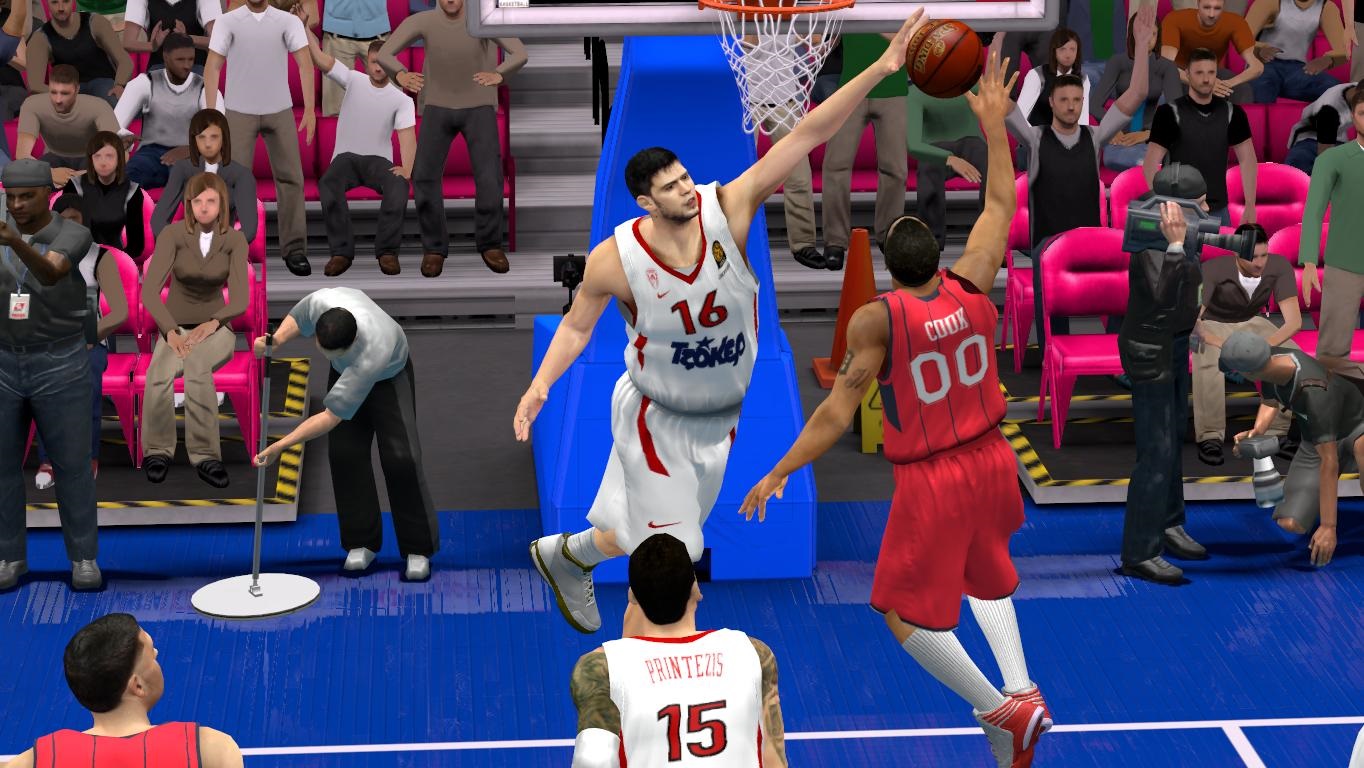
Source: http://forums.nba-live.com/viewtopic.php?f=149&t=88661&start=250 

The clash between SNB and 2K Games, albeit unprecedented at the European level, should not come as a surprise. The commercialization of athletes’ image rights has become a sine qua non component of sports marketing.[2] The transfer of professional players’ image rights to their clubs or third parties is for some of them more lucrative than their salaries. In the framework of international basketball, this has led to the proliferation of image rights contracts, signed by the players in addition to their employment contracts. While the legal nature of image rights and their unauthorized use by third parties has been recently extensively debated- in the wake of US College Athletes image rights cases before US Courts which will be discussed in the second part of this blog series[3]-, image rights contracts and their enforcement by basketball players before the Basketball Arbitral Tribunal (BAT)[4] are still very much uncharted territories.

This blogpost will look at the basketball players’ image rights contracts in a three-pronged approach. First, we will explain how image rights contracts in international basketball serve as tax loopholes by the clubs, which increasingly force players to sign them (I). Thereafter, based on BAT’s case law, we will attempt to build a legal roadmap with regard to the enforcement of image rights contracts by players. In this light, we will examine the relationship between the main contract and the image rights contract as well as the role of the different dispute settlement clauses included in the different contracts when assessing BAT’s jurisdiction (II). Finally, we will analyse the position of the BAT in enforcing image rights contracts and the significant impact of its awards in the basketball world, taking into account the unique features of basketball arbitration (III). 


I. Image rights contracts in international basketball: Cherchez l’argent!

The use of image rights contracts leads to two possible scenarios. In the first one, which is the most common, a player signs an employment contract with a club indicating the player’s remuneration net of all taxes. This initial contract is usually characterized as the “main agreement”[5] or “master agreement”[6]. Thereafter, the club approaches the player with two additional contracts: the league contract which provides for a remarkably lower monthly salary than the main contract; and an image rights contracts, where the player assigns his rights to a third party, an image rights company. The league contract reporting a much lower wage than the wage actually offered to the player is sent to the league and is used for tax purposes. In parallel, the club signs an image rights contract with the image rights company to which the player has previously assigned his intellectual property rights. According to this contract, the company owns the player’s image rights. This means that the player assigns to the club the use of these rights for commercial and promotional purposes. As a result of this assignment, the club undertakes the obligation to pay a specific amount of money per month to the company. Once the club pays the image rights company, the image rights company transfers this amount to the player.

In order to understand this quite complex scheme, let’s use a concrete example. A player signs with the club a main contract indicating a remuneration of EUR 300.000. Thereafter, the player signs the league contract indicating a remuneration of EUR 30.000 by the club, while the club signs a contract with an image rights company and undertakes to pay a total amount of EUR 270.000. Finally, the player receives the amount of EUR 270.000 by the image rights company. Thus, it is clear that a combination of the league and the image rights contracts amounts to sum foreseen in the main contract (30.000+270.000=300.000). While this fictitious transfer of money through a third party does not seem to have a practical effect on the player’s remuneration, the split of the main contract into two separate agreements helps the club to tailor its tax obligations. In fact, the club would in principle have had to pay taxes on the full amount of EUR 300.000. Nonetheless, by breaking up the payment into different amounts, the club pays taxes and social contributions for the individual income of EUR 30.000 only. True, the club is also obliged to pay the taxes due on the EUR 270.000 transferred to the image rights company. However, taking into account that the tax rate over intellectual property rights is typically much lower than that concerning individual income, the club gains significant tax benefits.[7]

In the second potential scenario, in parallel to the main contract, the player signs a side agreement with the club, which explicitly splits the net compensation into an amount derived from the league contract and an amount derived from the image contract. Subsequently the player enters into an exclusive license agreement with an image rights company to which he assigns the use of his image rights receiving as compensation the amount stipulated in the side agreement. At the same time, the club enters into a sublicense agreement with the image rights company in order to use the player’s image rights, by paying the company the same amount of money that the company then pays to the player under the license agreement.

In short, this scheme is a fiction invented by the clubs in order to get significant tax advantages. While this is done pro forma, without any intent of changing the player’s rights and obligations under the main contract[8], this tax evasion scheme can lead to the club evading also its contractual duties when a club fails to pay the player. In this case, with respect to any outstanding remuneration, can the player enforce the image rights contract against the club in BAT proceedings? 


II. How the BAT establishes its jurisdiction on image rights contracts disputes

An overview of the BAT case law shows that players bring a dispute against their club for outstanding payments on the grounds of a broadly drafted arbitration clause in the main contract, which provides for BAT’s jurisdiction over any dispute arising out of, or in connection with the main contract. However, as is already discussed, a player’s remuneration is often based on a matrix of several contracts – the main contract, the league contract, the image rights contract and/or the license agreement-, which may contain a dispute resolution clause of their own that does not refer to the BAT. Therefore, when a dispute for outstanding payments is brought before the BAT, the arbitrator first has to determine whether the claim made by the player falls within the scope of the BAT arbitration clause included in the main contract. Thus, the arbitrator must consequently determine the relation between the main contract and the other contracts, including the image rights contracts.

The difficulty emerges from the fact that the contracts do not define how they should inter-relate. As a result, the BAT has to interpret the contracts and decide whether the subsequent contracts actually supersede the main contract and the applicable BAT arbitration clause or whether they only supplement the main contract. Namely, the clubs, relying on the fact that the image rights contract is signed after the main contract and referring to the legal principle lex posterior derogate legi priori[9], claim that the dispute settlement provision contained in those contracts override the BAT arbitration clause included in the main contract.[10]

In order to decide on its jurisdiction and the underlying relation between the several contracts, the BAT has consistently used a double test based on the common intention of the parties and the wording of the BAT arbitration clause contained in the main contract. At first, the BAT examines whether the main contract includes all the essential elements with regard to the player’s rights remuneration. Then, it elaborates whether these terms reflect the parties’ common intent under the main agreement to guarantee the payment of the full salary to the player, irrespective of any modalities that would be agreed upon in subsequent contracts as to the mode and schedule of payments.[11] If the main contract is seen as containing the common agreement of the parties on the full amount of remuneration, any further agreement referring to the way this payment is organized has only a supplementary function. The second criterion is based on the interpretation of the BAT arbitration clause. The main contract usually contains a broad BAT arbitration provision that covers any dispute arising from the main contract. Once established that the common intent of the parties is to guarantee the salary stipulated in the main contract, the broad terms of the arbitration clause necessarily encompass any dispute relating to the non- payment of any part of the player’s total salary. Once these criteria are fulfilled, the BAT asserts that the outstanding payments deriving from the image rights contracts fall within the scope of the BAT arbitration clause.

Furthermore, in some cases, the BAT has introduced other criteria, such as the necessity to establish a link between the contracts. In the 0115/10 case, the BAT established a close link between the main contract and the image rights contract, in a way that the image rights contract could not exist but for the original contract.[12] Interestingly enough, this rather broad interpretation has been inspired by the liberal case law of the Swiss Federal Tribunal, which requires that the interconnection between different contracts be taken into account when examining the substantive validity of an arbitration agreement.[13]

It is remarkable that until now, when examining the jurisdictional basis, the BAT has consistently adopted a rather liberal approach by piercing the fictitious veil between the club, the player and the third party when using overlapping contractual constructions. However, on the merits, the BAT’s approach is not totally consistent. 


III. Enforcing image rights contracts: the BAT’s enigmatic approach

In a series of awards, the BAT has found the clubs liable for the breach of the image rights contract and the subsequent outstanding payment of the player.

Applying the legal roadmap established above, the BAT has addressed the supplementary role of the subsequent contracts in organizing the payment schedule of the full remuneration of the player provided in the main contract. Indeed, from a contractual point of view, the terms of the main contract are deemed sufficient to entitle the player to claim the entire amount owed to him on the basis of that contract alone.[14] In this sense, the fact that image rights payments have been made via a third party does not free the club from its duty to guarantee the full remuneration of the player.[15] To reinforce this argument, the BAT has even asserted that the only case in which the club would not be found liable for breach of image rights contract would be the case where the image rights contract explicitly provided a waiver of the player’s claims against the club relating to image rights.[16]

However, this - until recently- consistent approach has been overturned in the latest BAT award concerning the enforcement of image rights contracts.[17] In that case, the image contract was signed between a company to which the claimant assigned the rights to his promotion and a company managing the image and endorsement rights of the club. Although having confirmed the supplementary role of the image rights contract with regard to the employment contract at hand, the arbitrator chose to deviate from the entrenched interpretation in BAT jurisprudence of the intent of the parties. Namely, the arbitrator interpreted the parties’ behaviour as intending to discharge the club of its obligation to guarantee the full amount of the player’s salary under the main contract.

While, in this particular case, the company to which the player assigned his image rights could have been found liable for not transferring the missing amounts to the player, the BAT’s approach is questionable in that it undermined the club’s liability under the main contract. At this point, it should be highlighted that BAT decides all cases ex aequo et bono.[18] In this light, it is the opinion of the author of this blogpost that it would be contrary to general considerations of justice and fairness to consider that the club could take advantage of a tax-optimising structure to no longer guarantee principal amounts contractually due to the player. In other words, it would be unfair to consider that the player has implicitly renounced the guarantees offered to him by the club under the main contract. 


Conclusive Remarks

The system of image rights contracts in international basketball is fragile. Based on the lack of legal certainty in BAT jurisprudence, this blogpost has evidenced the risk that clubs use the BAT to escape their obligations deriving from the image rights contracts. Taking into account that BAT awards are directly enforceable under the New York Convention on the Recognition and Enforcement of Foreign Arbitral Awards, subject only to an appeal on the limited grounds provided in Article 190 Swiss Private International Law Act (PILA)[19], a denial of the BAT to enforce image rights contracts against the clubs leaves the players deprived of any real legal avenue to vindicate their rights. In this sense, a consistent approach of the BAT with regard to the intimate relation existing between the image rights contract and the main employment contract would not only be desirable, but would also be in line with the ex aequo et bono principle.


[1] Johan Passave-Ducteil, the president of SNB remarks in l’Equipe:"Ce n’est pas une histoire d’argent, on défend le droit des joueurs"

[2] D-R Martens, ‘An innovative System for Resolving Disputes in Sport (only in Sport?)’ (2011) 1-2 International Sports Law Journal 54, 60.

[3] Edward O’ Bannon et al v National Collegiate Athletics Association, Electronic Arts Inc and Collegiate Licensing Company ( US District Court, 08.08.2014) and NCAA Student-Athlete Name and Likeness Licensing Litigation, 724 F. 3d 1268 (9th Cir. 2013).

[4] The tribunal was established by FIBA in 2006 under the name “FIBA Arbitral Tribunal (FAT)”. In accordance with the 2010 FIBA General Statutes, the tribunal was renamed into “Basketball Arbitral Tribunal (BAT)”.

[5] Vladimir Golubovic v Basketball Club Union Olimpija Ljubljaba, BAT 0174/11, para 6.

[6] Pawel Kikoeski v KK Union Olimpija Ljubljana, BAT 0155/11, para 23.

[7] In the case where the image rights company is seated in a tax haven state, the tax benefits are almost double for the club.

[8] BAT 0155/11(n 6), para 51.  See also, 0174/11(n 5) para 10: “The Club suggested the image contract because it served tax driven purposes only. That was the only purpose for such a contract, and it was irrelevant for the player, because his remuneration were settled in net amount (tax free)”.

[9] i.e a subsequent law imparts the abolition of a previous one

[10] Richard Hendrix v Club Baloncesto Granada, FAT 0115/10, para 36.

[11] FAT 0115/10(n 10), para 44, Dalibor Bagaric v Fortitudo Pallacanestro SrL FAT 0105/10 para 49, Lazaros Papadopoulos v Fortitudo Palacanestro Societa’ Sportica Dilettantistica a R.L. FAT 0071/09 para 61, Darryl Eugene Strawberry and Bill Duffy International Inc v Fortitudo Palacanestro Societa’ Sportica Dilettantistica a R.L. FAT 0067/09, para 66.

[12] FAT 0115/10 (n 10), para 41.

[13] Ibid, para 43 where the arbitrator makes an extensive reference to Swiss Federal Tribunal case law: Decision of the Swiss Federal Tribunal of 16 October 2003, reported in ATF 129 III 727, 735 using the

word “liberal” with reference to ATF 121 III 38, 45 and the decisions 4P.126/2001 of 18 December 2001

reported in ASA Bulletin 2002, p. 482; 4C.40/2003 of 19 May 2003 at 4, reported in ASA Bulletin 2004, p.

344; see also decision 4P.230/2000 of 7 February 2001 reported in ASA Bulletin 2001, p. 523.

[14] FAT 0067/09 (n 11), para 83.

[15] FAT 0071/09 (n 11), para 76.

[16] FAT 0115/10 (n 10), para 64.

[17] Steven Smith v Virtus Palacanestro Bologna S.p.A, BAT 0413/13

[18] BAT Arbitration Rules, Article 15.1: "Unless the parties have agreed otherwise the Arbitrator shall decide the dispute ex aequo et bono, applying general considerations of justice and fairness without reference to any particular national or international law ".

[19] In fact, according to Article 190 (2) PILA, only serious procedural defects or rulings on substance that are contrary to international public policy may constitute grounds to set aside an award. See A Rigozzi, ‘Challenging Awards of the Court of Arbitration for Sport’ (2010)1 Journal of International Dispute Settlement 217, 217-254.

Pingbacks and trackbacks (1)+

Comments are closed