Asser International Sports Law Blog

Our International Sports Law Diary
The Asser International Sports Law Centre is part of the T.M.C. Asser Instituut

Doyen vs. Sporting I: Doyen’s Pyrrhic Victory at the CAS

At the end of December 2015, the CAS decided on a very public contractual dispute between Sporting Clube de Portugal Futebol SAD (Sporting) and Doyen Sports Investments Limited (Doyen). The club was claiming that Doyen’s Economic Rights Participation Agreement (ERPA) was invalid and refused to pay Doyen’s due share on the transfer of Marcos Rojo to Manchester United. The dispute made a lot of noise (see the excellent coverage by Tariq Panja from Bloomberg here, here and here) as it was the first TPO case heard by the CAS after FIFA’s ban. Yet, and it has to be clear from the outset, the case does not affect the legality of FIFA’s TPO ban; it concerned only the compatibility of Doyen’s ERPA with Swiss civil law. The hearing took place in June 2015, but the case was put under a new light by the football leaks revelations unveiled at the end of 2015 (see our blog from December 2015). Despite these revelations, the CAS award favoured Doyen, and was luckily for us quickly made available on the old football leaks website. This blog will provide a commentary of the CAS decision. It will be followed in the coming days by a commentary by Shervine Nafissi on the judgment, on appeal, by the Swiss Federal Tribunal. More...

UEFA’s Financial Fair Play Regulations and the Rise of Football’s 1%

On 12 January 2017 UEFA published its eighth club licensing benchmarking report on European football, concerning the financial year of 2015. In the press release that accompanied the report, UEFA proudly announced that Financial Fair Play (FFP) has had a huge positive impact on European football, creating a more stable financial environment. Important findings included a rise of aggregate operating profits of €1.5bn in the last two years, compared to losses of €700m in the two years immediately prior to the introduction of Financial Fair Play.


Source: UEFA’s eighth club licensing benchmarking report on European football, slide 107.


 Meanwhile the aggregate losses dropped by 81% from €1.7bn in 2011 to just over €300m in 2015.More...


International and European Sports Law – Monthly Report – January 2017. By Saverio Spera.

Editor’s note: This report compiles all relevant news, events and materials on International and European Sports Law based on the daily coverage provided on our twitter feed @Sportslaw_asser. You are invited to complete this survey via the comments section below, feel free to add links to important cases, documents and articles we might have overlooked. 


The Headlines

The Diarra ruling of the Tribunal of Charleroi

On 19 January 2017, the Hainaut Commercial Tribunal – Charleroi rendered its decision on the lawsuit filed by the football player Lassana Diarra against FIFA and the Belgian FA (URBSFA) for damages caused by not being able to exercise the status of a professional football player during the entire 2014/2015 season. The lawsuit is linked to the decision, rendered by the FIFA Dispute Resolution Chamber (DRC) on April 2015, to support Lokomotiv’s decision to terminate the player’s contract and to order Diarra to pay Lokomotiv the amount of EUR 10,500,000 for having breached his contract. According to the plaintiff, Diarra’s opportunity to be recruited by Sporting Charleroi was denied due to the club being potentially considered jointly liable for Diarra’s compensation pursuant to Article 17 (2) RSTP. The Belgian court held strongly that “when the contract is terminated by the club, the player must have the possibility to sign a new contract with a new employer, without restrictions to his free movement”. This case highlighted, once again, the need to read the RSTP in the light of EU law. Moreover, the decision is laying further ground for broader challenges to the RSTP on the basis of EU law (for a deeper insight into the Diarra ruling, see the recent blog written by our senior researcher Antoine Duval) More...


Introducing the new legal challenges of E-Sports. By N. Emre Bilginoglu

Editor’s Note: Emre Bilginoglu[1] is an attorney in Istanbul and the co-founder of the Turkish E-Sports Players Association, a non-profit based in Istanbul that aims to provide assistance to professional gamers and to work on the relevant laws affecting them. 


The world is witnessing the rise of a new sport that is growing at an incredible speed: E-Sports. We are only starting to understand its legal implications and challenges.

In recent years, E-Sports has managed to attract thousands of fans to arenas to see a group of people play a video game. These people are literally professional gamers (cyber athletes)[2] who make money by competing in tournaments. Not all video games have tournaments in which professional players compete against each other.

The most played games in E-Sports competitions are League of Legends (LoL), Defense of the Ancients 2 (DotA 2) and Counter-Strike: Global Offensive (CS:GO). LoL and DotA are both Multiplayer online battle arena (MOBA) games, a genre of strategy video games in which the player controls a single character in one of two teams. The goal of the game is to destroy the opponent’s main structure. CS:GO is a first-person shooter (FPS) game, a genre of video games where the player engages combat through a first-person perspective. The main objective in CS:GO is to eliminate the opposing team or to terrorize or counter-terrorize, planting bombs or rescuing hostages. Other games that have (popular) E-Sports competitions include Starcraft II (real time strategy), Hearthstone (collectible card video game), Call of Duty (FPS) and FIFA (football).

The gaming requires cooperation between team players, a high level of concentration, rapid reactions and some seriously fast clicking. E-Sports is a groovy term to describe organized competitive computer gaming. The E-Sports industry is exponentially growing, amounting to values expressed in billions of dollars. According to Newzoo, a website dedicated to the collection of E-Sports data, there are some 250 million occasional viewers of E-Sports with Asia-Pacific accounting for half of the total amount. The growth of the industry is indubitably supported by online streaming media platforms. This article aims to explain what E-Sports is and to give the readers an insight on the key legal questions raised by it. More...


Time for Transparency at the Court of Arbitration for Sport. By Saverio Spera

Editor’s Note: Saverio Spera is an Italian lawyer and LL.M. graduate in International Business Law from King’s College London. He is currently an intern at the ASSER International Sports Law Centre.


The time is ripe to take a closer look at the CAS and its transparency, as this is one of the ways to ensure its public accountability and its legitimacy. From 1986 to 2013, the number of arbitrations submitted to the CAS has grown from 2 to more than 400 a year. More specifically, the number of appeals submitted almost doubled in less than ten years (from 175 in 2006, to 349 in 2013[1]). Therefore, the Court can be considered the judicial apex of an emerging transnational sports law (or lex sportiva).[2] In turn, the increased authority and power of this institution calls for increased transparency, in order to ensure its legitimacy.[3]

More...


UEFA’s betting fraud detection system: How does the CAS regard this monitoring tool? By Emilio García.

Editor’s note: Emilio García (emilio.garcia@uefa.ch)  is a doctor in law and head of disciplinary and integrity at UEFA. Before joining UEFA, he was the Spanish Football Federation’s legal director (2004–12) and an arbitrator at the CAS (2012–13).In this blog, Emilio García provides a brief review of a recent case before the Court of Arbitration for Sport (CAS): Klubi Sportiv Skënderbeu v UEFA (CAS 2016/A/4650)[1], in which he acted as main counsel for UEFA. 


Sport and match-fixing – A quick overview

Match-fixing is now legally defined as “an intentional arrangement, act or omission aimed at an improper alteration of the result or the course of a sports competition in order to remove all or part of the unpredictable nature of the aforementioned sports competition with a view to obtaining an undue advantage for oneself or for others”.[2] It has been said that there has always been match-fixing in sport.[3] From the ancient Olympic Games to the most important global sports competitions of today, manipulation of results has always been an all-too-frequent occurrence.

We have seen a number of very prominent instances of this kind of issue over the years. One of the most remarkable examples, which was even the subject of a film,[4] was the match-fixing episode during the 1919 World Series, where several players from the Chicago White Sox were found guilty of accepting bribes and deliberately losing matches against the Cincinnati Reds.[5]

The situation has changed considerably since then. In particular, the globalisation of the sports betting industry has had a massive impact, with recent studies estimating that between €200bn and €500bn is betted on sport every year.[6] Match-fixing does not just affect football either;[7] it is also affecting other sports, most notably tennis.[8] More...


The Diarra Ruling of the Tribunal of Charleroi: The New Pechstein, Bosman or Mutu?

Yesterday the sports law world was buzzing due to the Diarra decision of the Tribunal de Commerce du Hainaut (the Tribunal) based in Charleroi, Belgium. Newspapers were lining up (here, here and here) to spread the carefully crafted announcement of the new triumph of Jean-Louis Dupont over his favourite nemesis: the transfer system. Furthermore, I was lucky enough to receive on this same night a copy of the French text of the judgment. My first reaction while reading quickly through the ruling, was ‘OMG he did it again’! “He” meaning Belgian lawyer Jean-Louis Dupont, who after a string of defeats in his long shot challenge against FIFA’s TPO ban or UEFA’s FFP (see here and here), had [at least I believed after rushing carelessly through the judgment] manufactured a new “it”: a Bosman. Yet, after carefully re-reading the judgment, it became quickly clear to me that this was rather a new Mutu (in the sense of the latest CAS award in the ‘Mutu saga’, which I have extensively analysed on this blog and in a recent commentary for the new Yearbook of International Sports Arbitration) coupled with some reflections reminding a bit (but not really as will be explicated below) the Pechstein case.

In this blog, I will retrace briefly the story behind the case and then analyse the decision of the Belgium court. In doing so, I will focus on its reasoning regarding its jurisdiction and the compatibility of article 17(2) RSTP with EU law.More...

The Russian Doping Scandal at the Court of Arbitration for Sport: The IPC’s Rio Ineligibility of Russian Paralympic Athletes

Editor's note: This blog is part of a special blog series on the Russian doping scandal at the CAS. Last year I analysed the numerous decisions rendered by the CAS ad hoc Division in Rio and earlier this year I reviewed the CAS award in the IAAF case.

Unlike the International Association of Athletics Federations (IAAF), the International Paralympic Committee (IPC) was very much unaffected by the Russian doping scandal until the publication of the first McLaren report in July 2016. The report highlighted that Russia’s doping scheme was way more comprehensive than what was previously thought. It extended beyond athletics to other disciplines, including Paralympic sports. Furthermore, unlike the International Olympic Committee (IOC) the IPC had a bit more time to deal with the matter, as the Rio Paralympic Games were due to start “only” in September.

After the release of the McLaren Report, the IPC president Sir Philip Craven was “truly shocked, appalled and deeply saddened at the extent of the state sponsored doping programme implemented in Russia”. He immediately announced the IPC’s intention to review the report’s findings and to act strongly upon them. Shortly thereafter, on 22 July, the IPC decided to open suspension proceedings against the National Paralympic Committee of Russia (NPC Russia) in light of its apparent inability to fulfil its IPC membership responsibilities and obligations. In particular, due to “the prevailing doping culture endemic within Russian sport, at the very highest levels, NPC Russia appears unable or unwilling to ensure compliance with and the enforcement of the IPC’s Anti-Doping Code within its own national jurisdiction”. A few weeks later, on 7 August, the IPC Governing Board decided to suspend the Russian Paralympic Committee with immediate effect “due to its inability to fulfil its IPC membership responsibilities and obligations, in particular its obligation to comply with the IPC Anti-Doping Code and the World Anti-Doping Code (to which it is also a signatory)”. Indeed, these “obligations are a fundamental constitutional requirement for all National Paralympic Committees (NPCs), and are vital to the IPC’s ability to ensure fair competition and to provide a level playing field for all Para athletes around the world”. Consequently, the Russian Paralympic Committee lost all rights and privileges of IPC membership. Specifically, it was not entitled to enter athletes in competitions sanctioned by the IPC, and/or to participate in IPC activities. Thus, “the Russian Paralympic Committee will not be able to enter its athletes in the Rio 2016 Paralympic Games”. More...


The Russian Doping Scandal at the Court of Arbitration for Sport: The IAAF’s Rio Ineligibility of Russian Athletes

Since the release of the earth-shattering ARD documentary two years ago, the athletics world has been in a permanent turmoil. The International Athletics Association Federation (IAAF) is faced with both a never-ending corruption scandal (playing out in front of the French police authorities) and the related systematic doping of Russian athletes. The situation escalated in different phases led by the revelations of Russian insiders. First, in December 2014 with the ARD documentary, which demonstrated how widespread (and organized) the recourse to doping was in Russian athletics. It triggered the Pound investigation financed by the World Anti-Doping Agency (WADA), which led to two damaging reports (available here and here) for the Russian anti-doping system and the IAAF itself. Thereafter, in November 2015, the IAAF had no other choice but to provisionally suspend the Russian athletics federation (ARAF then RusAF) and its members from IAAF competitions. Yet, this was only the beginning as shortly after the former head of Moscow’s anti-doping laboratory provided a detailed sketch to the New York Times of the operation of a general state-led doping scheme in Russia. The system was designed to avert any positive doping tests for top-level Russian sportspeople and was going way beyond athletics. These allegations were later largely confirmed and reinforced by the McLaren investigation initiated by WADA in May 2016, and which published its first report in July 2016 shortly before the Rio Olympics. In June 2016, the IAAF anticipated the conclusions of the report (it had received most of McLaren’s evidence beforehand) and decided to maintain the ineligibility of Russian athletes for IAAF competitions, and for the Rio Olympics. It did, however, foresee a narrow exception for Russian athletes able to show that they were properly tested outside of Russia. Nonetheless, the athletes using this exception were to compete under a neutral flag at the Olympics. Unsurprisingly, Russian athletes led by pole superstar (and now IOC member), Yelena Isinbayeva, and the Russian Olympic Committee decided to challenge this decision in front of the Court of Arbitration for Sport (CAS). Interestingly, while the decision was rendered on 21 July 2016, the full text of the award was publically released only on 10 October 2016. In September, I analysed the Rio CAS Ad Hoc Decisions involving Russian athletes aiming to participate to the Olympics. I will now turn to the IAAF decision, which is of great importance to the future of the anti-doping system. Indeed, it lays out the fundamental legal boundaries of the capacity of international federations to impose sanctions on their members (and their members) in order to support the world anti-doping fight. More...

International and European Sports Law – Monthly Report – November and December 2016. By Saverio Spera.

Editor’s note: This report compiles all relevant news, events and materials on International and European Sports Law based on the daily coverage provided on our twitter feed @Sportslaw_asser. You are invited to complete this survey via the comments section below, feel free to add links to important cases, documents and articles we might have overlooked. 


The Headlines

The Russian State Doping Scandal and the crisis of the World Anti-Doping System

Russian doping and the state of the Anti-Doping System has been the dominant international sports law story in November and December. This is mainly due to the release of the second report of the McLaren’s investigation on 9 December 2016. The outcome of McLaren’s work showed a “well-oiled systemic cheating scheme” that reached to the highest level of Russian sports and government, involving the striking figure of 30 sports and more than 1000 athletes in doping practices over four years and two Olympic Games. The report detailed tampering with samples to swap out athletes’ dirty urine with clean urine.More...


Asser International Sports Law Blog | All posts by oskar-van-maren

Asser International Sports Law Blog

Our International Sports Law Diary
The Asser International Sports Law Centre is part of the T.M.C. Asser Instituut

FIFA's Responsibility for Human Rights Abuses in Qatar - Part I: The Claims Against FIFA - By Tomáš Grell

Editor’s note: Tomáš Grell comes from Slovakia and is currently an LL.M. student in Public International Law at Leiden University. He contributes also to the work of the ASSER International Sports Law Centre as a part-time intern.

On 2 December 2010, the FIFA Executive Committee elected Qatar as host of the 2022 FIFA World Cup ('World Cup'), thereby triggering a wave of controversies which underlined, for the most part, the country's modest size, lack of football history, local climate, disproportionate costs or corruption that accompanied the selection procedure. Furthermore, opponents of the decision to award the World Cup to the tiny oil-rich Gulf country also emphasized the country's negative human rights record.

More than six years later, on 3 January 2017, the Commercial Court of the Canton of Zurich ('Court') dismissed the lawsuit filed against FIFA[1] jointly by the Dutch trade union FNV, the Bangladeshi Free Trade Union Congress, the Bangladesh Building and Wood Workers Federation and the Bangladeshi citizen Nadim Shariful Alam ('Plaintiffs').[2] The Plaintiffs requested the Court to find FIFA responsible for alleged human rights violations of migrant workers in connection with the World Cup in Qatar. Had the Plaintiffs' claims been upheld by the Court, such decision would have had far-reaching consequences on the fate of thousands of migrants, mostly from India, Nepal and Bangladesh, who are currently working on the construction of sporting facilities and other infrastructure associated with organization of the World Cup. More...

Doyen vs. Sporting II: The Bitter End of Sporting’s Fight at the Swiss Federal Supreme Court. By Shervine Nafissi

Editor’s Note: Shervine Nafissi (@SNafissi) is a Phd Student in sports law and teaching assistant in corporate law at University of Lausanne (Switzerland), Faculty of Business and Economics (HEC).


Introduction

The factual background

The dispute concerns a TPO contract entitled “Economic Rights Participation Agreement” (hereinafter “ERPA”) concluded in 2012 between Sporting Lisbon and the investment fund Doyen Sports. The Argentine player was transferred in 2012 by Spartak Moscow to Sporting Lisbon for a transfer fee of €4 million. Actually, Sporting only paid €1 million of the fee while Doyen Sports financed the remaining €3 million. In return, the investment company became the owner of 75% of the economic rights of the player.[1] Thus, in this specific case, the Portuguese club was interested in recruiting Marcos Rojo but was unable to pay the transfer fee required by Spartak Moscow, so that they required the assistance of Doyen Sports. The latter provided them with the necessary funds to pay part of the transfer fee in exchange of an interest on the economic rights of the player.

Given that the facts and circumstances leading to the dispute, as well as the decision of the CAS, were fully described by Antoine Duval in last week’s blog of Doyen vs. Sporting, this blog will solely focus on the decision of the Swiss Federal Supreme Court (“FSC”) following Sporting’s appeal against the CAS award. As a preliminary point, the role of the FSC in the appeal against CAS awards should be clarified.More...

UEFA’s Financial Fair Play Regulations and the Rise of Football’s 1%

On 12 January 2017 UEFA published its eighth club licensing benchmarking report on European football, concerning the financial year of 2015. In the press release that accompanied the report, UEFA proudly announced that Financial Fair Play (FFP) has had a huge positive impact on European football, creating a more stable financial environment. Important findings included a rise of aggregate operating profits of €1.5bn in the last two years, compared to losses of €700m in the two years immediately prior to the introduction of Financial Fair Play.


Source: UEFA’s eighth club licensing benchmarking report on European football, slide 107.


 Meanwhile the aggregate losses dropped by 81% from €1.7bn in 2011 to just over €300m in 2015.More...


International and European Sports Law – Monthly Report – January 2017. By Saverio Spera.

Editor’s note: This report compiles all relevant news, events and materials on International and European Sports Law based on the daily coverage provided on our twitter feed @Sportslaw_asser. You are invited to complete this survey via the comments section below, feel free to add links to important cases, documents and articles we might have overlooked. 


The Headlines

The Diarra ruling of the Tribunal of Charleroi

On 19 January 2017, the Hainaut Commercial Tribunal – Charleroi rendered its decision on the lawsuit filed by the football player Lassana Diarra against FIFA and the Belgian FA (URBSFA) for damages caused by not being able to exercise the status of a professional football player during the entire 2014/2015 season. The lawsuit is linked to the decision, rendered by the FIFA Dispute Resolution Chamber (DRC) on April 2015, to support Lokomotiv’s decision to terminate the player’s contract and to order Diarra to pay Lokomotiv the amount of EUR 10,500,000 for having breached his contract. According to the plaintiff, Diarra’s opportunity to be recruited by Sporting Charleroi was denied due to the club being potentially considered jointly liable for Diarra’s compensation pursuant to Article 17 (2) RSTP. The Belgian court held strongly that “when the contract is terminated by the club, the player must have the possibility to sign a new contract with a new employer, without restrictions to his free movement”. This case highlighted, once again, the need to read the RSTP in the light of EU law. Moreover, the decision is laying further ground for broader challenges to the RSTP on the basis of EU law (for a deeper insight into the Diarra ruling, see the recent blog written by our senior researcher Antoine Duval) More...


Introducing the new legal challenges of E-Sports. By N. Emre Bilginoglu

Editor’s Note: Emre Bilginoglu[1] is an attorney in Istanbul and the co-founder of the Turkish E-Sports Players Association, a non-profit based in Istanbul that aims to provide assistance to professional gamers and to work on the relevant laws affecting them. 


The world is witnessing the rise of a new sport that is growing at an incredible speed: E-Sports. We are only starting to understand its legal implications and challenges.

In recent years, E-Sports has managed to attract thousands of fans to arenas to see a group of people play a video game. These people are literally professional gamers (cyber athletes)[2] who make money by competing in tournaments. Not all video games have tournaments in which professional players compete against each other.

The most played games in E-Sports competitions are League of Legends (LoL), Defense of the Ancients 2 (DotA 2) and Counter-Strike: Global Offensive (CS:GO). LoL and DotA are both Multiplayer online battle arena (MOBA) games, a genre of strategy video games in which the player controls a single character in one of two teams. The goal of the game is to destroy the opponent’s main structure. CS:GO is a first-person shooter (FPS) game, a genre of video games where the player engages combat through a first-person perspective. The main objective in CS:GO is to eliminate the opposing team or to terrorize or counter-terrorize, planting bombs or rescuing hostages. Other games that have (popular) E-Sports competitions include Starcraft II (real time strategy), Hearthstone (collectible card video game), Call of Duty (FPS) and FIFA (football).

The gaming requires cooperation between team players, a high level of concentration, rapid reactions and some seriously fast clicking. E-Sports is a groovy term to describe organized competitive computer gaming. The E-Sports industry is exponentially growing, amounting to values expressed in billions of dollars. According to Newzoo, a website dedicated to the collection of E-Sports data, there are some 250 million occasional viewers of E-Sports with Asia-Pacific accounting for half of the total amount. The growth of the industry is indubitably supported by online streaming media platforms. This article aims to explain what E-Sports is and to give the readers an insight on the key legal questions raised by it. More...


Time for Transparency at the Court of Arbitration for Sport. By Saverio Spera

Editor’s Note: Saverio Spera is an Italian lawyer and LL.M. graduate in International Business Law from King’s College London. He is currently an intern at the ASSER International Sports Law Centre.


The time is ripe to take a closer look at the CAS and its transparency, as this is one of the ways to ensure its public accountability and its legitimacy. From 1986 to 2013, the number of arbitrations submitted to the CAS has grown from 2 to more than 400 a year. More specifically, the number of appeals submitted almost doubled in less than ten years (from 175 in 2006, to 349 in 2013[1]). Therefore, the Court can be considered the judicial apex of an emerging transnational sports law (or lex sportiva).[2] In turn, the increased authority and power of this institution calls for increased transparency, in order to ensure its legitimacy.[3]

More...


UEFA’s betting fraud detection system: How does the CAS regard this monitoring tool? By Emilio García.

Editor’s note: Emilio García (emilio.garcia@uefa.ch)  is a doctor in law and head of disciplinary and integrity at UEFA. Before joining UEFA, he was the Spanish Football Federation’s legal director (2004–12) and an arbitrator at the CAS (2012–13).In this blog, Emilio García provides a brief review of a recent case before the Court of Arbitration for Sport (CAS): Klubi Sportiv Skënderbeu v UEFA (CAS 2016/A/4650)[1], in which he acted as main counsel for UEFA. 


Sport and match-fixing – A quick overview

Match-fixing is now legally defined as “an intentional arrangement, act or omission aimed at an improper alteration of the result or the course of a sports competition in order to remove all or part of the unpredictable nature of the aforementioned sports competition with a view to obtaining an undue advantage for oneself or for others”.[2] It has been said that there has always been match-fixing in sport.[3] From the ancient Olympic Games to the most important global sports competitions of today, manipulation of results has always been an all-too-frequent occurrence.

We have seen a number of very prominent instances of this kind of issue over the years. One of the most remarkable examples, which was even the subject of a film,[4] was the match-fixing episode during the 1919 World Series, where several players from the Chicago White Sox were found guilty of accepting bribes and deliberately losing matches against the Cincinnati Reds.[5]

The situation has changed considerably since then. In particular, the globalisation of the sports betting industry has had a massive impact, with recent studies estimating that between €200bn and €500bn is betted on sport every year.[6] Match-fixing does not just affect football either;[7] it is also affecting other sports, most notably tennis.[8] More...


International and European Sports Law – Monthly Report – November and December 2016. By Saverio Spera.

Editor’s note: This report compiles all relevant news, events and materials on International and European Sports Law based on the daily coverage provided on our twitter feed @Sportslaw_asser. You are invited to complete this survey via the comments section below, feel free to add links to important cases, documents and articles we might have overlooked. 


The Headlines

The Russian State Doping Scandal and the crisis of the World Anti-Doping System

Russian doping and the state of the Anti-Doping System has been the dominant international sports law story in November and December. This is mainly due to the release of the second report of the McLaren’s investigation on 9 December 2016. The outcome of McLaren’s work showed a “well-oiled systemic cheating scheme” that reached to the highest level of Russian sports and government, involving the striking figure of 30 sports and more than 1000 athletes in doping practices over four years and two Olympic Games. The report detailed tampering with samples to swap out athletes’ dirty urine with clean urine.More...


FIFA’s provision on the protection of minors - Part 3: The compatibility of Article 19 with EU law. By Kester Mekenkamp.

Editor’s note: Kester Mekenkamp is an LL.M. student in European Law at Leiden University and an intern at the ASSER International Sports Law Centre. This blog is, to a great extent, an excerpt of his forthcoming thesis, which he shall submit in order to complete his master’s degree.

This final blog aims to provide some broader perspective, by sketching first the grander scheme in which Article 19 RSTP – FIFA's provision on the protection of minors – operates. Thereafter, the focus will shift towards testing Article 19 RSTP, thereby keeping in mind the previous blogs (Part 1: The Early Years and Part 2: The 2009 reform and its aftermath), against EU free movement law.  


Putting Article 19 RSTP into perspective: The bigger picture

After having investigated the nuts and bolts of FIFA’s provision on the protection of minors in the first two parts of this blog, it might be useful to address its bigger picture.

Article 19 RSTP and its accompanying provisions regulate only a small share of the targeted activity. There is, unfortunately, also an illegal world. Circumvention of the prohibition is allegedly commonplace.[1] Visas and passports can be falsified.[2] Work permits can be obtained on the basis of jobs arranged by clubs.[3] More...


FIFA’s Asser International Sports Law Blog | Our International Sports Law Diary <br/>The <a href="http://www.sportslaw.nl" target="_blank">Asser International Sports Law Centre</a> is part of the <a href="https://www.asser.nl/" target="_blank"><img src="/sportslaw/blog/media/logo_asser_horizontal.jpg" style="vertical-align: bottom; margin-left: 7px;width: 140px" alt="T.M.C. Asser Instituut" /></a>

Asser International Sports Law Blog

Our International Sports Law Diary
The Asser International Sports Law Centre is part of the T.M.C. Asser Instituut

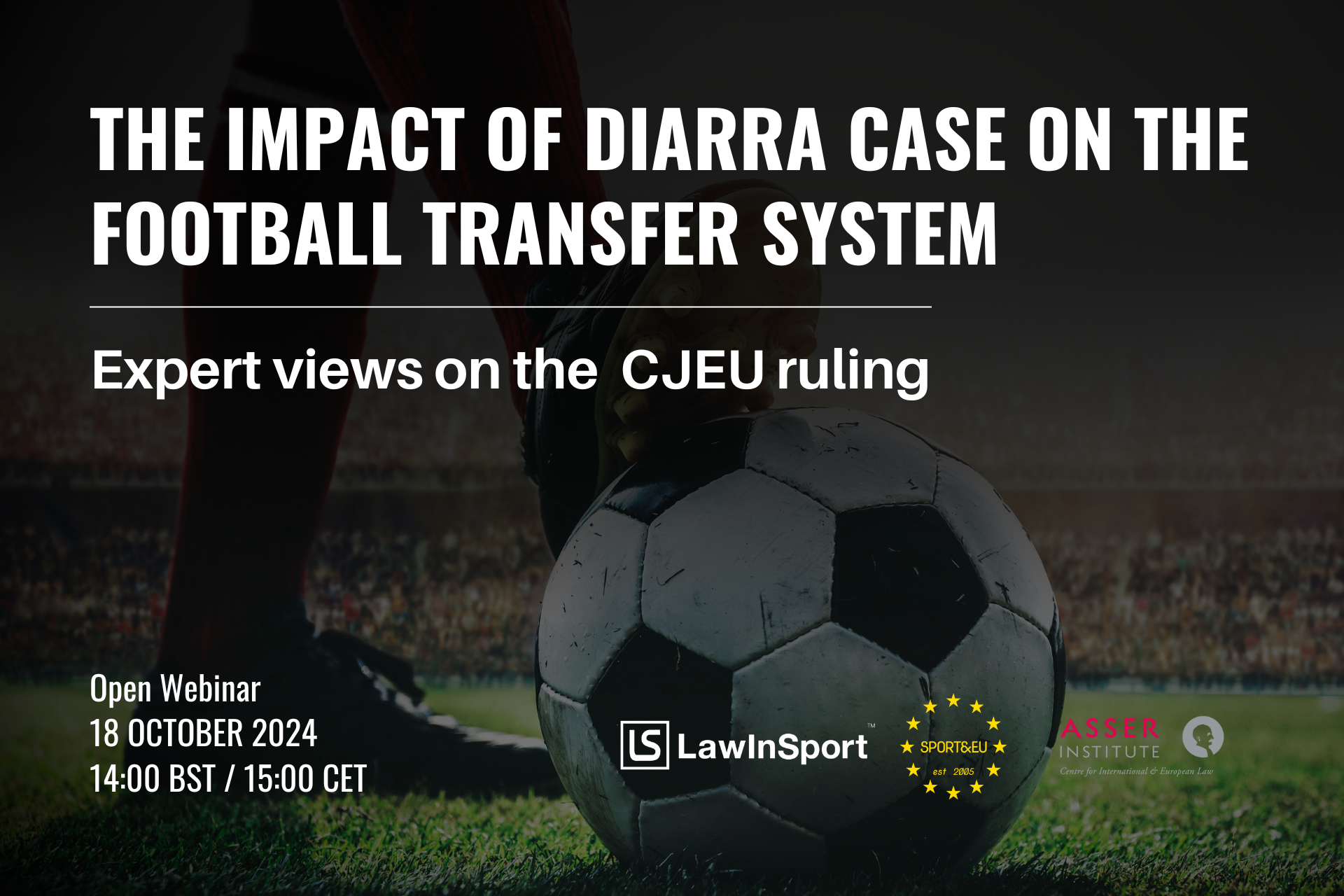
Free Webinar - The impact of the Diarra case on the football transfer system - 18 October 2024 - 15:00 CET

The Court of Justice of the European Union has recently handed down its judgement in the Lassana Diarra case (C-650/22 FIFA v. BZ).

Given the importance of this case to the sports industry, LawInSport, the Asser Instituut and the Association for the Study of Sport and the EU (Sport & EU) are hosting a joint webinar to bring together experts to unpack and provide clarity on the complex legal, regulatory & commercial issues stemming from this case. This free webinar will be hosted from 14:00 UK time (15:00 CET) on 18 October 2024.


Register HERE 


Speakers

Our expert speakers come from academia, law and sport. Our confirmed speakers are:


Register HERE 

Publications

ISLJ


Month List

Conference - Empowering athletes’ human rights: Global research conference on athletes’ rights - Asser Institute - 23 October

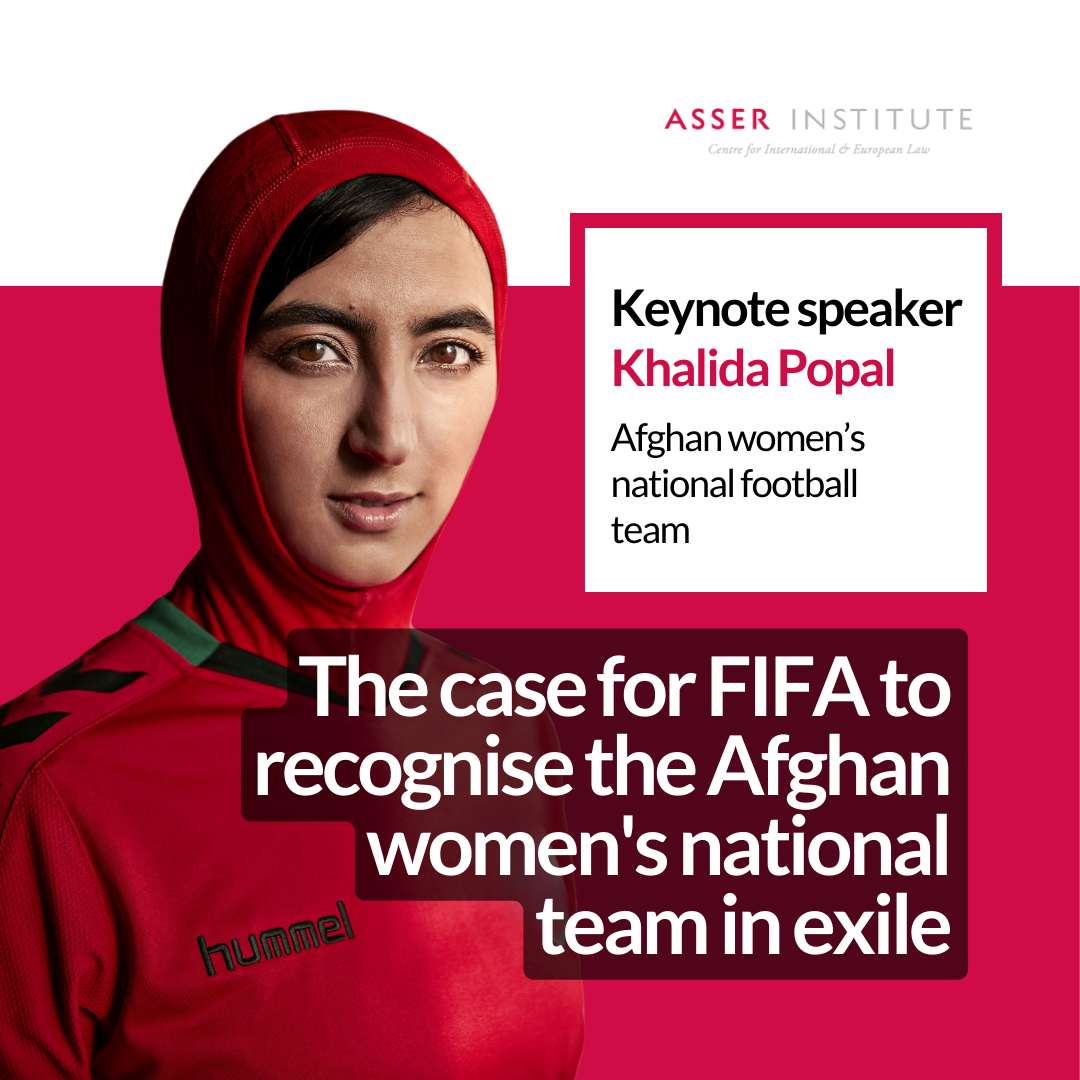
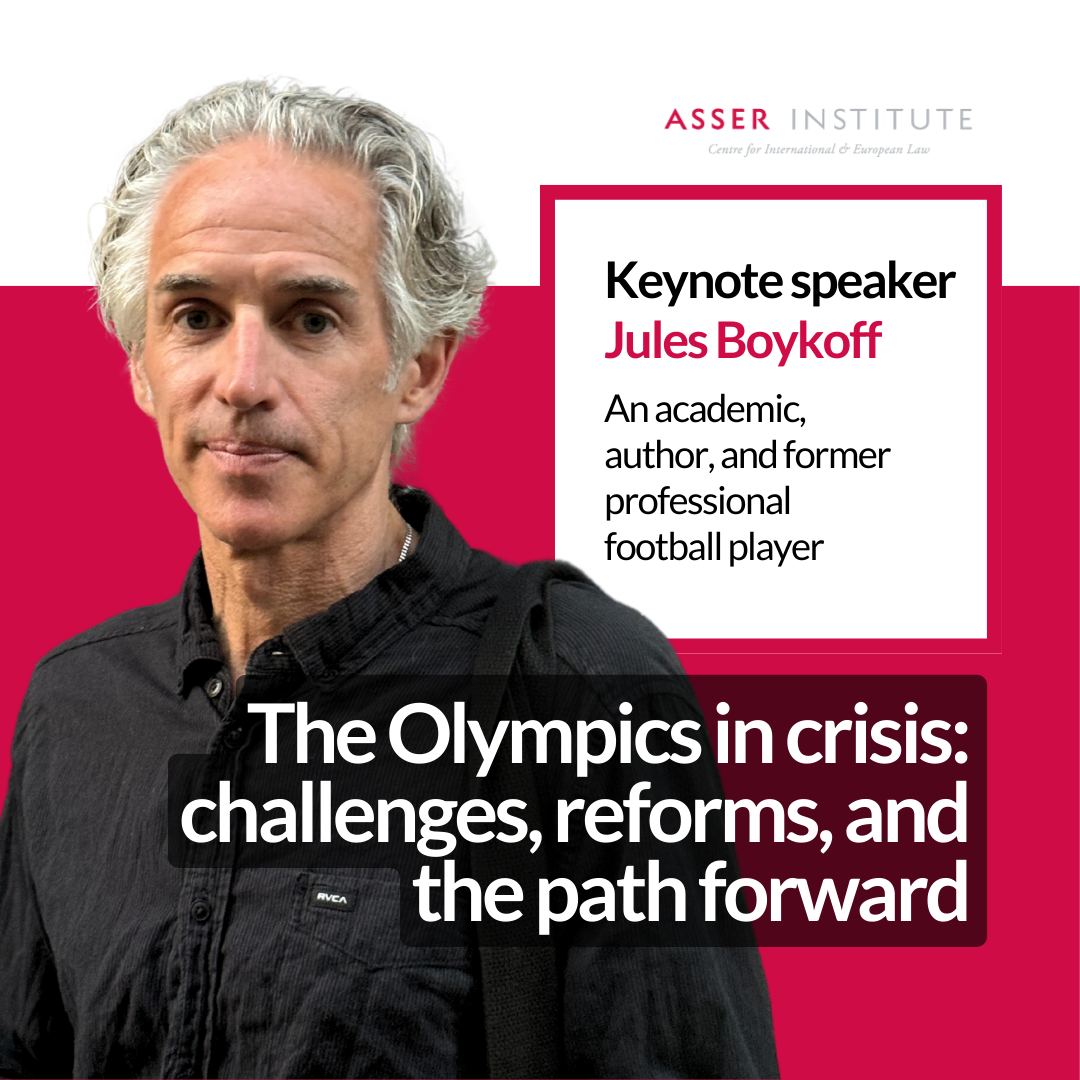
The newly launched ‘Global Sport and Human Rights Research Network’, an initiative jointly hosted by the T.M.C. Asser Instituut and the Centre for Sport and Human Rights, together with the European Union-funded project ‘Human Rights Empowered Through Athletes Rights (H.E.R.O.)' is organising an in-person conference on October 23 at the Asser Institute in The Hague, to map the field of athletes' rights and engage in critical discussions on protection of these rights and how to prevent rights violations.

The one-day conference will kick off with a presentation by the H.E.R.O. team on their research results, followed by a short panel discussion. The rest of the day will be filled with four panels on different aspects related to the topic of athletes’ human rights, with speakers from academic institutions around the world.

Check out the full programme HERE and register for free HERE

undefinedundefined

Co-funded by the European Union logo in png for web usage

Luxembourg calls…is the answer from Nyon the way forward? Assessing UEFA’s response to the ECJ’s ISU judgment - By Saverio Spera


Editor's note: Saverio P. Spera is an Italian qualified attorney-at-law. He has practiced civil and employment law in Italy and briefly worked at the Asser International Sports Law Centre before joining FIFA in 2017. Until May 2024, he has worked within the FIFA legal division - Litigation Department, and lectured in several FIFA sports law programmes. In the spring of 2024 he has co-founded SP.IN Law, a Zurich based international sports law firm.


On 21 December 2023 a judicial hat-trick stormed the scene of EU sports law. That day, the European Court of Justice (the “ECJ”) issued three decisions: (i) European Superleague Company, SL v FIFA and UEFA (Case C-333/21); (ii) UL and SA Royal Antwerp Football Club v Union royale belge des sociétés de football association ASBL (Case C-680/21)and (iii) International Skating Union (ISU) v. European Commission – Case C-124/21.

These judgments were much scrutinised (see herehere and here) in the past 6 months. For the reader’s relief, this paper will not venture into adding another opinion on whether this was a fatal blow to the foundation of EU sports law or if, after all, the substantive change is minimal (as persuasively argued here). It will analyse, instead, UEFA’s recent amendments of its Statutes and Authorisation Rules governing International Club Competitions (the “Authorisation Rules”) and whether these amendments, clearly responding to the concerns raised in the ISU judgment with respect to the sports arbitration system,[1] might pave the way for other Sports Governing Bodies (SGBs) to follow suit and what the implications for CAS arbitration might be. More...

The International Cricket Council and its human rights responsibilities to the Afghanistan women's cricket team - By Rishi Gulati

Editor's note: Dr Rishi Gulati is Associate Professor in International Law at the University of East Anglia (UK) and Barrister in Law. He has a PhD from King’s College London, Advanced Masters in Public International Law from Leiden University, and a Bachelor of Laws from the Australian National University. Amongst other publications, he is the author of Access to Justice and International Organisations (Cambridge University Press, 2022). He has previously worked for the Australian Government, has consulted for various international organizations, and regularly appears as counsel in transnational cases.

On 1 December 2024, Jay Shah, the son of India’s powerful Home Minister and Modi confidante Amit Shah, will take over the role of the Independent Chair of the International Cricket Council (ICC). This appointment reflects the influence India now has on the governance of cricket globally. A key test Jay Shah will face is whether or not the ICC should suspend the Afghanistan Cricket Board (ACB) from its membership as Afghanistan no longer maintains a women’s cricket team contrary to the organization’s own rules, as well as its human rights responsibilities. More...

Women’s Football and the Fundamental Right to Occupational Health and Safety: FIFA’s Responsibility to Regulate Female Specific Health Issues - By Ella Limbach

Editor's noteElla Limbach is currently completing her master’s degree in International Sport Development and Politics at the German Sport University Cologne. Her interests include human rights of athletes, labour rights in sport, the intersection of gender, human rights and sport and the working conditions in women’s football. Previously, she graduated from Utrecht University with a LL.M in Public International Law with a specialization in International Human Rights Law. This blog was written during Ella's internship at the Asser Institute where she conducted research for the H.E.R.O. project. The topic of this blog is also the subject of her master's thesis.

Women’s football has experienced exponential growth over the past decade, though the professionalization of the women’s game continues to face barriers that can be tied to the historical exclusion of women from football and insufficient investment on many levels. While attendance records have been broken and media coverage has increased, the rise in attention also highlighted the need for special accommodations for female footballers regarding health and safety at the workplace. Female footballers face gender specific circumstances which can have an impact on their health such as menstruation, anterior cruciate ligament (ACL) injuries and the impact of maternity. As the recent ILO Brief on ‘Professional athletes and the fundamental principles and rights at work' states “gender issues related to [occupational health and safety] risks are often neglected (p. 23).” While it could be argued that from a human rights point of view article 13(c) of the Convention on the Elimination of Discrimination of Women stipulates “the right to participate in […] sports [on an equal basis to men],” reality shows that so far practices of men’s football were simply applied to women’s football without taking into consideration the physiological differences between male and female players and the implications that can have for female players’ health. The ILO Declaration on Fundamental Principles and Rights at Work(ILO Declaration, amended in 2022) includes “a safe and healthy working environment” as one of the fundamental rights at work (Art. 2e). This begs the question whether the scope of the right to occupational health and safety at the workplace includes the consideration of female specific health issues in women’s football. More...

[Call for Papers] - International Sports Law Journal - Annual Conference - Asser Institute, The Hague - 24-25 October 2024 - Reminder!

The Editors of the International Sports Law Journal (ISLJ) invite you to submit abstracts for the next edition of the ISLJ Conference on International Sports Law, which will take place on 24 and 25 October 2024 at the Asser Institute in The Hague. The ISLJ, published by Springer and TMC Asser Press, is the leading academic publication in the field of international sports law and the conference is a unique occasion to discuss the main legal issues affecting international sports and its governance with renowned academic experts.

We welcome abstracts from academics and practitioners on all issues related to international and transnational sports law and their impact on the governance of sport. We also welcome panel proposals (including a minimum of three presenters) on specific issues of interest to the Journal and its readers. For this year’s edition, we specifically invite submissions on the following themes and subthemes:


Reformism in transnational sports governance: Drivers and impacts

  • Legal and social drivers of reforms in transnational sports governance   
  • The role of strategic litigation (before the EU/ECtHR/National courts) as a driver of reform;
  • The role of public/fan pressure groups on clubs, competition organisers and governments as a driver of change.
  • The impact of internal reforms in transnational sports governance: Cosmetic or real change? (e.g. IOC Agenda 2020+5, FIFA governance reforms, CAS post-Pechstein changes, WADA sfter the Russian doping scandal)
  • Emerging alternatives to private sports governance – the UK’s Independent Football Regulator.


The organization and regulation of mega sporting events: Current and future challenges 

  • Mega-sporting events as legalized sites of digital surveillance 
  • Greening mega-sporting events (e.g. carbon neutral pledges, environmental footprints of events, the impact of multiple hosting sites)
  • Mega-sporting events and the protection of human rights and labour rights (e.g. Paris 2024 Social Charter, Euro 2024 human rights commitments)
  • The Olympic Games and athletes’ economic rights (remuneration/advertisement)
  • Reviews of the legal issues raised at Euro 2024 in Germany and the Paris 2024 Olympic Games
  • Previews of the legal issues likely to have an impact on the FIFA 2026 World Cup and the Milano-Cortina 2026 Winter Olympic Games


Please send your abstract of 300 words and CV no later than 15 July 2024 to a.duval@asser.nl. Selected speakers will be informed by 30 July.

The selected participants will be expected to submit a draft of their paper by 1 October 2024. Papers accepted and presented at the conference are eligible for publication in a special issue of the ISLJ, subject to peer-review. 

The Asser Institute will provide a limited number of travel & accommodation grants (max. 300€). If you wish to be considered for a grant, please explain why in your submission.


[New Event] Feminist theory and sport governance: exploring sports as sites of cultural transformation - 9 July -15:00-17:00 - Asser Institute


This seminar is part of the Asser International Sports Law Centre's event series on the intersection between transnational sports law and governance and gender. Dr Pavlidis will present her take on feminist theories and sport governance by exploring sports and in particular Australian rules football and roller derby as sites of cultural transformation.

Register HERE

Australian rules football is Australia's most popular spectator sport and for most of its history it has been a men's-only sport, including in its governance and leadership. This is slowly changing. Roller derby on the other hand has been reinvented with an explicitly DIY (Do It Yourself) governance structure that resists formal incorporation by 'outsiders'. This paper provides an overview of sport governance in the Australian context before focusing in on these two seemingly disparate sport contexts to explore the challenges of gender inclusive governance in sport.

Dr Adele Pavlidis is an Associate Professor in Sociology with the School of Humanities, Languages and Social Science at Griffith University in Australia. She has published widely on a range of sociocultural issues in sport and leisure, with a focus on gender and power relations. Theoretically her work traverses contemporary scholarship on affect, power and organisations, and she is deeply interested in social, cultural and personal transformation and the entanglements between people, organisations, and wellbeing.

We look forward to hearing Dr Pavlidis present on this topic, followed by reflections and comments by Dr Åsa Ekvall from the Erasmus Center for Sport Integrity & Transition, and Dr Antoine Duval from the T.M.C. Asser Institute. There will also be a Q&A with the audience.

Download the latest programme here 

Register HERE


[Call for papers] - International Sports Law Journal - Annual Conference - Asser Institute, The Hague - 24-25 October 2024

The Editors of the International Sports Law Journal (ISLJ) invite you to submit abstracts for the next edition of the ISLJ Conference on International Sports Law, which will take place on 24 and 25 October 2024 at the Asser Institute in The Hague. The ISLJ, published by Springer and TMC Asser Press, is the leading academic publication in the field of international sports law and the conference is a unique occasion to discuss the main legal issues affecting international sports and its governance with renowned academic experts.

We welcome abstracts from academics and practitioners on all issues related to international and transnational sports law and their impact on the governance of sport. We also welcome panel proposals (including a minimum of three presenters) on specific issues of interest to the Journal and its readers. For this year’s edition, we specifically invite submissions on the following themes and subthemes:


Reformism in transnational sports governance: Drivers and impacts

  • Legal and social drivers of reforms in transnational sports governance   
  • The role of strategic litigation (before the EU/ECtHR/National courts) as a driver of reform;
  • The role of public/fan pressure groups on clubs, competition organisers and governments as a driver of change.
  • The impact of internal reforms in transnational sports governance: Cosmetic or real change? (e.g. IOC Agenda 2020+5, FIFA governance reforms, CAS post-Pechstein changes, WADA sfter the Russian doping scandal)
  • Emerging alternatives to private sports governance – the UK’s Independent Football Regulator.


The organization and regulation of mega sporting events: Current and future challenges 

  • Mega-sporting events as legalized sites of digital surveillance 
  • Greening mega-sporting events (e.g. carbon neutral pledges, environmental footprints of events, the impact of multiple hosting sites)
  • Mega-sporting events and the protection of human rights and labour rights (e.g. Paris 2024 Social Charter, Euro 2024 human rights commitments)
  • The Olympic Games and athletes’ economic rights (remuneration/advertisement)
  • Reviews of the legal issues raised at Euro 2024 in Germany and the Paris 2024 Olympic Games
  • Previews of the legal issues likely to have an impact on the FIFA 2026 World Cup and the Milano-Cortina 2026 Winter Olympic Games


Please send your abstract of 300 words and CV no later than 15 July 2024 to a.duval@asser.nl. Selected speakers will be informed by 30 July.

The selected participants will be expected to submit a draft of their paper by 1 October 2024. Papers accepted and presented at the conference are eligible for publication in a special issue of the ISLJ, subject to peer-review. 

The Asser Institute will provide a limited number of travel & accommodation grants (max. 300€). If you wish to be considered for a grant, please explain why in your submission.


[Online Summer Programme] - International sports and human rights - 22 - 29 May 2024 - Last spots!

Join us for the first online version of our unique training programme on ‘Sport and human rights’ jointly organised by the Centre for Sport and Human Rights and the Asser Institute taking place on May 22-24 & May 27-29.

After the success of the first editions in 2022 and 2023 the programme returns, focusing on the link between the sport and human rights and zooming in on a number of topics, such as the UN Guiding Principles for Business and Human Rights and their application in sports. We will also adopt a human rights lens to sport governance and address freedom of speech, the rights of athletes, and access to remedy.

Tackling contemporary human rights challenges in sport

The programme brings together the latest in academic research with practical experiences from working in the field in an interactive package, fostering productive exchanges between the speakers and participants. Theoretical knowledge will be complemented by exposure to hands-on know-how.

Participants will have the opportunity to learn from experts from the Asser Institute, the Centre for Sport and Human Rights, and high-profile external speakers from both academia and practice.

What will you gain?

  • An extensive introduction to the emergence of the sport and human rights movement
  • A greater understanding of the normative framework for human rights standards in sport
  • A comprehensive overview of the latest developments in the interplay between gender and sports
  • Practical know-how to govern  human rights in the context of sporting organisations
  • Practical know-how to address  human rights risks in the context of day-to-day sports, including safeguarding
  • Practical know-how to access remedy in human rights disputes
  • The opportunity to engage in discussions and network with leading academics and professionals

Topics addressed in this summer programme include:

  • The emergence of the sport and human rights discussion/movement
  • The integration of human rights in the governance of sport
  • The protection of athletes’ rights
  • Access to remedy for sport-related human rights harms


Read the full programme.

Register HERE


In partnership with:

undefined    undefined