Asser International Sports Law Blog

Our International Sports Law Diary
The Asser International Sports Law Centre is part of the T.M.C. Asser Instituut

Free Webinar - The impact of the Diarra case on the football transfer system - 18 October 2024 - 15:00 CET

The Court of Justice of the European Union has recently handed down its judgement in the Lassana Diarra case (C-650/22 FIFA v. BZ).

Given the importance of this case to the sports industry, LawInSport, the Asser Instituut and the Association for the Study of Sport and the EU (Sport & EU) are hosting a joint webinar to bring together experts to unpack and provide clarity on the complex legal, regulatory & commercial issues stemming from this case. This free webinar will be hosted from 14:00 UK time (15:00 CET) on 18 October 2024.


Register HERE 


Speakers

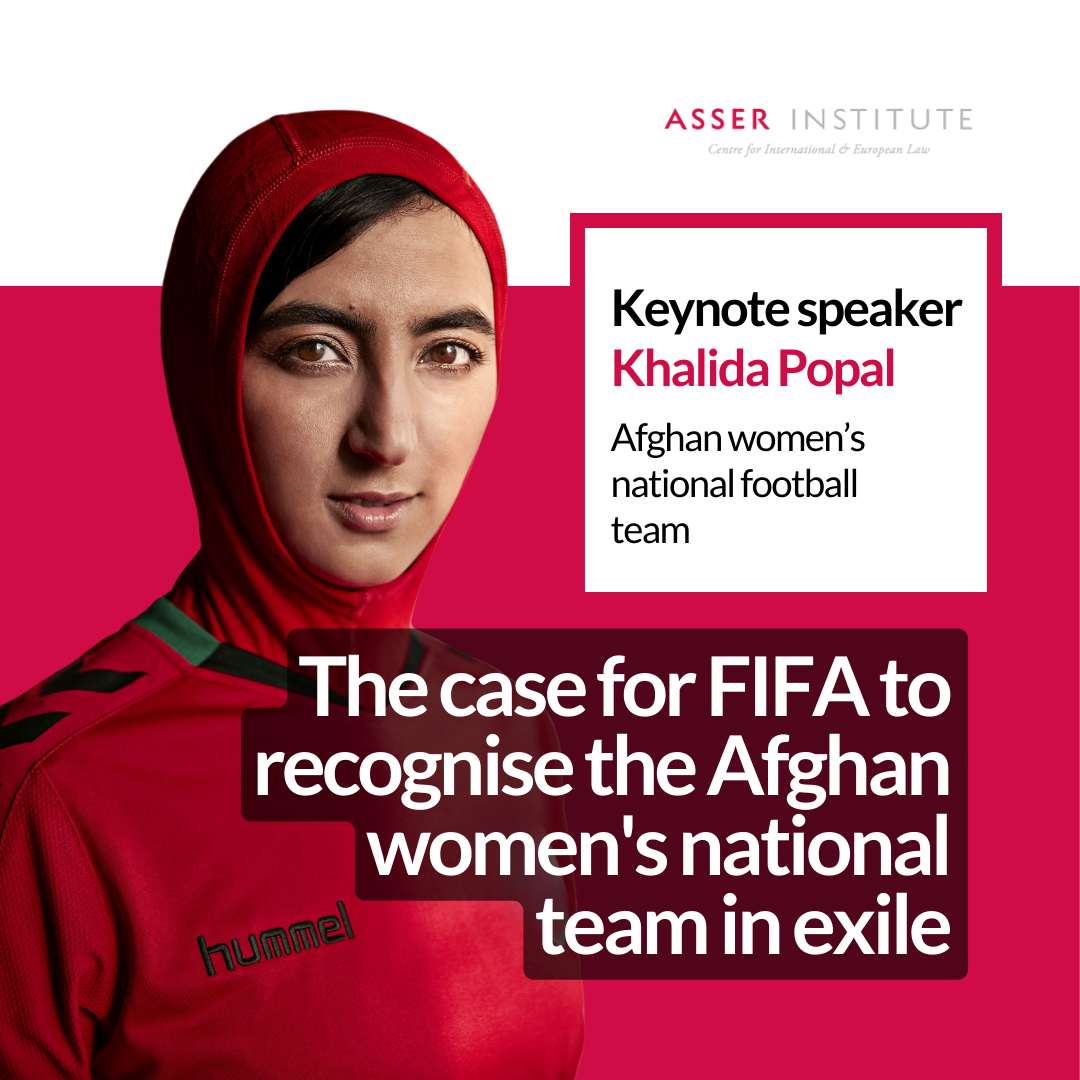
Our expert speakers come from academia, law and sport. Our confirmed speakers are:


Register HERE 

Conference - ISLJ Annual Conference 2024 - 24-25 October - Asser Institute - The Hague

On 24 and 25 October 2024, the Asser Institute in The Hague will host the 2024 edition of the  International Sports Law Journal (ISLJ)  Conference. The ISLJ is the leading academic journal in transnational sports law and governance and is proud to provide a platform for transnational debates on the state of the field. The conference will address a number of issues of interest to the ISLJ and its readers. 

Register HERE

Drivers and effects of reform in transnational sports governance 

Transnational sports governance seems to be in a permanently unstable state of crisis and reform. At regular interval, international sports governing bodies face scandals triggered by corruption investigations or human rights violations, as well as adverse judidicial decisions. These are often followed by waves of institutional reforms, such as the creation of new bodies (E.g. the Athletics Integrity Unit), the adoption of new codes and regulation (such as Codes of Ethics) or human rights commitments (e.g. FIFA and the IOC’s Human Rights Policy/Strategy). This dynamic of crisis and reform will be at the heart of this year’s ISLJ conference, as a number of panels will critically investigate the triggers, transformative effects and limited impacts of reforms in transnational sports governance.  

Football in the midst of international law and relations 
As the war in Gaza and Russia’s invasion of Ukraine continue to rage, it has become even clearer that the football world can hardly be entirely abstracted from international relations. Yet, FIFA and UEFA continue to insist on their neutrality and to deny that their governance is (or should be) affected by the world’s political affairs. During the conference, we will engage with case studies in which football is entangled with international politics and law. In particular, the speakers will delve into the role of FIFA and UEFA in such situations and on the legal standards and processes that should be applied throughout their decision-making.  

Olympic challenges of today and tomorrow 
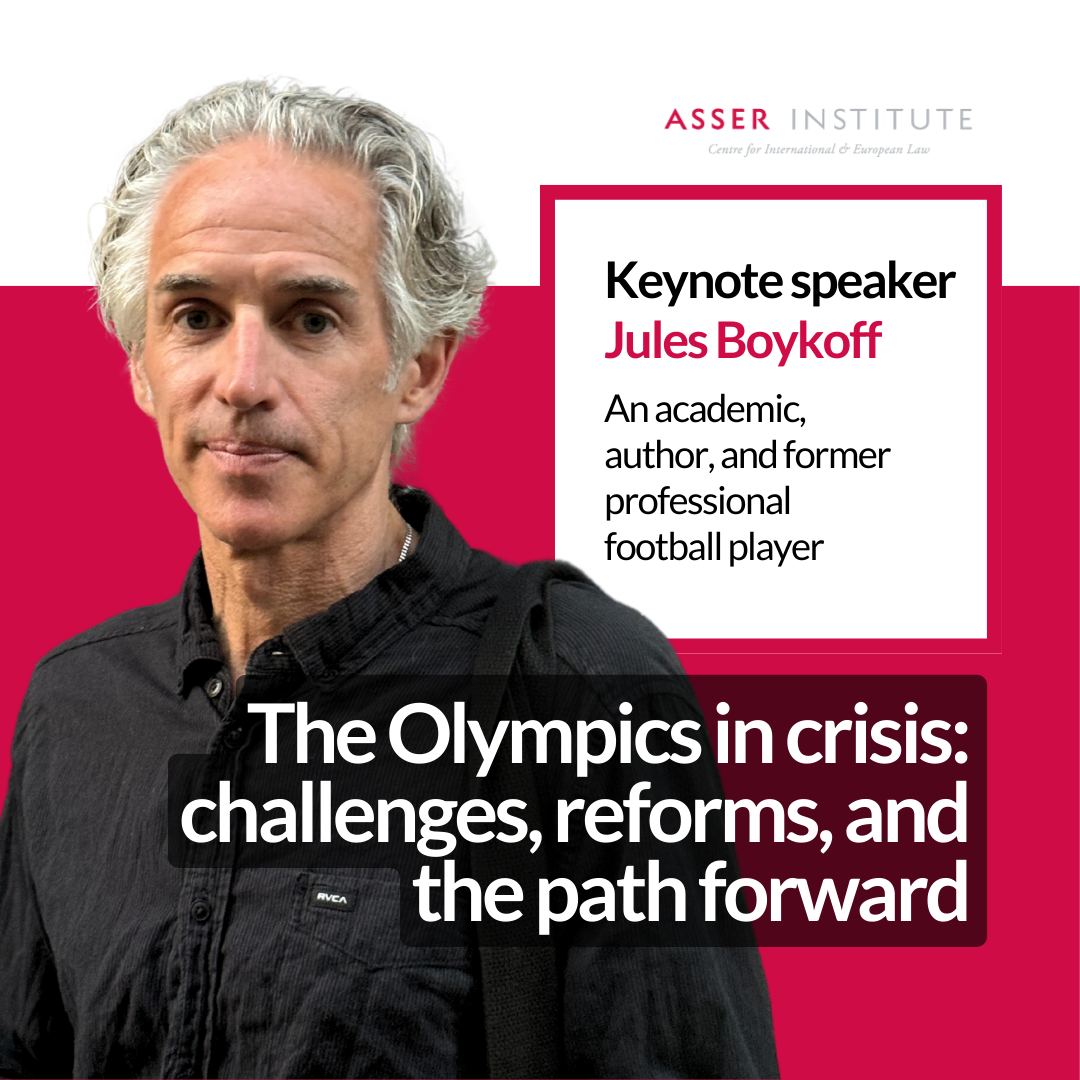
While the Paris 2024 Olympics have come to a close, the legal questions they have raised are far from exhausted. Instead, the Olympics have highlighted new issues (such as the question of the legality of the hijab ban imposed by the French Federation on its athletes) or old ones (such as the question whether Olympians should be remunerated by the IOC or the international federations), which will be discussed by our speakers. Finally, with the help of our keynote speaker, Prof. Jules Boykoff, a longstanding critique of the current Olympic regime, we will explore the IOC’s capacity to adapt to challenges while resisting radical change to the current model of olympism.   

Download the full programme 

Online participation available 
Following the success of our webinar option in the past years, we are once again allowing online participation to the conference at an affordable price. Thus, we hope to internationalise and diversify our audience and to reach people who are not in a position to travel to The Hague.  

We look forward to welcoming you in person in The Hague or digitally to this new iteration of the ISLJ conference. 

Register HERE

Speakers 


Register HERE

Conference - Empowering athletes’ human rights: Global research conference on athletes’ rights - Asser Institute - 23 October

The newly launched ‘Global Sport and Human Rights Research Network’, an initiative jointly hosted by the T.M.C. Asser Instituut and the Centre for Sport and Human Rights, together with the European Union-funded project ‘Human Rights Empowered Through Athletes Rights (H.E.R.O.)' is organising an in-person conference on October 23 at the Asser Institute in The Hague, to map the field of athletes' rights and engage in critical discussions on protection of these rights and how to prevent rights violations.

The one-day conference will kick off with a presentation by the H.E.R.O. team on their research results, followed by a short panel discussion. The rest of the day will be filled with four panels on different aspects related to the topic of athletes’ human rights, with speakers from academic institutions around the world.

Check out the full programme HERE and register for free HERE

undefinedundefined

Co-funded by the European Union logo in png for web usage

Luxembourg calls…is the answer from Nyon the way forward? Assessing UEFA’s response to the ECJ’s ISU judgment - By Saverio Spera


Editor's note: Saverio P. Spera is an Italian qualified attorney-at-law. He has practiced civil and employment law in Italy and briefly worked at the Asser International Sports Law Centre before joining FIFA in 2017. Until May 2024, he has worked within the FIFA legal division - Litigation Department, and lectured in several FIFA sports law programmes. In the spring of 2024 he has co-founded SP.IN Law, a Zurich based international sports law firm.


On 21 December 2023 a judicial hat-trick stormed the scene of EU sports law. That day, the European Court of Justice (the “ECJ”) issued three decisions: (i) European Superleague Company, SL v FIFA and UEFA (Case C-333/21); (ii) UL and SA Royal Antwerp Football Club v Union royale belge des sociétés de football association ASBL (Case C-680/21)and (iii) International Skating Union (ISU) v. European Commission – Case C-124/21.

These judgments were much scrutinised (see herehere and here) in the past 6 months. For the reader’s relief, this paper will not venture into adding another opinion on whether this was a fatal blow to the foundation of EU sports law or if, after all, the substantive change is minimal (as persuasively argued here). It will analyse, instead, UEFA’s recent amendments of its Statutes and Authorisation Rules governing International Club Competitions (the “Authorisation Rules”) and whether these amendments, clearly responding to the concerns raised in the ISU judgment with respect to the sports arbitration system,[1] might pave the way for other Sports Governing Bodies (SGBs) to follow suit and what the implications for CAS arbitration might be. More...

The International Cricket Council and its human rights responsibilities to the Afghanistan women's cricket team - By Rishi Gulati

Editor's note: Dr Rishi Gulati is Associate Professor in International Law at the University of East Anglia (UK) and Barrister in Law. He has a PhD from King’s College London, Advanced Masters in Public International Law from Leiden University, and a Bachelor of Laws from the Australian National University. Amongst other publications, he is the author of Access to Justice and International Organisations (Cambridge University Press, 2022). He has previously worked for the Australian Government, has consulted for various international organizations, and regularly appears as counsel in transnational cases.

On 1 December 2024, Jay Shah, the son of India’s powerful Home Minister and Modi confidante Amit Shah, will take over the role of the Independent Chair of the International Cricket Council (ICC). This appointment reflects the influence India now has on the governance of cricket globally. A key test Jay Shah will face is whether or not the ICC should suspend the Afghanistan Cricket Board (ACB) from its membership as Afghanistan no longer maintains a women’s cricket team contrary to the organization’s own rules, as well as its human rights responsibilities. More...

Women’s Football and the Fundamental Right to Occupational Health and Safety: FIFA’s Responsibility to Regulate Female Specific Health Issues - By Ella Limbach

Editor's noteElla Limbach is currently completing her master’s degree in International Sport Development and Politics at the German Sport University Cologne. Her interests include human rights of athletes, labour rights in sport, the intersection of gender, human rights and sport and the working conditions in women’s football. Previously, she graduated from Utrecht University with a LL.M in Public International Law with a specialization in International Human Rights Law. This blog was written during Ella's internship at the Asser Institute where she conducted research for the H.E.R.O. project. The topic of this blog is also the subject of her master's thesis.

Women’s football has experienced exponential growth over the past decade, though the professionalization of the women’s game continues to face barriers that can be tied to the historical exclusion of women from football and insufficient investment on many levels. While attendance records have been broken and media coverage has increased, the rise in attention also highlighted the need for special accommodations for female footballers regarding health and safety at the workplace. Female footballers face gender specific circumstances which can have an impact on their health such as menstruation, anterior cruciate ligament (ACL) injuries and the impact of maternity. As the recent ILO Brief on ‘Professional athletes and the fundamental principles and rights at work' states “gender issues related to [occupational health and safety] risks are often neglected (p. 23).” While it could be argued that from a human rights point of view article 13(c) of the Convention on the Elimination of Discrimination of Women stipulates “the right to participate in […] sports [on an equal basis to men],” reality shows that so far practices of men’s football were simply applied to women’s football without taking into consideration the physiological differences between male and female players and the implications that can have for female players’ health. The ILO Declaration on Fundamental Principles and Rights at Work(ILO Declaration, amended in 2022) includes “a safe and healthy working environment” as one of the fundamental rights at work (Art. 2e). This begs the question whether the scope of the right to occupational health and safety at the workplace includes the consideration of female specific health issues in women’s football. More...

[Call for Papers] - International Sports Law Journal - Annual Conference - Asser Institute, The Hague - 24-25 October 2024 - Reminder!

The Editors of the International Sports Law Journal (ISLJ) invite you to submit abstracts for the next edition of the ISLJ Conference on International Sports Law, which will take place on 24 and 25 October 2024 at the Asser Institute in The Hague. The ISLJ, published by Springer and TMC Asser Press, is the leading academic publication in the field of international sports law and the conference is a unique occasion to discuss the main legal issues affecting international sports and its governance with renowned academic experts.

We welcome abstracts from academics and practitioners on all issues related to international and transnational sports law and their impact on the governance of sport. We also welcome panel proposals (including a minimum of three presenters) on specific issues of interest to the Journal and its readers. For this year’s edition, we specifically invite submissions on the following themes and subthemes:


Reformism in transnational sports governance: Drivers and impacts

  • Legal and social drivers of reforms in transnational sports governance   
  • The role of strategic litigation (before the EU/ECtHR/National courts) as a driver of reform;
  • The role of public/fan pressure groups on clubs, competition organisers and governments as a driver of change.
  • The impact of internal reforms in transnational sports governance: Cosmetic or real change? (e.g. IOC Agenda 2020+5, FIFA governance reforms, CAS post-Pechstein changes, WADA sfter the Russian doping scandal)
  • Emerging alternatives to private sports governance – the UK’s Independent Football Regulator.


The organization and regulation of mega sporting events: Current and future challenges 

  • Mega-sporting events as legalized sites of digital surveillance 
  • Greening mega-sporting events (e.g. carbon neutral pledges, environmental footprints of events, the impact of multiple hosting sites)
  • Mega-sporting events and the protection of human rights and labour rights (e.g. Paris 2024 Social Charter, Euro 2024 human rights commitments)
  • The Olympic Games and athletes’ economic rights (remuneration/advertisement)
  • Reviews of the legal issues raised at Euro 2024 in Germany and the Paris 2024 Olympic Games
  • Previews of the legal issues likely to have an impact on the FIFA 2026 World Cup and the Milano-Cortina 2026 Winter Olympic Games


Please send your abstract of 300 words and CV no later than 15 July 2024 to a.duval@asser.nl. Selected speakers will be informed by 30 July.

The selected participants will be expected to submit a draft of their paper by 1 October 2024. Papers accepted and presented at the conference are eligible for publication in a special issue of the ISLJ, subject to peer-review. 

The Asser Institute will provide a limited number of travel & accommodation grants (max. 300€). If you wish to be considered for a grant, please explain why in your submission.


[New Event] Feminist theory and sport governance: exploring sports as sites of cultural transformation - 9 July -15:00-17:00 - Asser Institute


This seminar is part of the Asser International Sports Law Centre's event series on the intersection between transnational sports law and governance and gender. Dr Pavlidis will present her take on feminist theories and sport governance by exploring sports and in particular Australian rules football and roller derby as sites of cultural transformation.

Register HERE

Australian rules football is Australia's most popular spectator sport and for most of its history it has been a men's-only sport, including in its governance and leadership. This is slowly changing. Roller derby on the other hand has been reinvented with an explicitly DIY (Do It Yourself) governance structure that resists formal incorporation by 'outsiders'. This paper provides an overview of sport governance in the Australian context before focusing in on these two seemingly disparate sport contexts to explore the challenges of gender inclusive governance in sport.

Dr Adele Pavlidis is an Associate Professor in Sociology with the School of Humanities, Languages and Social Science at Griffith University in Australia. She has published widely on a range of sociocultural issues in sport and leisure, with a focus on gender and power relations. Theoretically her work traverses contemporary scholarship on affect, power and organisations, and she is deeply interested in social, cultural and personal transformation and the entanglements between people, organisations, and wellbeing.

We look forward to hearing Dr Pavlidis present on this topic, followed by reflections and comments by Dr Åsa Ekvall from the Erasmus Center for Sport Integrity & Transition, and Dr Antoine Duval from the T.M.C. Asser Institute. There will also be a Q&A with the audience.

Download the latest programme here 

Register HERE


[Call for papers] - International Sports Law Journal - Annual Conference - Asser Institute, The Hague - 24-25 October 2024

The Editors of the International Sports Law Journal (ISLJ) invite you to submit abstracts for the next edition of the ISLJ Conference on International Sports Law, which will take place on 24 and 25 October 2024 at the Asser Institute in The Hague. The ISLJ, published by Springer and TMC Asser Press, is the leading academic publication in the field of international sports law and the conference is a unique occasion to discuss the main legal issues affecting international sports and its governance with renowned academic experts.

We welcome abstracts from academics and practitioners on all issues related to international and transnational sports law and their impact on the governance of sport. We also welcome panel proposals (including a minimum of three presenters) on specific issues of interest to the Journal and its readers. For this year’s edition, we specifically invite submissions on the following themes and subthemes:


Reformism in transnational sports governance: Drivers and impacts

  • Legal and social drivers of reforms in transnational sports governance   
  • The role of strategic litigation (before the EU/ECtHR/National courts) as a driver of reform;
  • The role of public/fan pressure groups on clubs, competition organisers and governments as a driver of change.
  • The impact of internal reforms in transnational sports governance: Cosmetic or real change? (e.g. IOC Agenda 2020+5, FIFA governance reforms, CAS post-Pechstein changes, WADA sfter the Russian doping scandal)
  • Emerging alternatives to private sports governance – the UK’s Independent Football Regulator.


The organization and regulation of mega sporting events: Current and future challenges 

  • Mega-sporting events as legalized sites of digital surveillance 
  • Greening mega-sporting events (e.g. carbon neutral pledges, environmental footprints of events, the impact of multiple hosting sites)
  • Mega-sporting events and the protection of human rights and labour rights (e.g. Paris 2024 Social Charter, Euro 2024 human rights commitments)
  • The Olympic Games and athletes’ economic rights (remuneration/advertisement)
  • Reviews of the legal issues raised at Euro 2024 in Germany and the Paris 2024 Olympic Games
  • Previews of the legal issues likely to have an impact on the FIFA 2026 World Cup and the Milano-Cortina 2026 Winter Olympic Games


Please send your abstract of 300 words and CV no later than 15 July 2024 to a.duval@asser.nl. Selected speakers will be informed by 30 July.

The selected participants will be expected to submit a draft of their paper by 1 October 2024. Papers accepted and presented at the conference are eligible for publication in a special issue of the ISLJ, subject to peer-review. 

The Asser Institute will provide a limited number of travel & accommodation grants (max. 300€). If you wish to be considered for a grant, please explain why in your submission.


[Online Summer Programme] - International sports and human rights - 22 - 29 May 2024 - Last spots!

Join us for the first online version of our unique training programme on ‘Sport and human rights’ jointly organised by the Centre for Sport and Human Rights and the Asser Institute taking place on May 22-24 & May 27-29.

After the success of the first editions in 2022 and 2023 the programme returns, focusing on the link between the sport and human rights and zooming in on a number of topics, such as the UN Guiding Principles for Business and Human Rights and their application in sports. We will also adopt a human rights lens to sport governance and address freedom of speech, the rights of athletes, and access to remedy.

Tackling contemporary human rights challenges in sport

The programme brings together the latest in academic research with practical experiences from working in the field in an interactive package, fostering productive exchanges between the speakers and participants. Theoretical knowledge will be complemented by exposure to hands-on know-how.

Participants will have the opportunity to learn from experts from the Asser Institute, the Centre for Sport and Human Rights, and high-profile external speakers from both academia and practice.

What will you gain?

  • An extensive introduction to the emergence of the sport and human rights movement
  • A greater understanding of the normative framework for human rights standards in sport
  • A comprehensive overview of the latest developments in the interplay between gender and sports
  • Practical know-how to govern  human rights in the context of sporting organisations
  • Practical know-how to address  human rights risks in the context of day-to-day sports, including safeguarding
  • Practical know-how to access remedy in human rights disputes
  • The opportunity to engage in discussions and network with leading academics and professionals

Topics addressed in this summer programme include:

  • The emergence of the sport and human rights discussion/movement
  • The integration of human rights in the governance of sport
  • The protection of athletes’ rights
  • Access to remedy for sport-related human rights harms


Read the full programme.

Register HERE


In partnership with:

undefined    undefined

Asser International Sports Law Blog | Our International Sports Law Diary <br/>The <a href="http://www.sportslaw.nl" target="_blank">Asser International Sports Law Centre</a> is part of the <a href="https://www.asser.nl/" target="_blank"><img src="/sportslaw/blog/media/logo_asser_horizontal.jpg" style="vertical-align: bottom; margin-left: 7px;width: 140px" alt="T.M.C. Asser Instituut" /></a>

Asser International Sports Law Blog

Our International Sports Law Diary
The Asser International Sports Law Centre is part of the T.M.C. Asser Instituut

Free Webinar - The impact of the Diarra case on the football transfer system - 18 October 2024 - 15:00 CET

The Court of Justice of the European Union has recently handed down its judgement in the Lassana Diarra case (C-650/22 FIFA v. BZ).

Given the importance of this case to the sports industry, LawInSport, the Asser Instituut and the Association for the Study of Sport and the EU (Sport & EU) are hosting a joint webinar to bring together experts to unpack and provide clarity on the complex legal, regulatory & commercial issues stemming from this case. This free webinar will be hosted from 14:00 UK time (15:00 CET) on 18 October 2024.


Register HERE 


Speakers

Our expert speakers come from academia, law and sport. Our confirmed speakers are:


Register HERE 

Conference - ISLJ Annual Conference 2024 - 24-25 October - Asser Institute - The Hague

On 24 and 25 October 2024, the Asser Institute in The Hague will host the 2024 edition of the  International Sports Law Journal (ISLJ)  Conference. The ISLJ is the leading academic journal in transnational sports law and governance and is proud to provide a platform for transnational debates on the state of the field. The conference will address a number of issues of interest to the ISLJ and its readers. 

Register HERE

Drivers and effects of reform in transnational sports governance 

Transnational sports governance seems to be in a permanently unstable state of crisis and reform. At regular interval, international sports governing bodies face scandals triggered by corruption investigations or human rights violations, as well as adverse judidicial decisions. These are often followed by waves of institutional reforms, such as the creation of new bodies (E.g. the Athletics Integrity Unit), the adoption of new codes and regulation (such as Codes of Ethics) or human rights commitments (e.g. FIFA and the IOC’s Human Rights Policy/Strategy). This dynamic of crisis and reform will be at the heart of this year’s ISLJ conference, as a number of panels will critically investigate the triggers, transformative effects and limited impacts of reforms in transnational sports governance.  

Football in the midst of international law and relations 
As the war in Gaza and Russia’s invasion of Ukraine continue to rage, it has become even clearer that the football world can hardly be entirely abstracted from international relations. Yet, FIFA and UEFA continue to insist on their neutrality and to deny that their governance is (or should be) affected by the world’s political affairs. During the conference, we will engage with case studies in which football is entangled with international politics and law. In particular, the speakers will delve into the role of FIFA and UEFA in such situations and on the legal standards and processes that should be applied throughout their decision-making.  

Olympic challenges of today and tomorrow 
While the Paris 2024 Olympics have come to a close, the legal questions they have raised are far from exhausted. Instead, the Olympics have highlighted new issues (such as the question of the legality of the hijab ban imposed by the French Federation on its athletes) or old ones (such as the question whether Olympians should be remunerated by the IOC or the international federations), which will be discussed by our speakers. Finally, with the help of our keynote speaker, Prof. Jules Boykoff, a longstanding critique of the current Olympic regime, we will explore the IOC’s capacity to adapt to challenges while resisting radical change to the current model of olympism.   

Download the full programme 

Online participation available 
Following the success of our webinar option in the past years, we are once again allowing online participation to the conference at an affordable price. Thus, we hope to internationalise and diversify our audience and to reach people who are not in a position to travel to The Hague.  

We look forward to welcoming you in person in The Hague or digitally to this new iteration of the ISLJ conference. 

Register HERE

Speakers 


Register HERE

Conference - Empowering athletes’ human rights: Global research conference on athletes’ rights - Asser Institute - 23 October

The newly launched ‘Global Sport and Human Rights Research Network’, an initiative jointly hosted by the T.M.C. Asser Instituut and the Centre for Sport and Human Rights, together with the European Union-funded project ‘Human Rights Empowered Through Athletes Rights (H.E.R.O.)' is organising an in-person conference on October 23 at the Asser Institute in The Hague, to map the field of athletes' rights and engage in critical discussions on protection of these rights and how to prevent rights violations.

The one-day conference will kick off with a presentation by the H.E.R.O. team on their research results, followed by a short panel discussion. The rest of the day will be filled with four panels on different aspects related to the topic of athletes’ human rights, with speakers from academic institutions around the world.

Check out the full programme HERE and register for free HERE

undefinedundefined

Co-funded by the European Union logo in png for web usage

Luxembourg calls…is the answer from Nyon the way forward? Assessing UEFA’s response to the ECJ’s ISU judgment - By Saverio Spera


Editor's note: Saverio P. Spera is an Italian qualified attorney-at-law. He has practiced civil and employment law in Italy and briefly worked at the Asser International Sports Law Centre before joining FIFA in 2017. Until May 2024, he has worked within the FIFA legal division - Litigation Department, and lectured in several FIFA sports law programmes. In the spring of 2024 he has co-founded SP.IN Law, a Zurich based international sports law firm.


On 21 December 2023 a judicial hat-trick stormed the scene of EU sports law. That day, the European Court of Justice (the “ECJ”) issued three decisions: (i) European Superleague Company, SL v FIFA and UEFA (Case C-333/21); (ii) UL and SA Royal Antwerp Football Club v Union royale belge des sociétés de football association ASBL (Case C-680/21)and (iii) International Skating Union (ISU) v. European Commission – Case C-124/21.

These judgments were much scrutinised (see herehere and here) in the past 6 months. For the reader’s relief, this paper will not venture into adding another opinion on whether this was a fatal blow to the foundation of EU sports law or if, after all, the substantive change is minimal (as persuasively argued here). It will analyse, instead, UEFA’s recent amendments of its Statutes and Authorisation Rules governing International Club Competitions (the “Authorisation Rules”) and whether these amendments, clearly responding to the concerns raised in the ISU judgment with respect to the sports arbitration system,[1] might pave the way for other Sports Governing Bodies (SGBs) to follow suit and what the implications for CAS arbitration might be. More...

The International Cricket Council and its human rights responsibilities to the Afghanistan women's cricket team - By Rishi Gulati

Editor's note: Dr Rishi Gulati is Associate Professor in International Law at the University of East Anglia (UK) and Barrister in Law. He has a PhD from King’s College London, Advanced Masters in Public International Law from Leiden University, and a Bachelor of Laws from the Australian National University. Amongst other publications, he is the author of Access to Justice and International Organisations (Cambridge University Press, 2022). He has previously worked for the Australian Government, has consulted for various international organizations, and regularly appears as counsel in transnational cases.

On 1 December 2024, Jay Shah, the son of India’s powerful Home Minister and Modi confidante Amit Shah, will take over the role of the Independent Chair of the International Cricket Council (ICC). This appointment reflects the influence India now has on the governance of cricket globally. A key test Jay Shah will face is whether or not the ICC should suspend the Afghanistan Cricket Board (ACB) from its membership as Afghanistan no longer maintains a women’s cricket team contrary to the organization’s own rules, as well as its human rights responsibilities. More...

Women’s Football and the Fundamental Right to Occupational Health and Safety: FIFA’s Responsibility to Regulate Female Specific Health Issues - By Ella Limbach

Editor's noteElla Limbach is currently completing her master’s degree in International Sport Development and Politics at the German Sport University Cologne. Her interests include human rights of athletes, labour rights in sport, the intersection of gender, human rights and sport and the working conditions in women’s football. Previously, she graduated from Utrecht University with a LL.M in Public International Law with a specialization in International Human Rights Law. This blog was written during Ella's internship at the Asser Institute where she conducted research for the H.E.R.O. project. The topic of this blog is also the subject of her master's thesis.

Women’s football has experienced exponential growth over the past decade, though the professionalization of the women’s game continues to face barriers that can be tied to the historical exclusion of women from football and insufficient investment on many levels. While attendance records have been broken and media coverage has increased, the rise in attention also highlighted the need for special accommodations for female footballers regarding health and safety at the workplace. Female footballers face gender specific circumstances which can have an impact on their health such as menstruation, anterior cruciate ligament (ACL) injuries and the impact of maternity. As the recent ILO Brief on ‘Professional athletes and the fundamental principles and rights at work' states “gender issues related to [occupational health and safety] risks are often neglected (p. 23).” While it could be argued that from a human rights point of view article 13(c) of the Convention on the Elimination of Discrimination of Women stipulates “the right to participate in […] sports [on an equal basis to men],” reality shows that so far practices of men’s football were simply applied to women’s football without taking into consideration the physiological differences between male and female players and the implications that can have for female players’ health. The ILO Declaration on Fundamental Principles and Rights at Work(ILO Declaration, amended in 2022) includes “a safe and healthy working environment” as one of the fundamental rights at work (Art. 2e). This begs the question whether the scope of the right to occupational health and safety at the workplace includes the consideration of female specific health issues in women’s football. More...

[Call for Papers] - International Sports Law Journal - Annual Conference - Asser Institute, The Hague - 24-25 October 2024 - Reminder!

The Editors of the International Sports Law Journal (ISLJ) invite you to submit abstracts for the next edition of the ISLJ Conference on International Sports Law, which will take place on 24 and 25 October 2024 at the Asser Institute in The Hague. The ISLJ, published by Springer and TMC Asser Press, is the leading academic publication in the field of international sports law and the conference is a unique occasion to discuss the main legal issues affecting international sports and its governance with renowned academic experts.

We welcome abstracts from academics and practitioners on all issues related to international and transnational sports law and their impact on the governance of sport. We also welcome panel proposals (including a minimum of three presenters) on specific issues of interest to the Journal and its readers. For this year’s edition, we specifically invite submissions on the following themes and subthemes:


Reformism in transnational sports governance: Drivers and impacts

  • Legal and social drivers of reforms in transnational sports governance   
  • The role of strategic litigation (before the EU/ECtHR/National courts) as a driver of reform;
  • The role of public/fan pressure groups on clubs, competition organisers and governments as a driver of change.
  • The impact of internal reforms in transnational sports governance: Cosmetic or real change? (e.g. IOC Agenda 2020+5, FIFA governance reforms, CAS post-Pechstein changes, WADA sfter the Russian doping scandal)
  • Emerging alternatives to private sports governance – the UK’s Independent Football Regulator.


The organization and regulation of mega sporting events: Current and future challenges 

  • Mega-sporting events as legalized sites of digital surveillance 
  • Greening mega-sporting events (e.g. carbon neutral pledges, environmental footprints of events, the impact of multiple hosting sites)
  • Mega-sporting events and the protection of human rights and labour rights (e.g. Paris 2024 Social Charter, Euro 2024 human rights commitments)
  • The Olympic Games and athletes’ economic rights (remuneration/advertisement)
  • Reviews of the legal issues raised at Euro 2024 in Germany and the Paris 2024 Olympic Games
  • Previews of the legal issues likely to have an impact on the FIFA 2026 World Cup and the Milano-Cortina 2026 Winter Olympic Games


Please send your abstract of 300 words and CV no later than 15 July 2024 to a.duval@asser.nl. Selected speakers will be informed by 30 July.

The selected participants will be expected to submit a draft of their paper by 1 October 2024. Papers accepted and presented at the conference are eligible for publication in a special issue of the ISLJ, subject to peer-review. 

The Asser Institute will provide a limited number of travel & accommodation grants (max. 300€). If you wish to be considered for a grant, please explain why in your submission.


[New Event] Feminist theory and sport governance: exploring sports as sites of cultural transformation - 9 July -15:00-17:00 - Asser Institute


This seminar is part of the Asser International Sports Law Centre's event series on the intersection between transnational sports law and governance and gender. Dr Pavlidis will present her take on feminist theories and sport governance by exploring sports and in particular Australian rules football and roller derby as sites of cultural transformation.

Register HERE

Australian rules football is Australia's most popular spectator sport and for most of its history it has been a men's-only sport, including in its governance and leadership. This is slowly changing. Roller derby on the other hand has been reinvented with an explicitly DIY (Do It Yourself) governance structure that resists formal incorporation by 'outsiders'. This paper provides an overview of sport governance in the Australian context before focusing in on these two seemingly disparate sport contexts to explore the challenges of gender inclusive governance in sport.

Dr Adele Pavlidis is an Associate Professor in Sociology with the School of Humanities, Languages and Social Science at Griffith University in Australia. She has published widely on a range of sociocultural issues in sport and leisure, with a focus on gender and power relations. Theoretically her work traverses contemporary scholarship on affect, power and organisations, and she is deeply interested in social, cultural and personal transformation and the entanglements between people, organisations, and wellbeing.

We look forward to hearing Dr Pavlidis present on this topic, followed by reflections and comments by Dr Åsa Ekvall from the Erasmus Center for Sport Integrity & Transition, and Dr Antoine Duval from the T.M.C. Asser Institute. There will also be a Q&A with the audience.

Download the latest programme here 

Register HERE


[Call for papers] - International Sports Law Journal - Annual Conference - Asser Institute, The Hague - 24-25 October 2024

The Editors of the International Sports Law Journal (ISLJ) invite you to submit abstracts for the next edition of the ISLJ Conference on International Sports Law, which will take place on 24 and 25 October 2024 at the Asser Institute in The Hague. The ISLJ, published by Springer and TMC Asser Press, is the leading academic publication in the field of international sports law and the conference is a unique occasion to discuss the main legal issues affecting international sports and its governance with renowned academic experts.

We welcome abstracts from academics and practitioners on all issues related to international and transnational sports law and their impact on the governance of sport. We also welcome panel proposals (including a minimum of three presenters) on specific issues of interest to the Journal and its readers. For this year’s edition, we specifically invite submissions on the following themes and subthemes:


Reformism in transnational sports governance: Drivers and impacts

  • Legal and social drivers of reforms in transnational sports governance   
  • The role of strategic litigation (before the EU/ECtHR/National courts) as a driver of reform;
  • The role of public/fan pressure groups on clubs, competition organisers and governments as a driver of change.
  • The impact of internal reforms in transnational sports governance: Cosmetic or real change? (e.g. IOC Agenda 2020+5, FIFA governance reforms, CAS post-Pechstein changes, WADA sfter the Russian doping scandal)
  • Emerging alternatives to private sports governance – the UK’s Independent Football Regulator.


The organization and regulation of mega sporting events: Current and future challenges 

  • Mega-sporting events as legalized sites of digital surveillance 
  • Greening mega-sporting events (e.g. carbon neutral pledges, environmental footprints of events, the impact of multiple hosting sites)
  • Mega-sporting events and the protection of human rights and labour rights (e.g. Paris 2024 Social Charter, Euro 2024 human rights commitments)
  • The Olympic Games and athletes’ economic rights (remuneration/advertisement)
  • Reviews of the legal issues raised at Euro 2024 in Germany and the Paris 2024 Olympic Games
  • Previews of the legal issues likely to have an impact on the FIFA 2026 World Cup and the Milano-Cortina 2026 Winter Olympic Games


Please send your abstract of 300 words and CV no later than 15 July 2024 to a.duval@asser.nl. Selected speakers will be informed by 30 July.

The selected participants will be expected to submit a draft of their paper by 1 October 2024. Papers accepted and presented at the conference are eligible for publication in a special issue of the ISLJ, subject to peer-review. 

The Asser Institute will provide a limited number of travel & accommodation grants (max. 300€). If you wish to be considered for a grant, please explain why in your submission.


[Online Summer Programme] - International sports and human rights - 22 - 29 May 2024 - Last spots!

Join us for the first online version of our unique training programme on ‘Sport and human rights’ jointly organised by the Centre for Sport and Human Rights and the Asser Institute taking place on May 22-24 & May 27-29.

After the success of the first editions in 2022 and 2023 the programme returns, focusing on the link between the sport and human rights and zooming in on a number of topics, such as the UN Guiding Principles for Business and Human Rights and their application in sports. We will also adopt a human rights lens to sport governance and address freedom of speech, the rights of athletes, and access to remedy.

Tackling contemporary human rights challenges in sport

The programme brings together the latest in academic research with practical experiences from working in the field in an interactive package, fostering productive exchanges between the speakers and participants. Theoretical knowledge will be complemented by exposure to hands-on know-how.

Participants will have the opportunity to learn from experts from the Asser Institute, the Centre for Sport and Human Rights, and high-profile external speakers from both academia and practice.

What will you gain?

  • An extensive introduction to the emergence of the sport and human rights movement
  • A greater understanding of the normative framework for human rights standards in sport
  • A comprehensive overview of the latest developments in the interplay between gender and sports
  • Practical know-how to govern  human rights in the context of sporting organisations
  • Practical know-how to address  human rights risks in the context of day-to-day sports, including safeguarding
  • Practical know-how to access remedy in human rights disputes
  • The opportunity to engage in discussions and network with leading academics and professionals

Topics addressed in this summer programme include:

  • The emergence of the sport and human rights discussion/movement
  • The integration of human rights in the governance of sport
  • The protection of athletes’ rights
  • Access to remedy for sport-related human rights harms


Read the full programme.

Register HERE


In partnership with:

undefined    undefined

Asser International Sports Law Blog | Our International Sports Law Diary <br/>The <a href="http://www.sportslaw.nl" target="_blank">Asser International Sports Law Centre</a> is part of the <a href="https://www.asser.nl/" target="_blank"><img src="/sportslaw/blog/media/logo_asser_horizontal.jpg" style="vertical-align: bottom; margin-left: 7px;width: 140px" alt="T.M.C. Asser Instituut" /></a>

Asser International Sports Law Blog

Our International Sports Law Diary
The Asser International Sports Law Centre is part of the T.M.C. Asser Instituut

Free Webinar - The impact of the Diarra case on the football transfer system - 18 October 2024 - 15:00 CET

The Court of Justice of the European Union has recently handed down its judgement in the Lassana Diarra case (C-650/22 FIFA v. BZ).

Given the importance of this case to the sports industry, LawInSport, the Asser Instituut and the Association for the Study of Sport and the EU (Sport & EU) are hosting a joint webinar to bring together experts to unpack and provide clarity on the complex legal, regulatory & commercial issues stemming from this case. This free webinar will be hosted from 14:00 UK time (15:00 CET) on 18 October 2024.


Register HERE 


Speakers

Our expert speakers come from academia, law and sport. Our confirmed speakers are:


Register HERE 

Conference - ISLJ Annual Conference 2024 - 24-25 October - Asser Institute - The Hague

On 24 and 25 October 2024, the Asser Institute in The Hague will host the 2024 edition of the  International Sports Law Journal (ISLJ)  Conference. The ISLJ is the leading academic journal in transnational sports law and governance and is proud to provide a platform for transnational debates on the state of the field. The conference will address a number of issues of interest to the ISLJ and its readers. 

Register HERE

Drivers and effects of reform in transnational sports governance 

Transnational sports governance seems to be in a permanently unstable state of crisis and reform. At regular interval, international sports governing bodies face scandals triggered by corruption investigations or human rights violations, as well as adverse judidicial decisions. These are often followed by waves of institutional reforms, such as the creation of new bodies (E.g. the Athletics Integrity Unit), the adoption of new codes and regulation (such as Codes of Ethics) or human rights commitments (e.g. FIFA and the IOC’s Human Rights Policy/Strategy). This dynamic of crisis and reform will be at the heart of this year’s ISLJ conference, as a number of panels will critically investigate the triggers, transformative effects and limited impacts of reforms in transnational sports governance.  

Football in the midst of international law and relations 
As the war in Gaza and Russia’s invasion of Ukraine continue to rage, it has become even clearer that the football world can hardly be entirely abstracted from international relations. Yet, FIFA and UEFA continue to insist on their neutrality and to deny that their governance is (or should be) affected by the world’s political affairs. During the conference, we will engage with case studies in which football is entangled with international politics and law. In particular, the speakers will delve into the role of FIFA and UEFA in such situations and on the legal standards and processes that should be applied throughout their decision-making.  

Olympic challenges of today and tomorrow 
While the Paris 2024 Olympics have come to a close, the legal questions they have raised are far from exhausted. Instead, the Olympics have highlighted new issues (such as the question of the legality of the hijab ban imposed by the French Federation on its athletes) or old ones (such as the question whether Olympians should be remunerated by the IOC or the international federations), which will be discussed by our speakers. Finally, with the help of our keynote speaker, Prof. Jules Boykoff, a longstanding critique of the current Olympic regime, we will explore the IOC’s capacity to adapt to challenges while resisting radical change to the current model of olympism.   

Download the full programme 

Online participation available 
Following the success of our webinar option in the past years, we are once again allowing online participation to the conference at an affordable price. Thus, we hope to internationalise and diversify our audience and to reach people who are not in a position to travel to The Hague.  

We look forward to welcoming you in person in The Hague or digitally to this new iteration of the ISLJ conference. 

Register HERE

Speakers 


Register HERE


Conference - Empowering athletes’ human rights: Global research conference on athletes’ rights - Asser Institute - 23 October

The newly launched ‘Global Sport and Human Rights Research Network’, an initiative jointly hosted by the T.M.C. Asser Instituut and the Centre for Sport and Human Rights, together with the European Union-funded project ‘Human Rights Empowered Through Athletes Rights (H.E.R.O.)' is organising an in-person conference on October 23 at the Asser Institute in The Hague, to map the field of athletes' rights and engage in critical discussions on protection of these rights and how to prevent rights violations.

The one-day conference will kick off with a presentation by the H.E.R.O. team on their research results, followed by a short panel discussion. The rest of the day will be filled with four panels on different aspects related to the topic of athletes’ human rights, with speakers from academic institutions around the world.

Check out the full programme HERE and register for free HERE

undefinedundefined

Co-funded by the European Union logo in png for web usage

Luxembourg calls…is the answer from Nyon the way forward? Assessing UEFA’s response to the ECJ’s ISU judgment - By Saverio Spera


Editor's note: Saverio P. Spera is an Italian qualified attorney-at-law. He has practiced civil and employment law in Italy and briefly worked at the Asser International Sports Law Centre before joining FIFA in 2017. Until May 2024, he has worked within the FIFA legal division - Litigation Department, and lectured in several FIFA sports law programmes. In the spring of 2024 he has co-founded SP.IN Law, a Zurich based international sports law firm.


On 21 December 2023 a judicial hat-trick stormed the scene of EU sports law. That day, the European Court of Justice (the “ECJ”) issued three decisions: (i) European Superleague Company, SL v FIFA and UEFA (Case C-333/21); (ii) UL and SA Royal Antwerp Football Club v Union royale belge des sociétés de football association ASBL (Case C-680/21)and (iii) International Skating Union (ISU) v. European Commission – Case C-124/21.

These judgments were much scrutinised (see herehere and here) in the past 6 months. For the reader’s relief, this paper will not venture into adding another opinion on whether this was a fatal blow to the foundation of EU sports law or if, after all, the substantive change is minimal (as persuasively argued here). It will analyse, instead, UEFA’s recent amendments of its Statutes and Authorisation Rules governing International Club Competitions (the “Authorisation Rules”) and whether these amendments, clearly responding to the concerns raised in the ISU judgment with respect to the sports arbitration system,[1] might pave the way for other Sports Governing Bodies (SGBs) to follow suit and what the implications for CAS arbitration might be. More...

The International Cricket Council and its human rights responsibilities to the Afghanistan women's cricket team - By Rishi Gulati

Editor's note: Dr Rishi Gulati is Associate Professor in International Law at the University of East Anglia (UK) and Barrister in Law. He has a PhD from King’s College London, Advanced Masters in Public International Law from Leiden University, and a Bachelor of Laws from the Australian National University. Amongst other publications, he is the author of Access to Justice and International Organisations (Cambridge University Press, 2022). He has previously worked for the Australian Government, has consulted for various international organizations, and regularly appears as counsel in transnational cases.

On 1 December 2024, Jay Shah, the son of India’s powerful Home Minister and Modi confidante Amit Shah, will take over the role of the Independent Chair of the International Cricket Council (ICC). This appointment reflects the influence India now has on the governance of cricket globally. A key test Jay Shah will face is whether or not the ICC should suspend the Afghanistan Cricket Board (ACB) from its membership as Afghanistan no longer maintains a women’s cricket team contrary to the organization’s own rules, as well as its human rights responsibilities. More...

Women’s Football and the Fundamental Right to Occupational Health and Safety: FIFA’s Responsibility to Regulate Female Specific Health Issues - By Ella Limbach

Editor's noteElla Limbach is currently completing her master’s degree in International Sport Development and Politics at the German Sport University Cologne. Her interests include human rights of athletes, labour rights in sport, the intersection of gender, human rights and sport and the working conditions in women’s football. Previously, she graduated from Utrecht University with a LL.M in Public International Law with a specialization in International Human Rights Law. This blog was written during Ella's internship at the Asser Institute where she conducted research for the H.E.R.O. project. The topic of this blog is also the subject of her master's thesis.

Women’s football has experienced exponential growth over the past decade, though the professionalization of the women’s game continues to face barriers that can be tied to the historical exclusion of women from football and insufficient investment on many levels. While attendance records have been broken and media coverage has increased, the rise in attention also highlighted the need for special accommodations for female footballers regarding health and safety at the workplace. Female footballers face gender specific circumstances which can have an impact on their health such as menstruation, anterior cruciate ligament (ACL) injuries and the impact of maternity. As the recent ILO Brief on ‘Professional athletes and the fundamental principles and rights at work' states “gender issues related to [occupational health and safety] risks are often neglected (p. 23).” While it could be argued that from a human rights point of view article 13(c) of the Convention on the Elimination of Discrimination of Women stipulates “the right to participate in […] sports [on an equal basis to men],” reality shows that so far practices of men’s football were simply applied to women’s football without taking into consideration the physiological differences between male and female players and the implications that can have for female players’ health. The ILO Declaration on Fundamental Principles and Rights at Work(ILO Declaration, amended in 2022) includes “a safe and healthy working environment” as one of the fundamental rights at work (Art. 2e). This begs the question whether the scope of the right to occupational health and safety at the workplace includes the consideration of female specific health issues in women’s football. More...

[Call for Papers] - International Sports Law Journal - Annual Conference - Asser Institute, The Hague - 24-25 October 2024 - Reminder!

The Editors of the International Sports Law Journal (ISLJ) invite you to submit abstracts for the next edition of the ISLJ Conference on International Sports Law, which will take place on 24 and 25 October 2024 at the Asser Institute in The Hague. The ISLJ, published by Springer and TMC Asser Press, is the leading academic publication in the field of international sports law and the conference is a unique occasion to discuss the main legal issues affecting international sports and its governance with renowned academic experts.

We welcome abstracts from academics and practitioners on all issues related to international and transnational sports law and their impact on the governance of sport. We also welcome panel proposals (including a minimum of three presenters) on specific issues of interest to the Journal and its readers. For this year’s edition, we specifically invite submissions on the following themes and subthemes:


Reformism in transnational sports governance: Drivers and impacts

  • Legal and social drivers of reforms in transnational sports governance   
  • The role of strategic litigation (before the EU/ECtHR/National courts) as a driver of reform;
  • The role of public/fan pressure groups on clubs, competition organisers and governments as a driver of change.
  • The impact of internal reforms in transnational sports governance: Cosmetic or real change? (e.g. IOC Agenda 2020+5, FIFA governance reforms, CAS post-Pechstein changes, WADA sfter the Russian doping scandal)
  • Emerging alternatives to private sports governance – the UK’s Independent Football Regulator.


The organization and regulation of mega sporting events: Current and future challenges 

  • Mega-sporting events as legalized sites of digital surveillance 
  • Greening mega-sporting events (e.g. carbon neutral pledges, environmental footprints of events, the impact of multiple hosting sites)
  • Mega-sporting events and the protection of human rights and labour rights (e.g. Paris 2024 Social Charter, Euro 2024 human rights commitments)
  • The Olympic Games and athletes’ economic rights (remuneration/advertisement)
  • Reviews of the legal issues raised at Euro 2024 in Germany and the Paris 2024 Olympic Games
  • Previews of the legal issues likely to have an impact on the FIFA 2026 World Cup and the Milano-Cortina 2026 Winter Olympic Games


Please send your abstract of 300 words and CV no later than 15 July 2024 to a.duval@asser.nl. Selected speakers will be informed by 30 July.

The selected participants will be expected to submit a draft of their paper by 1 October 2024. Papers accepted and presented at the conference are eligible for publication in a special issue of the ISLJ, subject to peer-review. 

The Asser Institute will provide a limited number of travel & accommodation grants (max. 300€). If you wish to be considered for a grant, please explain why in your submission.


[New Event] Feminist theory and sport governance: exploring sports as sites of cultural transformation - 9 July -15:00-17:00 - Asser Institute


This seminar is part of the Asser International Sports Law Centre's event series on the intersection between transnational sports law and governance and gender. Dr Pavlidis will present her take on feminist theories and sport governance by exploring sports and in particular Australian rules football and roller derby as sites of cultural transformation.

Register HERE

Australian rules football is Australia's most popular spectator sport and for most of its history it has been a men's-only sport, including in its governance and leadership. This is slowly changing. Roller derby on the other hand has been reinvented with an explicitly DIY (Do It Yourself) governance structure that resists formal incorporation by 'outsiders'. This paper provides an overview of sport governance in the Australian context before focusing in on these two seemingly disparate sport contexts to explore the challenges of gender inclusive governance in sport.

Dr Adele Pavlidis is an Associate Professor in Sociology with the School of Humanities, Languages and Social Science at Griffith University in Australia. She has published widely on a range of sociocultural issues in sport and leisure, with a focus on gender and power relations. Theoretically her work traverses contemporary scholarship on affect, power and organisations, and she is deeply interested in social, cultural and personal transformation and the entanglements between people, organisations, and wellbeing.

We look forward to hearing Dr Pavlidis present on this topic, followed by reflections and comments by Dr Åsa Ekvall from the Erasmus Center for Sport Integrity & Transition, and Dr Antoine Duval from the T.M.C. Asser Institute. There will also be a Q&A with the audience.

Download the latest programme here 

Register HERE


[Call for papers] - International Sports Law Journal - Annual Conference - Asser Institute, The Hague - 24-25 October 2024

The Editors of the International Sports Law Journal (ISLJ) invite you to submit abstracts for the next edition of the ISLJ Conference on International Sports Law, which will take place on 24 and 25 October 2024 at the Asser Institute in The Hague. The ISLJ, published by Springer and TMC Asser Press, is the leading academic publication in the field of international sports law and the conference is a unique occasion to discuss the main legal issues affecting international sports and its governance with renowned academic experts.

We welcome abstracts from academics and practitioners on all issues related to international and transnational sports law and their impact on the governance of sport. We also welcome panel proposals (including a minimum of three presenters) on specific issues of interest to the Journal and its readers. For this year’s edition, we specifically invite submissions on the following themes and subthemes:


Reformism in transnational sports governance: Drivers and impacts

  • Legal and social drivers of reforms in transnational sports governance   
  • The role of strategic litigation (before the EU/ECtHR/National courts) as a driver of reform;
  • The role of public/fan pressure groups on clubs, competition organisers and governments as a driver of change.
  • The impact of internal reforms in transnational sports governance: Cosmetic or real change? (e.g. IOC Agenda 2020+5, FIFA governance reforms, CAS post-Pechstein changes, WADA sfter the Russian doping scandal)
  • Emerging alternatives to private sports governance – the UK’s Independent Football Regulator.


The organization and regulation of mega sporting events: Current and future challenges 

  • Mega-sporting events as legalized sites of digital surveillance 
  • Greening mega-sporting events (e.g. carbon neutral pledges, environmental footprints of events, the impact of multiple hosting sites)
  • Mega-sporting events and the protection of human rights and labour rights (e.g. Paris 2024 Social Charter, Euro 2024 human rights commitments)
  • The Olympic Games and athletes’ economic rights (remuneration/advertisement)
  • Reviews of the legal issues raised at Euro 2024 in Germany and the Paris 2024 Olympic Games
  • Previews of the legal issues likely to have an impact on the FIFA 2026 World Cup and the Milano-Cortina 2026 Winter Olympic Games


Please send your abstract of 300 words and CV no later than 15 July 2024 to a.duval@asser.nl. Selected speakers will be informed by 30 July.

The selected participants will be expected to submit a draft of their paper by 1 October 2024. Papers accepted and presented at the conference are eligible for publication in a special issue of the ISLJ, subject to peer-review. 

The Asser Institute will provide a limited number of travel & accommodation grants (max. 300€). If you wish to be considered for a grant, please explain why in your submission.


[Online Summer Programme] - International sports and human rights - 22 - 29 May 2024 - Last spots!

Join us for the first online version of our unique training programme on ‘Sport and human rights’ jointly organised by the Centre for Sport and Human Rights and the Asser Institute taking place on May 22-24 & May 27-29.

After the success of the first editions in 2022 and 2023 the programme returns, focusing on the link between the sport and human rights and zooming in on a number of topics, such as the UN Guiding Principles for Business and Human Rights and their application in sports. We will also adopt a human rights lens to sport governance and address freedom of speech, the rights of athletes, and access to remedy.

Tackling contemporary human rights challenges in sport

The programme brings together the latest in academic research with practical experiences from working in the field in an interactive package, fostering productive exchanges between the speakers and participants. Theoretical knowledge will be complemented by exposure to hands-on know-how.

Participants will have the opportunity to learn from experts from the Asser Institute, the Centre for Sport and Human Rights, and high-profile external speakers from both academia and practice.

What will you gain?

  • An extensive introduction to the emergence of the sport and human rights movement
  • A greater understanding of the normative framework for human rights standards in sport
  • A comprehensive overview of the latest developments in the interplay between gender and sports
  • Practical know-how to govern  human rights in the context of sporting organisations
  • Practical know-how to address  human rights risks in the context of day-to-day sports, including safeguarding
  • Practical know-how to access remedy in human rights disputes
  • The opportunity to engage in discussions and network with leading academics and professionals

Topics addressed in this summer programme include:

  • The emergence of the sport and human rights discussion/movement
  • The integration of human rights in the governance of sport
  • The protection of athletes’ rights
  • Access to remedy for sport-related human rights harms


Read the full programme.

Register HERE


In partnership with:

undefined    undefined

Asser International Sports Law Blog | Our International Sports Law Diary <br/>The <a href="http://www.sportslaw.nl" target="_blank">Asser International Sports Law Centre</a> is part of the <a href="https://www.asser.nl/" target="_blank"><img src="/sportslaw/blog/media/logo_asser_horizontal.jpg" style="vertical-align: bottom; margin-left: 7px;width: 140px" alt="T.M.C. Asser Instituut" /></a>

Asser International Sports Law Blog

Our International Sports Law Diary
The Asser International Sports Law Centre is part of the T.M.C. Asser Instituut

Call for Papers - How football changed Qatar (or not): Transnational legal struggles in the shadow of the FIFA World Cup 2022 - Deadline 6 January 2023

The FIFA World Cup 2022 in Qatar is now well under way, yet the relentless public debates around Qatar’s human rights record, be it regarding the rights of LGBTQ+ or the rights of migrant workers who built the infrastructure that underpin the competition, is not dying down. In fact, the whole build-up towards the event has been defined by an intense public scrutiny of Qatar, with civil society organizations and international labor unions engaging in continuous advocacy to report on and improve the living and working conditions of migrant workers active on Qatar’s many building sites. This issue also attracted attention and critique from both the international media and public authorities all around the globe. In fact, the question of Qatar’s (lack of) compliance with internationally recognized human rights and core labor standards caused so much negative publicity and external pressure that a number of legislative and institutional reforms were initiated, officially aimed at improving the rights and standing of migrant workers in Qatar. While it is highly disputed whether these reforms have led to actual changes on the ground or should be seen only as window-dressing, it remains clear that the global public attention brought to Qatar by its hosting of the FIFA World Cup 2022 has forced the Qatari authorities to engage legislative reforms and pay at least lip service to the concerns raised.

In spite of the fact that this issue continues to play a major role in the transnational public discourse, it received until now relatively scant attention in the academic literature, specifically in the international/transnational legal field. Yet, the debates around the Qatar 2022 World Cup are in practice mobilizing a range of legal arguments connected to the interpretation and application of international human rights law and international labor law, as well as activating international (at the ILO) or transnational (at the Swiss OECD National Contact Point) legal processes. Furthermore, they raise well-known questions regarding the compliance of states with international legal commitments and connect with debates on the universality of human rights and their translation in particular social contexts. In short, we believe there is room for a multi-disciplinary engagement with the legal processes and social mobilizations triggered by Qatar’s successful bid to host the FIFA World Cup 2022 and their impacts on local social and legal rules and institutions. Hence, Qatar’s journey towards the FIFA World Cup 2022 constitutes an interesting case study to investigate more generally the transnational social and legal mechanisms which underpin the concretization of international (human rights/labor) law in a particular context and give it a specific reality.

We invite paper submissions from different methodological backgrounds (e.g. law, anthropology, sociology, history, public policy) which engage with the many entanglements of Qatar with international (human rights and labor) law in the context of the organizing and hosting of the FIFA World Cup 2022. The papers will be first discussed in a digital workshop that will take place on 15 and 16 February 2023. Please note that we have an agreement with the German Law Journal (Open access journal on comparative, European and international law published by Cambridge University Press) to publish a selection of the papers.

If you wish to participate in the workshop and the ensuing publications, please send an abstract of max. 300 words and a CV to a.duval@asser.nl by 6 January 2023. The selected participants will be informed by 9 January 2023. Extended abstracts (2000 words) will be due on 6 February 2023.


Supported by German Law Journal


New Event! Governing European football: What role for the European Union? - 16 December - Brussels

Join us for a round table co-organized by GLawNet and the Asser Institute at the Campus Brussels of the Maastricht University (Avenue de Tervueren 153, 1150 Brussels) just one day after the publication of the Opinion of Advocate General Rantos in the European Super League (ESL) case. The discussion between academics and stakeholders will focus on the role played by the EU, as well as the role it ought to play, in determining the way football is organised and governed.


In 2021, the announcement of the creation of a breakaway European Super League (ESL), as well as the drama of its early demise, stunned the world.  Since then, the company behind the ESL and UEFA (as well as FIFA) are locked into a legal battle that will soon come to an end at the Court of Justice of the European Union (CJEU). Following the preliminary questions raised by a Spanish court, the CJEU will weigh in on whether UEFA and FIFA breached EU competition law with their attempts to thwart the emergence of the ESL. It will not be the first time that the governing bodies of football, both Swiss associations, face scrutiny before the EU courts - many will remember the 1995 Bosman ruling. However, this time around various stakeholders and observers are calling for the EU to not only referee this particular dispute, but to as well start playing a stronger governance role by regulating European football.


Programme:

15:00 – 15:05 Opening: Mariolina Eliantonio (Maastricht University)

15:05 – 16:30 - Roundtable: Governing European Football: What role for the European Union?
Moderator: Carlo Colombo (Maastricht University)

16:30 Reception


This is an In-Person event only and will take place at the Campus Brussels of the Maastricht University (Avenue de Tervueren 153, 1150 Brussels). If you wish to attend, please register HERE.


Supported by undefined

Time to focus on freedom of expression: Rainbows, armbands, and FIFA’s commitment to human rights - By Prof. Mark James (Manchester Metropolitan University)

Editor's note: Mark James is Professor of Sports Law at Manchester Metropolitan University and the author of a leading Sports Law textbook.


The opening days of the FIFA World Cup Qatar 2022 have already resulted in a number of issues of interest to sports lawyers and human rights lawyers, with FARE’s Piara Powar claiming that this is the most political major sporting event that he has attended. Both FIFA and the local organisers have been active in their suppression of expressions of support for LGBTQIA+ rights by players, fans and journalists alike, calling into question once again the legality of restricting free speech by sporting rules and regulations.

There have been two major flashpoints to date. First, seven European federations had asked FIFA for permission for their captains to wear armbands supporting the ‘OneLove’ campaign. FIFA’s response was to refuse, resulting in the German players covering their mouths for their pre-match photographs in protest at their being silenced. There are several grounds on which FIFA would seek to support its position:

  •  Law 4.5 of the Laws of the Game prohibits any playing equipment from carrying any political, religious or personal slogans, statements or images.
  • Regulation 4.3.1 of FIFA’s Equipment Regulations and Regulation 27.1 of the FIFA World Cup 2022 Regulations prohibits clothing or equipment that includes political, religious, or personal slogans, statements, or images, or otherwise does not comply in full with the Laws of the Game.
  • Regulation 33.3 of the FIFA World Cup 2022 Regulations prohibits the display of political, religious or personal messages or slogans of any nature in any language or form by players and officials.
  • Regulation 13.8.1 of FIFA’s Equipment Regulations states that for FIFA Final Competitions, the captain of each Team must wear the captain’s armband provided by FIFA (all Regulations available in the FIFA Legal Handbook 2022).

Although the DFB is considering a challenge to FIFA’s refusal to allow its captain to wear the OneLove armband, which would ultimately be heard before CAS, it is unlikely to succeed in the face of the strict requirements of the above Laws and Regulations. However, what could cause more difficulty for both FIFA and CAS is if the DFB frames its case as a challenge to the compliance of the rules that restrict players’ freedom of expression with Article 3 of FIFA’s Statutes, which states that ‘FIFA is committed to respecting all internationally recognised human rights.’ Article 3, together with the additional detail provided by FIFA’s Human Rights Policy, ensures that freedom of expression as defined in Article 19 of the Universal Declaration of Human Rights and Article 10 of the European Convention on Human Rights are limitative rules that can be applied directly to FIFA’s activities, as has been argued by Bützler and Schöddert. Further, if the affected players and associations can define themselves as human rights defenders, then Article 11 of FIFA’s Human Rights Policy states that, ‘FIFA will respect and not interfere with the work of … human rights defenders who voice concerns about adverse human rights impacts relating to FIFA.’ Any challenge using this approach would be the first real test of the enforceability of the human rights protections to which FIFA claims to be committed. It would also be a test of CAS’s ability to require adherence to the human rights commitments made by ISFs and to prove that they are more than simple window-dressing.

Secondly, members of The Rainbow Wall, a contingent of LGBTQIA+ rights-supporting Welsh fans, were prevented from entering the Ahmed bin Ali stadium whilst wearing bucket hats incorporating a rainbow into its design. No explanation for why was given, however, FIFA and the local organisers would argue that openly supporting LGBTQIA+ rights with the aim of promoting legal change in a country where homosexuality is illegal is a political statement on apparel and therefore entry into the stadium wearing the rainbow hat is in breach of the Regulation 3.1.23 of the Stadium Code of Conduct. A similar argument could be used to justify preventing US journalist Grant Wahl from entering the stadium wearing a t-shirt incorporating a rainbow into its design and Danish journalist Jon Pagh from wearing the OneLove armband. However, it must be stressed that no such explanation for the prohibitions applied to these garments was provided to any of the affected fans or journalists. It must also be recognised that the opinion that promoting LGBTQIA+ rights is a political expression is highly contested. In a statement from FIFPRO, the opposing view was stated succinctly: ‘We maintain that a rainbow flag is not a political statement but an endorsement of equality and thus a universal human right.’

It is clear that, as with Rule 50 of the Olympic Charter, the chilling effect that FIFA’s Regulations have on players’ and fans’ freedom of expression is likely to be unlawful, as has been discussed at length both on this blog and on the Verfassungsblog Debate on Freedom of Expression in the Olympic Movement. Instead of revisiting these arguments, which are taken to apply to FIFA’s actions at Qatar 2022, two additional issues related to the FIFA Statutes are explored here.

Articles 3 and 4 of FIFA’s Statutes state that:

3 Human rights

FIFA is committed to respecting all internationally recognised human rights and shall strive to promote the protection of these rights.

4 Non-discrimination, equality and neutrality

4.1 Discrimination of any kind against a country, private person or group of people on account of race, skin colour, ethnic, national or social origin, gender, disability, language, religion, political opinion or any other opinion, wealth, birth or any other status, sexual orientation or any other reason is strictly prohibited and punishable by suspension or expulsion.

FIFA is a long-time supporter of pride events and in its press release for Pride Month 2022 stated:

[The] FIFA World Cup Qatar 2022™ will be a celebration of unity and diversity – a joining of people from all walks of life – regardless of race, ethnicity, religion, age, disability, sex characteristics, sexual orientation, gender identity and expression – everybody will be welcome.

Claims that all staff involved in the Qatar 2022 including public and private security forces, would be trained on how to accomplish their tasks in a non-discriminatory manner, seem not to have been operationalised effectively.

This begs the question whether FIFA is in breach of its own Statutes by refusing to allow players to express themselves freely on armbands and failing to protect fans’ freedom of expression by wearing rainbows. At the very least, FIFA should have ensured that a protective LGBTQIA+ regime in the stadiums and the fan zones during the World Cup was implemented to enable the ‘celebration of unity and diversity’ it claims that Qatar 2022 should be. FIFA’s actions in Qatar call into question its claims to be an inclusive and supportive leader on anti-discrimination and human rights, and is likely to see a backlash from the LGBTQIA+ community that it claims to support when it engages with Pride 2023; accusations of hypocrisy and virtue signalling are guaranteed.

With no resolution to the debate at the time of writing, Articles 3 and 4 could provide players and fans with the opportunity to demonstrate their support for human rights and anti-discrimination causes. At the Sochi 2014 Winter Olympics, Athlete Ally developed the ‘Principle 6 Campaign.’ Instead of criticising directly Russia's so called anti-gay laws, which are currently in the process of being extended, athletes promoted Principle 6 of the Olympic Charter, which at the time stated that, ‘Any form of discrimination with regard to a country or a person on grounds of race, religion, politics, gender or otherwise is incompatible with belonging to the Olympic Movement.’ The eventual outcome of this campaign was the addition of sexual orientation to the list of characteristics protected by Principle 6. Unlike at Sochi 2014, there is no need to campaign for a change to either of Articles 3 or 4 of the FIFA Statutes; instead, activists want to ensure that they are being applied. An immediate response for both players and fans would be for them to quote specifically from Articles 3 and 4, as it would be extremely difficult for FIFA to claim that they are making political or personal statements when promoting FIFA’s own foundational values. A creative reminder of what FIFA claims to stand for could enable player and fan activism to continue throughout the tournament, and beyond, whilst affected players and associations can develop a compelling case for the restrictions on freedom of expression to be struck out by CAS, the Swiss Federal Tribunal and/or the European Court of Human Rights.

New Event - Zoom In - Sports Governing Bodies and the Russian invasion of Ukraine - The end of neutrality? - 12 October - 16.00-17.30 CET

Sport is often presented by Sports Governing Bodies (SGBs), and in particular the International Olympic Committee, as apolitical. A neutral endeavor, which ignores the whims of politics and keeps national governments at arm’s length. In short, it is thought of as an autonomous sphere of transnational society wishing to remain unaffected by the political turbulences out there. In fact, many SGBs enforce strict rules banning political speech by individuals, and in the spaces, subjected to their contractual power. Moreover, FIFA, for example, regularly issues effective sanctions against states which are perceived as threatening the autonomy of the governance of football on their territory. Hence, this apolitical ideal of international sports is not only a founding myth of the Olympic Movement, it is actively pursued by SGBs through their private regulatory powers and has hard consequences for athletes, clubs, sport officials alike.


Yet, on 24 February, Russia decided to invade Ukraine, in what has become the most important land war in Europe since the implosion of ex-Yugoslavia. This invasion was quickly followed by condemnations from the IOC and many other SGBs, leading in many cases, most prominently by UEFA and FIFA, to the exclusion of Russian teams and athletes from international sporting competitions. This reaction is difficult to square with the neutrality and autonomy of sport so vigorously defended by the international SGBs until recently. It raises also many questions of double standards: why did this illegal invasion lead to sporting consequences and not others? Furthermore, the Court of Arbitration of Sport recently released two orders (available here and here) concerning UEFA and FIFA’s decisions to exclude Russian national teams and clubs from their football competitions, which outline the legal strategies pursued by the SGBs to reconcile the public urge to exclude Russia(ns) from international sporting competitions, and their commitments to political neutrality.

We are very happy to welcome three outstanding scholars to discuss these issues with us from different methodological perspectives.

Speakers:

  • Prof. Carmen Pérez (Universidad Carlos III de Madrid), who wrote a blog on the reactions of SGBs to Russia’s invasion
  • Dr. Daniela Heerdt (Asser Institute and Centre for Sports and Human Rights), who is the co-author of a blog mapping the reactions of SGBs to Russia’s invasion
  • Carole Gomez (University of Lausanne and Institut de Relations Internationales et Strategiques), who has been interviewed numerous times by international media on the issue (see here and here)

Moderators:

Register for free HERE!


ISLJ Conference 2022 - Transnational sports law and governance in turbulent times - Early Bird Registration Ends Tomorrow!

On 25 and 26 October 2022, the Asser Institute in The Hague will host the 2022 edition of the International Sports Law Journal (ISLJ) Conference. The ISLJ is the leading academic journal in transnational sports law and governance and is proud to provide a platform for transnational debates on the state of the field. 2022 has put a number of complex issues and disputes on the top of the transnational sports law agenda, which will be at the heart of the conference.


Sports governing bodies react to Russia's invasion of Ukraine
First, Russia’s brutal invasion of Ukraine in February triggered a swift and decisive reaction by a wide range of international sports governing bodies (SGBs), leading in particular to the exclusion of Russian teams and athletes from many international sporting competitions, including most prominently the FIFA World Cup 2022 in Qatar. These reactions have shown, once again, that sport is far from immune from the turbulences of international relations and raise the question of its alleged neutrality and apolitical nature. To engage with these issues, we have invited Prof. Jonathan Grix (Metropolitan Manchester University) to deliver a keynote speech and will dedicate a specific panel to discussing the intersection between transnational sports law and international law/relations.

Monopoly of sports governing bodies
Second, the organization of international sports is also currently threatened by challenges to the traditional monopoly position of international SGBs raised under EU antitrust law. Early July 2022, the Grand Chamber of the Court of Justice of the European Union heard two crucial cases (International Skating Union and Superleague) concerning the compatibility of the rules of international SGBs aimed at sanctioning athletes and clubs who participate in unauthorized third-party competitions. Dr. Van Rompuy (Leiden University), the driving force behind the ISU case, will be discussing with us the potential impact of competition law on the governance of sport and what to expect from the pending decisions of the CJEU. Additionally, we will host two panels dedicated to the application of competition law to sports governance, both at an international and national level.

Human rights and mega-sporting events
Third, with both Beijing and Qatar hosting mega-sporting events this year, it is difficult to ignore the human rights issues raised by international sporting competitions. A fast-growing social movement aimed at urging the SGBs to abide by their human rights responsibilities has been developing around the activism of some NGOs and the creation of the Centre for Sport and Human Rights (CSHR). The CEO of the CSHR, Mary Harvey, will be joining us to share her thoughts on the role of sports lawyers and sports law academics in this discussion. Her intervention will be followed by a panel dedicated to the intersections between human rights and transnational sports law and governance.

Trans and queer participation in sporting competitions
Finally, the question of the participation of transgender athletes in sporting competitions has become an extremely contentious issue of debate in recent years, especially in the United States. Furthermore, International SGBs, such as FINA recently, have started to impose specific requirements to the participation of trans athlete in international competitions. Our closing panel will take a fresh look at this question by foregrounding the way in which trans and queer participation in sporting competitions has been accommodated in South Asia.

Online participation available
For the first time this year, we will allow online participation to the conference for an affordable price. Our aim is to internationalise and diversify further our audience and to reach people who in light of the current challenges, be it Covid-19 or climate change, are not in a position to come in person to The Hague.

Programme
Download the full programme.

Register HERE! (Early Bird Registration is available only until 1 October, 23:59CET)

A personal reflection on the Summer Programme on Sports Governance and Human Rights - By Pedro José Mercado Jaén

Editor’s note:Pedro is an intern at the Asser Institute and currently studying the Erasmus Mundus Master Degree in Sports Ethics and Integrity (KU Leuven et al.) He was one of the participants of the first edition of the Summer Programme on Sports Governance and Human Rights.


In early September, the first Summer Programme on the Governance of Sport and Human Rights took place at the Asser Institute. During one week, various experts in the field presented different lectures to a very diverse group of participants with a wide range of professional backgrounds. Being a participant myself, I would like to reflect on this one-week course and share what I learned. More...


Can Formula 1 drive to protect human rights? A case study of the Bahrain GP - By Pedro José Mercado Jaén

Editor's Note: Pedro is an intern at the Asser Institute and currently studying the Erasmus Mundus Master Degree in Sports Ethics and Integrity (KU Leuven et al.) He worked as a research fellow for the Centre for Sport and Human Rights, and his primary research interests lie in the fields of International Human Rights and sport. 


I.               Introduction

“I can’t do everything and I can’t do it alone. I need allies.” These are the words of the seven-time Formula 1 (F1) world champion, Lewis Hamilton. He was urging more support to advocate for the protection of human rights in the countries visited by Formula 1. During the last years, Hamilton together with Sebastian Vettel, have become the leaders of a movement demanding accountability and greater awareness of the impact of F1 on society.

The inclusion of the Bahrain GP on the F1 racing calendar for the first time in 2004 ignited concerns, which have grown with the inclusion of Abu Dhabi in 2007, Russia in 2014, Azerbaijan in 2017, and Saudi Arabia and Qatar in 2021. The inability and lack of commitment of state authorities to protect and respect human rights, the ineffectiveness of judicial procedures and the systematic repression of political opposition are some of the factors that make these countries prone to human rights violations. Academics and CSOs regularly argue that F1, by signing multi-million dollar contracts with these countries, is complicit in sportswashing. Those pulling the sport’s strings deny these accusations and claim that human rights are at the centre of their agenda when they visit these countries. They claim F1 can drive the improvement of human rights standards in a particular country. However, reality tells a different story. The Bahrain GP has been running for more than a decade and the situation in the country has only worsened, without any signs of F1 contributing to the improvement of the protection of human rights there.

This blog aims to provide an overview of the human rights challenges F1 is facing when hosting a Grand Prix. For this purpose, a case study of the Bahrain GP, one of the longest-running on the modern/current F1 calendar, will be carried out. This will allow us to examine in detail the historical evolution of the GP, the complaints from civil society organisations and the reaction of the Federation Internationale de l’Automobile (FIA) and other stakeholders to the ongoing allegations of human rights violations.More...


Call for papers - ISLJ Conference on International Sports Law - Asser Institute - 25 and 26 October 2022


Call for papers

ISLJ Conference on International Sports Law

Asser Institute, The Hague

25 and 26 October 2022


The Editors of the International Sports Law Journal (ISLJ) invite you to submit abstracts for the ISLJ Conference on International Sports Law, which will take place on 25 and 26 October 2022 at the Asser Institute in The Hague. The ISLJ, published by Springer and TMC Asser Press, is the leading academic publication in the field of international sports law. The conference is a unique occasion to discuss the main legal issues affecting international sports and its governance with renowned academic experts.


We are delighted to announce the following confirmed keynote speakers:

  • Jonathan Grix (Professor of Sport Policy and Politics at Manchester Metropolitan University), and
  • Mary Harvey (CEO at the Centre for Sport and Human Rights),
  • Ben Van Rompuy (Assistant Professor at Leiden University).


We welcome abstracts from academics and practitioners on all issues related to international sports law and governance. We also welcome panel proposals (including a minimum of three presenters) on a specific issue. For this year’s edition, we specifically invite submissions on the following themes and subthemes:

  • International sports law and governance in times of conflict:
    • The emergence of the idea(l) of political neutrality of SGBs and its translation in legal/governance practice
    • The intersection between public international law and international sports law and governance in the context of international conflicts
    • The role of sports diplomacy/conditionality in the context of international conflicts
    • International sports law and the Russian invasion of Ukraine

  • Human rights and mega sporting events (MSEs)
    • The adverse or positive impact of MSEs on (specific) human rights
    • The influence of human rights commitments on the organisation of MSEs
    • The effects of MSEs on human rights in organising countries
    • The responsibilities and strategies of SGBs to ensure respect of human rights at MSEs
    • The role and responsibilities of states in ensuring respect of human rights in the context of MSEs

  • Competition law and challenges to the governance monopoly of SGBs
    • The impact of competition law on SGBs and their governance
    • The limits of competition law on effecting change in the governance of sport
    • The specific modalities of application of competition law to sports governance
    • The legitimacy of competition authorities in challenging SGBs


Please send your abstract of 300 words and CV no later than 1 July 2022 to a.duval@asser.nl. Selected speakers will be informed by 15 July.

The selected participants will be expected to submit a draft paper by 10 October 2022. Papers accepted and presented at the conference are eligible for publication in a special issue of the ISLJ subject to peer-review. Submissions after this date will be considered for publication in later editions of the Journal.

The Asser Institute will cover one night accommodation for the speakers and may provide a limited amount of travel grants (max. 250€). If you wish to be considered for a grant, please indicate it in your submission.

Reactions of International Sport Organisations to the Russian Invasion of Ukraine: An Overview - By Daniela Heerdt & Guido Battaglia

Editor's note:

Daniela is a researcher at the Asser Institute in the field of sport and human rights. She has a background in public international law and human rights law and defended her PhD project entitled “Blurred Lines of Responsibility and Accountability – Human Rights Abuses at Mega-Sporting Events” in April 2021 at Tilburg University. She also works as independent consultant in the field of sport and human rights for the Centre for Sport and Human Rights, or the European Parliament among other clients from the sports ecosystem

As Head of Policy and Outreach, Guido is in charge of the Centre for Sport & Human Rights engagement with governments, international and intergovernmental organisations and sports organisations. He represents the Centre at conferences, events and bilateral dialogues to reach new audiences and partners and raise public awareness and understanding of the Centre’s work .


On February 24, 2022, the Russian military invaded Ukrainian territory. What followed was an escalation of the war, day by day, causing thousands of victims and forcing millions of people to flee. On March 2, the UN General Assembly overwhelmingly adopted a resolution deploring "in the strongest possible terms" Russia's aggression against Ukraine by a vote of 141 to 5, with 35 abstentions. On March 29, Russian and Ukrainian representatives met in Istanbul for another round of negotiations. No ceasefire has been agreed and hostilities continue.

Many states, international organizations and corporations quickly took measures in response to this invasion. Hundreds of companies decided to withdraw from Russia. Some countries decided to strengthen economic sanctions against Russia and Belarus and to provide military and economic help to Ukraine. Many civil society actors mobilised to organize and provide humanitarian support for Ukraine. Interestingly, international sports organisations like the International Olympic Committee (IOC), the Fédération Internationale de Football Association (FIFA), World Athletics and many other international federations, issued statements condemning the invasion and imposed bans and sanctions on Russian and Belarussian sports bodies and athletes.

This blog post provides an overview of the measures adopted by a number of international sports federations (IFs) that are part of the Olympic Movement since the beginning of the war and analyses how they relate to the statements issued by the IOC and other sanctions and measures taken by international sports organisations in reaction to (geo)political tensions and conflict.

More...


Asser International Sports Law Blog | Our International Sports Law Diary <br/>The <a href="http://www.sportslaw.nl" target="_blank">Asser International Sports Law Centre</a> is part of the <a href="https://www.asser.nl/" target="_blank"><img src="/sportslaw/blog/media/logo_asser_horizontal.jpg" style="vertical-align: bottom; margin-left: 7px;width: 140px" alt="T.M.C. Asser Instituut" /></a>

Asser International Sports Law Blog

Our International Sports Law Diary
The Asser International Sports Law Centre is part of the T.M.C. Asser Instituut

Mega-sporting events and human rights: What role can EU sports diplomacy play? - Conference Report – By Thomas Terraz

Editor’s note: Thomas Terraz is a fourth year LL.B. candidate at the International and European Law programme at The Hague University of Applied Sciences with a specialisation in European Law. Currently he is pursuing an internship at the T.M.C. Asser Institute with a focus on International and European Sports Law.


1.     Introduction

 On March 05, the T.M.C. Asser Institute hosted ‘Mega-sporting events and human rights: What role can EU sports diplomacy play?’ a Multiplier Sporting Event organized in the framework of a European research project on ‘Promoting a Strategic Approach to EU Sports Diplomacy’. This project funded by the European Commission through its Erasmus+ program aims to help the EU adopt a strategic approach to sports diplomacy and to provide evidence of instances where sport can help amplify EU diplomatic messages and forge better relations with third countries. In particular, Antoine Duval from the Asser Institute is focusing on the role of EU sports diplomacy to strengthen human rights in the context of mega sporting events (MSE) both in Europe and abroad. To this end, he organized the two panels of the day focusing, on the one hand, on the ability of sport governing bodies (SGB) to leverage their diplomatic power to promote human rights, particularly in the context of MSEs and, on the other, on the EU’s role and capacity to strengthened human rights around MSEs. The following report summarizes the main points raised during the discussions. More...

Special Issue Call for Papers: Legal Aspects of Fantasy Sports - International Sports Law Journal

The International Sports Law Journal (ISLJ) invites submissions to a special issue focusing on legal aspects of fantasy sports. For some time, fantasy sports has been a major phenomena in North America and this has been reflected in the sports law literature. Fantasy sports have more recently grown in popularity in the rest of world, raising a number of novel legal questions. The ISLJ wants to support fruitful global discussions about these questions through a special issue. We welcome contributions from different jurisdictions analyzing fantasy sports from the perspective of various areas of law including, but not limited to, intellectual property law, gambling law, and competition law.

Please submit proposed papers through the ISLJ submission system (http://islj.edmgr.com/) no later than November 15, 2020. Submissions should have a reccomended length of 8,000–12,000 words and be prepared in accordance with the ISLJ's house style guidelines (https://www.springer.com/journal/40318/submission-guidelines). All submissions will be subject to double-blind peer review.

Question about the special issue can be directed to the Editor–in-Chief, Johan Lindholm (johan.lindholm@umu.se).

International and European Sports Law – Monthly Report – January 2020 - By Thomas Terraz

Editor's note: This report compiles the most relevant legal news, events and materials on International and European Sports Law based on the daily coverage provided on our twitter feed @Sportslaw_asser. 


The Headlines

IOC Athlete Commission releases its Rule 50 Guidelines for Tokyo 2020

The IOC Athlete Commission presented its Rule 50 Guidelines for Tokyo 2020 at its annual joint meeting with the IOC Executive Board. It comes as Thomas Bach had recently underlined the importance of political neutrality for the IOC and the Olympic Games in his New Year’s message. Generally, rule 50 of the Olympic Charter prohibits any political and religious expression by athletes and their team during the Games, subject to certain exceptions. The Guidelines clarify that this includes the ‘field of play’, anywhere inside the Olympic Village, ‘during Olympic medal ceremonies’ and ‘during the Opening, Closing and other official ceremonies’. On the other hand, athletes may express their views ‘during press conferences and interview’, ‘at team meetings’ and ‘on digital or traditional media, or on other platforms. While rule 50 is nothing new, the Guidelines have reignited a debate on whether it could be considered as a justified restriction on one’s freedom of expression.


The IOC has made the case that it is defending the neutrality of sport and that the Olympics is an international forum that should help bring people together instead of focusing on divisions. Specifically, Richard Pound has recently made the argument that the Guidelines have been formulated by the athletes themselves and are a justified restriction on free expression with its basis in ‘mutual respect’. However, many commentators have expressed their skepticism to this view (see here, here and here) citing that politics and the Olympics are inherently mixed, that the IOC is heavily involved in politics, and that the Olympics has often served as the grounds for some of history’s most iconic political protests. All in all, the Guidelines have certainly been a catalyst for a discussion on the extent to which the Olympics can be considered neutral. It also further highlights a divide between athlete committees from within the Olympic Movement structures and other independent athlete representation groups (see Global Athlete and FIFPro’s statements on rule 50).


Doping and Corruption Allegations in Weightlifting 

The International Weightlifting Federation (IWF) has found itself embroiled in a doping and corruption scandal after an ARD documentary was aired early in January which raised a wide array of allegations, including against the President of the IWF, Tamás Aján. The documentary also included hidden camera interviews from a Thai Olympic medalist who admits having taken anabolic steroids before having won a bronze medal at the 2012 London Olympic Games and from a team doctor from the Moldovan national team who describes paying for clean doping tests. The IWF’s initial reaction to the documentary was hostile, describing the allegations as ‘insinuations, unfounded accusations and distorted information’ and ‘categorically denies the unsubstantiated’ accusations. It further claims that it has ‘immediately acted’ concerning the situation with the Thai athletes, and WADA has stated that it will follow up with the concerned actors. However, as the matter gained further attention in the main stream media and faced increasing criticism, the IWF moved to try to ‘restore’ its reputation. In practice, this means that Tamás Aján has ‘delegated a range of operation responsibilities’ to Ursual Papandrea, IWF Vice President, while ‘independent experts’ will conduct a review of the allegations made in the ARD documentary. Richard McLaren has been announced to lead the investigation and ‘is empowered to take whatever measures he sees fit to ensure each and every allegation is fully investigated and reported’. The IWF has also stated that it will open a whistleblower line to help aid the investigation.More...


Free Event! Mega-sporting events and human rights: What role can EU sports diplomacy play? - 5 March at the Asser Institute in The Hague

The upcoming 2022 FIFA World Cup in Qatar and its links to human rights violations has been the subject of many debates in the media and beyond. In particular, the respect of migrant workers’ labour rights was at the forefront of much public criticisms directed against FIFA. Similarly, past Olympics in Rio, Sochi or Beijing have also been in the limelight for various human rights issues, such as the lack of freedom of the press, systematic discrimination on the basis of sexual orientation or forced evictions. These controversies have led sports governing bodies (SGBs) to slowly embrace human rights as an integral part of their core values and policies. Leading to an increased expectation for SGBs to put their (private) diplomatic capital at the service of human rights by using their leverage vis-à-vis host countries of their mega-sporting events (MSEs). In turn, this also raises the question of the need for the EU to accompany this change by putting human rights at the heart of its own sports diplomacy.


Research collective 
This Multiplier Sporting Event, organised in the framework of the transnational project on ‘Promoting a Strategic Approach to EU Sports Diplomacy’ funded by the Erasmus + Programme, aims to trigger discussions on the role of an EU sports diplomacy in strengthening respect for human rights in the context of MSEs both at home and abroad. It will feature two roundtables focused on the one hand on the diplomatic power and capacity of SGBs to fend for human rights during MSEs and on the other on the EU’s integration of human rights considerations linked to MSEs in its own sports diplomacy.


Programme

13:20 – 14:00 – Welcome and opening speech –Antoine Duval (Asser Institute)
14:00 - 15:30 - Panel 1: Leveraging the Diplomatic Power of the Sports Governing Bodies for Human Rights

  • Lucy Amis (Unicef UK/Institute for Human Rights and Business)
  • Guido Battaglia (Centre for Sport and Human Rights)
  • Florian Kirschner (World Players Association/UNI Global Union)
  • Claire Jenkin (University of Hertfordshire)

15:30 – 16:00 - Coffee Break

16:00 - 17:30 - Panel 2: A Human Rights Dimension for the EU’s Sports Diplomacy?

  • Arnout Geeraert (Utrecht University)
  • Agata Dziarnowska (European Commission)
  • Alexandre Mestre (Sport and Citizenship)
  • Ministry of Health, Welfare and Sport (TBC)

17:30 - Reception

How 2019 Will Shape the International Sports Law of the 2020s - By Thomas Terraz

Editor’s note: Thomas Terraz is a fourth year LL.B. candidate at the International and European Law programme at The Hague University of Applied Sciences with a specialisation in European Law. Currently he is pursuing an internship at the T.M.C. Asser Institute with a focus on International and European Sports Law.


1.     Introduction

As we begin plunging into a new decade, it can be helpful to look back and reflect on some of the most influential developments and trends from 2019 that may continue to shape international sports law in 2020 and beyond. Hence, this piece will not attempt to recount every single sports law news item but rather identify a few key sports law stories of 2019 that may have a continued impact in the 2020s. The following sections are not in a particular order.More...

International and European Sports Law – Monthly Report – November and December 2019- By Thomas Terraz

Editor's note: This report compiles the most relevant legal news, events and materials on International and European Sports Law based on the daily coverage provided on our twitter feed @Sportslaw_asser. 


The Headlines

WADA Conference and the Adoption of 2021 WADA Code Amid Calls for Reform

On November 5-7, WADA held its Fifth World Conference on Doping in Sport where it faced a busy schedule, including the adoption of the revised 2021 World Anti-Doping Code and the election of a new WADA President and Vice-President by the Foundation Board. Concerning the latter, Witold Bańka, Poland’s Minister of Sport and Tourism, was elected as WADA President and Yang Yang, a former Chinese speed skater, elected as Vice-President, replacing Sir Craig Reedie and Linda Helleland respectively.  As Helleland leaves her position, she has expressed some strong views on the state of sport governance, particularly that ‘there is an absence of good governance, openness and independence in the highest levels of international sports’. Helleland was not the only one to recently voice governance concerns, as Rob Koehler, Director General of Global Athlete, also called for a ‘wholesale structural change at WADA’, which includes giving ‘independent’ athletes a vote in WADA’s Foundation Board, ensuring a greater ‘separation of powers’ and ensuring greater protection of athletes’ rights.

In the midst of the calls for reform, the amended 2021 WADA Code and the amended International Standards were also adopted after a two year, three stage code review process. Furthermore, a major milestone in athletes’ rights was achieved with the adoption of the Athletes’ Anti-Doping Rights Acts (separate from the WADA Code), which enumerates certain basic rights to help ‘ensure that Athlete rights within anti-doping are clearly set out, accessible, and universally applicable’. On the other hand, the Act ‘is not a legal document’, which clearly circumscribes some of the potential effects the Act may have. Nonetheless, athlete representative groups have ‘cautiously welcomed’ some of the changes brought by the 2021 WADA Code, such as the ‘modified sanctions for substances of abuse violations’.

Sung Yang’s Historical Public Hearing at the CAS

After much anticipation, the second public hearing in CAS history occurred on November 15 in Montreux, Switzerland in the Sun Yang case (details of this case were discussed in August and September’s monthly report), which was livestreamed and can be seen in its totality in four different parts (Part 1, Part 2, Part 3, Part 4). This was an extremely unique opportunity, which hopefully will become a more common occurrence, to see just how CAS hearings are conducted and perhaps get a taste of some of the logistical issues that can emerge during live oral hearings. One of these problems, accurate translations, rapidly became apparent as soon as Sun Yang sat in the witness chair to give his opening statements. The translators in the box seemed to struggle to provide an intelligible English interpretation of Sun Yang and other witnesses’ statements, while Sun Yang also seemingly had trouble understanding the translated questions being posed to him. The situation degenerated to such an extent that ultimately one of WADA’s officials was called to replace the translators. However, the translation drama did not end there, since during Sun Yang’s closing statements an almost seemingly random person from the public appeared next to Sun Yang who claimed to have been requested from Sun Yang’s team to ‘facilitate’ the translation. Franco Frattini, president of the panel, questioned the identity of the ‘facilitator’ and explained that one could not just simply appear before the court without notice. Interestingly, Sun Yang’s legal team also rapidly intervened claiming that it had not been made of aware of the inclusion of the supporting translator, further complicating the matter. In the end, Sun Yang concluded his statements with the translation from the WADA official.

While it was Sun Yang’s legal team that had provided the original translators in the box, it still raises the question as to how translation at CAS could be improved to ensure a certain standard of translators. After all, quality translation is critical to the parties’ right to be heard under Article 6 (e) ECHR. Regardless, in the end, neither parties made an objection that their right to be heard was violated.

Russian Doping Saga Continues: WADA Compliance Review Committee Recommends Strong Sanctions

As was already discussed in August and September’s monthly report, WADA uncovered numerous inconsistencies concerning data taken from the Moscow Laboratory. After further investigation, WADA’s Compliance Review Committee has recommended that the Russian Anti-Doping Agency (RUSADA) be found non-compliant with the WADA Code. Accompanying the recommendation, the Compliance Review Committee also suggested several sanctions, which include prohibiting Russian athletes from participating in major events like the Olympic Games and ‘any World Championships organized or sanctioned by any Signatory’ for the next four years unless they may ‘dmonstrate that they are not implicated in any way by the non-compliance’. It would also see an embargo on events hosted in Russia during the same period. However, these sanctions did not go far enough for some, like Travis Tygart, chief executive of USADA, who wishes to prevent a repeat of Rio 2016 and PyeongChang 2018 ‘in which a secretly-managed process permitting Russians to compete – did not work’. On the other hand, the IOC has advocated for a softer, individual based approach that pursues ‘the rules of natural justice and respect human rights’. In the midst of these developments, the Athletics Integrity Unit also decided to charge several members of the Russian Athletics Federation (RusAF), including its President Dmitry Shlyakhtin, after a 15 month investigation for ‘tampering and complicity’ concerning a Russian athlete’s whereabouts violations.

Following many calls for strong consequences, the WADA Executive Committee met on December 9th and adopted the recommendations of the Compliance Review Committee. Athlete representatives have expressed their disappointment with the sanctions, calling the decision ‘spineless’ since it did not pursue a complete ban on Russian participation at events such as Euro 2020 and the 2020 Olympics. At this point, RUSADA has sent notice to WADA that it will be disputing the decision of WADA’s Executive Committee’s decision at the CAS.More...


Balancing Athletes’ Interests and The Olympic Partner Programme: the Bundeskartellamt’s Rule 40 Decision - By Thomas Terraz

Editor’s note: Thomas Terraz is a fourth year LL.B. candidate at the International and European Law programme at The Hague University of Applied Sciences with a specialisation in European Law. Currently he is pursuing an internship at the T.M.C. Asser Institute with a focus on International and European Sports Law.


1        Introduction

The International Olympic Committee (IOC), after many years of ineffective pushback (see here, here and here) over bye law 3 of rule 40[1] of the Olympic Charter (OC), which restricts the ability of athletes and their entourage to advertise themselves during the ‘blackout’ period’[2] (also known as the ‘frozen period’) of the Olympic Games, may have been gifted a silver bullet to address a major criticism of its rules. This (potentially) magic formula was handed down in a relatively recent decision of the Bundeskartellamt, the German competition law authority, which elucidated how restrictions to athletes’ advertisements during the frozen period may be scrutinized under EU competition law. The following blog begins by explaining the historical and economic context of rule 40 followed by the facts that led to the decision of the Bundeskartellamt. With this background, the decision of the Bundeskartellamt is analyzed to show to what extent it may serve as a model for EU competition law authorities. More...

Is UCI the new ISU? Analysing Velon’s Competition Law Complaint to the European Commission - By Thomas Terraz

Editor’s note: Thomas Terraz is a fourth year LL.B. candidate at the International and European Law programme at The Hague University of Applied Sciences with a specialisation in European Law. Currently he is pursuing an internship at the T.M.C. Asser Institute with a focus on International and European Sports Law.


1.     Introduction

The UCI may soon have to navigate treacherous legal waters after being the subject of two competition law based complaints (see here and here) to the European Commission in less than a month over rule changes and decisions made over the past year. One of these complaints stems from Velon, a private limited company owned by 11 out of the 18 World Tour Teams,[1] and the other comes from the Lega del Ciclismo Professionistico, an entity based in Italy representing an amalgamation of stakeholders in Italian professional cycling. While each of the complaints differ on the actual substance, the essence is the same: both are challenging the way the UCI exercises its regulatory power over cycling because of a growing sense that the UCI is impeding the development of cycling as a sport. Albeit in different ways: Velon sees the UCI infringing on its ability to introduce new race structures and technologies; the Lega del Ciclismo Professionistico believes the UCI is cutting opportunities for semi-professional cycling teams, the middle ground between the World Tour Teams and the amateur teams.

While some of the details remain vague, this blog will aim to unpack part of the claims made by Velon in light of previous case law from both the European Commission and the Court of Justice of the European Union (CJEU) to give a preliminary overview of the main legal issues at stake and some of the potential outcomes of the complaint. First, it will be crucial to understand just who/what Velon is before analyzing the substance of Velon’s complaint. More...

International and European Sports Law – Monthly Report – October 2019 by Thomas Terraz

Editor's note: This report compiles the most relevant legal news, events and materials on International and European Sports Law based on the daily coverage provided on our twitter feed @Sportslaw_asser. 


The Headlines

International Sports Law Journal (ISLJ) Conference 2019

The T.M.C. Asser Institute and the Asser International Sports Law Centre held the third International Sports Law Journal (ISLJ) Conference on October 24-25. The Conference created a forum for academics and practitioners to discuss, debate and share knowledge on the latest developments of sports law. It featured six uniquely themed panels, which included topics such as ‘Transfer systems in international sports’ and ‘Revisiting the (in)dependence and transparency of the CAS’ to ‘The future of sports: sports law of the future’. The ISLJ Conference was also honored to have two exceptional keynote speakers: Moya Dodd and Ulrich Haas. To kick off the conference, Moya Dodd shared her experiences from an athlete’s perspective in the various boardrooms of FIFA. The second day was then launched by Ulrich Haas, who gave an incredibly thorough and insightful lecture on the importance, function and legal basis of association tribunals in international sport. For a detailed overview of this year’s ISLJ Conference, click here for the official conference report.

The Asser International Sports Law Centre was delighted to have been able to host another great edition of the ISLJ Conference and is thankful to all the participants and speakers who made this edition such a success.

Moving towards greater transparency: Launch of FIFA’s Legal Portal

On October 31, FIFA announced that it was introducing a new legal portal on its website that will give greater access to numerous documents that previously were kept private. FIFA explains that this is in order to help increase its transparency, which was one of the key ‘Guiding Principles’ highlighted in FIFA 2.0: The Vision for the Future released in 2016. This development comes as many sport governing bodies face increasing criticism for the opacity of its judicial bodies’ decisions, which can have tremendous economic and societal impacts. The newly available documents will include: ‘decisions rendered on the merits by the FIFA Disciplinary Committee and the FIFA Appeal Committee (notified as of 1 January 2019); decisions rendered on the merits by the FIFA Ethics Committee (notified since 1 January 2019); decisions rendered on the merits by the FIFA Players’ Status Committee and the FIFA Dispute Resolution Chamber; non-confidential CAS awards in proceedings to which FIFA is a party (notified since 1 January 2019); list of CAS arbitrators proposed by FIFA for appointment by ICAS, and the number of times they have been nominated in CAS proceedings’. The list of decisions from all the aforementioned bodies are updated every four months, according to their respective webpages. However, time will ultimately tell how consistently decisions are published. Nevertheless, this move is a major milestone in FIFA’s journey towards increasing its transparency.

Hong Kong Protests, Human Rights and (e)Sports Law: The Blizzard and NBA controversies

Both Blizzard, a major video game developer, and the NBA received a flurry of criticism for their responses to persons expressing support for the Hong Kong protests over the past month. On October 8, Blizzard sanctioned Blitzchung, a professional Hearthstone player who expressed support of the Hong Kong protest during a post-match interview, by eliminating the prize money he had won and suspending him for one year from any Hearthstone tournament. Additionally, Blizzard will cease to work with the casters who conducted the interview. With mounting disapproval over the sanctions,  J. Allen Brack, the president of Blizzard, restored the prize money and reduced the period of ineligibility to 6 months.

The NBA controversy started when Daryl Morey, the general manager of the Houston Rockets, tweeted his support for the protests in Hong Kong. The tweet garnered much attention, especially in China where it received a lot of backlash, including an announcement from CCTV, the official state broadcaster in China, that it was suspending all broadcasts of the NBA preseason games. In attempts to appease its Chinese audience, which is a highly profitable market for the NBA, Morey deleted the tweet and posted an apology, and the NBA responded by saying that the initial tweet was ‘regrettable’. Many scolded these actions and accused the NBA of censorship to which the NBA Commissioner, Adam Silver, responded that the NBA remains committed to freedom of expression.

Both cases highlighted how (e)sport organizations may be faced with competing interests to either guarantee greater protection of human rights or to pursue interests that perhaps have certain financial motivations. More...


International and European Sports Law – Monthly Report – August and September 2019 - By Thomas Terraz

Editor's note: This report compiles all relevant news, events and materials on International and European Sports Law based on the daily coverage provided on our twitter feed @Sportslaw_asser. You are invited to complete this survey via the comments section below, feel free to add links to important cases, documents and articles we might have overlooked.


The Headlines

Another Russian Doping Crisis? Inconsistencies Uncovered in the Data from the Moscow Lab

Storm clouds are brewing once more in the Russian Doping Saga, after several inconsistencies were uncovered by WADA from data retrieved from the Moscow Laboratory. More specifically, a certain number of positive tests had been removed from the data WADA retrieved from the Moscow Laboratory compared to the one received from the original whistleblower. WADA launched a formal compliance procedure on 23 September, giving three weeks for Russian authorities to respond and provide their explanations. WADA’s Compliance Review Committee is set to meet on 23 October in order to determine whether to recommend declaring Russia non-compliant.

Russian authorities are not the only ones now facing questions in light of these new revelations. Criticism of WADA’s decision to declare Russia compliant back in September 2018 have been reignited by stakeholders. That original decision had been vehemently criticized (see also Edwin Moses’ response), particularly by athlete representative groups.

The fallout of these data discrepancies may be far reaching if Russian authorities are unable to provide a satisfying response. There are already whispers of another impending Olympic Games ban and the possibility of a ban extending to other sports signed to the WADA Code. In the meantime, the IAAF has already confirmed that the Russian Athletes would compete as ‘authorised neutral athletes’ at the World Athletics Championship in Doha, Qatar.

Legal Challenges Ahead to Changes to the FIFA Football Transfer Market

FIFA is set to make amendments to its player transfer market that take aim at setting new boundaries for football agents. These changes will prohibit individuals from representing both the buying and selling club in the same transaction and set new limits on agent commissions (3 percent for the buying club and player representative and 10 percent for the selling team). FIFA is already in the process of creating a central clearinghouse through which all transfer payments would have to pass through, including agent commissions. FIFA will be making a final decision on these proposed changes at the FIFA Council meeting on 24 October.

If these proposed changes are confirmed, they will almost certainly be challenged in court. The British trade organization representing football agents, Association of Football Agents, has already begun its preparations for a costly legal battle by sending a plea to its members for donations. It claims that it had not been properly consulted by FIFA before this decision had been made. On the other hand, FIFA claims that ‘there has been a consultation process with a representative group of agents’ and that FIFA kept ‘an open dialogue with agents’. Regardless, if these proposed changes go through, FIFA will be on course to a looming legal showdown.

CAS Public Hearing in the Sun Yang Case: One Step Forward for Transparency?

On 20 August, 2019, the Court of Arbitration for Sport (CAS) announced that the hearing in the appeal procedure of the Sun Yang case will be held publicly. It will be only the second time in its history that a public hearing has been held (the last one being in 1999, Michelle Smith De Bruin v. FINA). WADA has appealed the original decision of the FINA Doping Panel which had cleared Sun Yang from an alleged anti-doping rule violation. The decision to make the hearing public was at the request of both parties. The hearing is set to take place November 15th and is likely to be an important milestone in improving the CAS’ transparency.

Sun Yang, who has already served a doping ban for a previous violation in 2014, has also been at the center of another controversy, where Mack Horton, an Australian swimmer, refused to shake hands and stand on the podium with Sun Yang at the world championships in Gwangju. More...